
Yusril’s Full Response to Plans to Change Indonesia’s Definition of Corruption
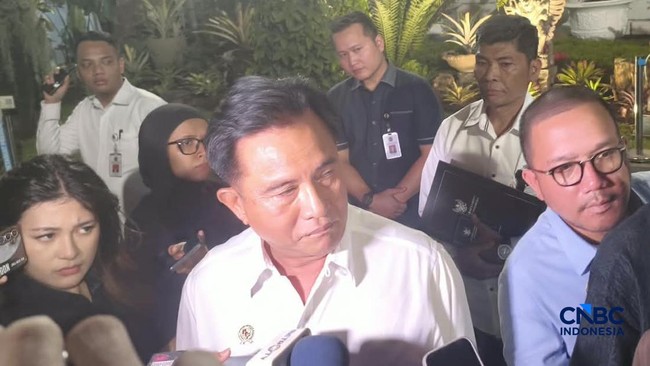
Jakarta, CNBC Indonesia — Coordinating Minister for Legal Affairs, Human Rights, Immigration and Corrections Yusril Ihza Mahendra said that proposals to change the definition of corruption offences, put forward by National Economic Council (DEN) chair Luhut Binsar Pandjaitan, require in-depth and careful consideration.
Yusril said the proposal remained at the discussion stage, and required a more detailed explanation of the intended changes, including their relationship with the United Nations Convention against Corruption (UNCAC).
“The DEN proposal is only an idea at this point. What has been presented is an outline and does not yet address the details of the definition of corruption that is to be aligned with UNCAC, whether in relation to substantive or procedural law. It therefore requires further examination,” Yusril said in a press release on Saturday (24 October 2026).
Yusril stressed that any proposal to amend regulations must be based on a full understanding of the circumstances in which the rules were created, their aims and the experience of applying them. The regulations in force should also be critically evaluated to identify their strengths and weaknesses.
He said discussions about changing the definition of corruption offences should not be met with immediate rejection or support before the substance of the proposal is understood.
“Everything must be examined and considered with a clear head. Those who want to revise the law and those who want to retain it must think wisely and carefully. This cannot be done casually, or simply to appear heroic in the fight against corruption while having only a superficial understanding of the law,” he said.
Yusril noted that he was justice minister when Law No. 31/1999 on the Eradication of Corruption was amended through Law No. 20/2001. He also signed UNCAC at the UN headquarters in New York in 2003 and submitted a bill to establish the Corruption Eradication Commission (KPK) that same year.
“I am willing to explain this if asked, so that we can gain a clear understanding of the background and history behind the drafting of the various laws and UN conventions related to combating corruption. Understanding that history is very important, because regulations do not appear out of nowhere,” Yusril said.
He said debate over changes to anti-corruption regulations must ultimately rest on strong legal arguments, an understanding of UNCAC and an objective assessment of law-enforcement practice.
“That way, every decision can be legally justified and will not be driven solely by reactions to the controversy as it unfolds,” he said.
Yusril said he would attend a meeting with the National Economic Council on Monday (26 October 2026). He expects the meeting to give the council an opportunity to explain its proposal in greater detail and hear his views on the development of anti-corruption law in Indonesia.
Luhut’s clarification
Luhut had previously stressed that recommendations to improve the Corruption Eradication Law would not remove state financial losses from the definition of corruption offences. Articles 2 and 3 of the law, corresponding to Articles 603 and 604 of the Criminal Code, would remain in place.
He said the National Economic Council’s recommendations focused on two areas. First, clarifying evidentiary requirements to make law enforcement more certain, objective and consistent. Second, expanding the reach of anti-corruption efforts by adopting UNCAC offences that are not yet covered by national law.
The recommendations were presented to President Prabowo Subianto at Merdeka Palace in Jakarta on 20 October 2026. They aim to provide legal certainty, strengthen the effectiveness of anti-corruption efforts and promote sustainable economic growth.
Speaking to the media after his meeting with Prabowo, Luhut said UNCAC’s formulation of corruption offences does not make state losses an element of an offence. He said this was an explanation of international standards as a point of comparison.
He clarified that this was not a proposal to change Indonesia’s definition of corruption or to remove state losses as an element of corruption offences. Luhut said the National Economic Council had three positions on the matter. First, Articles 2 and 3 of the Corruption Eradication Law, or Articles 603 and 604 of the Criminal Code, would be retained. Criminal liability and the recovery of state financial losses would remain in force.
Second, the proposed improvements concern how the elements of those offences are proved, not whether state losses remain an element. Third, the scope of anti-corruption efforts would be broadened by adding UNCAC offences not yet covered by national law, including bribery of foreign public officials.
“State financial losses will remain an element under the Corruption Eradication Law, and misappropriated public money must still be returned. What we are proposing is clear and objective proof, so that corrupt offenders do not escape, while someone who makes a decision or takes action in good faith is not punished without grounds. At the same time, we propose adding new offences to broaden the reach of anti-corruption efforts,” Luhut said.
Source: jawawa.id (https://jawawa.id/newsitem/yusrils-full-response-to-plans-to-change-indonesias-definition-of-corruption-1792831866)
Originally published by CNBC Indonesia (https://www.cnbcindonesia.com/news/20261024152627-4-779158/respons-lengkap-yusril-soal-rencana-perubahan-definisi-korupsi-di-ri), translated from Indonesian