
Yusril States Revision of Military Court Law is Already a Statutory Mandate
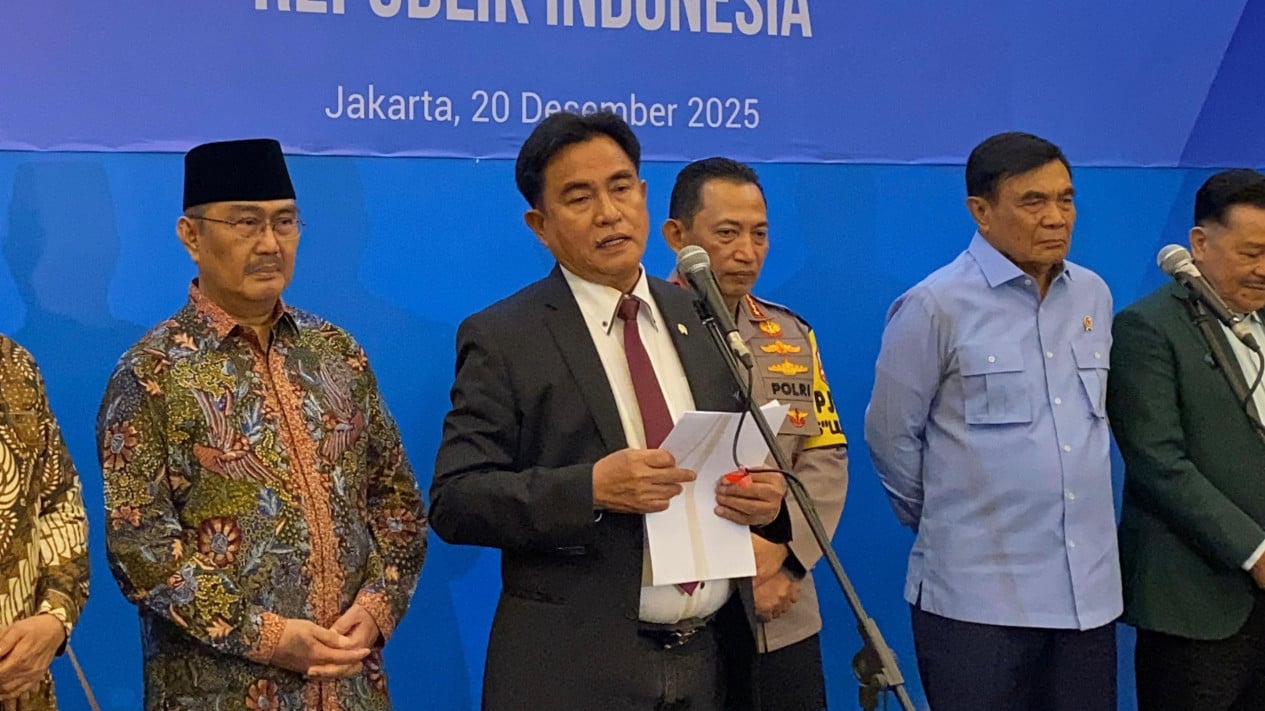
The Coordinating Minister for Law, Human Rights, Immigration, and Correctional Affairs, Yusril Ihza Mahendra, has addressed the calls from civil society for the revision of Law Number 31 of 1997 concerning the Military Court.
Yusril emphasised that the revision of these regulations is not merely a discourse arising from public pressure. According to him, the amendment to the Military Court Law is indeed a statutory mandate.
“Regarding the request to revise the Military Court Law, it is indeed a mandate of the law,” he stated in Jakarta on Tuesday, 8 September 2026.
Yusril revealed that the issue of changing the military justice system has long been a point of focus. During his tenure as Minister of Justice, several regulations related to general and religious courts were amended to be unified under the Supreme Court (MA).
However, one part remains unresolved, namely the changes to the military justice system.
“There is one part left, which remains unresolved, and that is the change to the military court,” he said.
According to Yusrol, the need to synchronise military justice regulations has become increasingly important following the introduction of the new Criminal Procedure Code (KUHAP). He noted that these regulations have introduced new issues regarding connectivity trials, particularly in handling cases involving TNI personnel.
“With connectivity trials, everything must be synchronised with one another,” Yusril remarked.
Pressure to revise the Military Court Law has previously intensified among civil society groups. One major concern relates to various cases of violence involving TNI members against civilians, which are perceived as not yet delivering true justice.
This scrutiny intensified after the High Military Court II-06 Jakarta overturned the dismissal sanctions of two TNI members who were involved in an attack on activist Andrie Yunus.
Meanwhile, judicial reviews of the Military Court Law have also been ongoing in the Constitutional Court (MK). One of the petitions regarding the regulation was declared inadmissible in a ruling read in June 2026.