
Yusril: Indonesia-Malaysia Prisoner Transfer Agreement Finalised
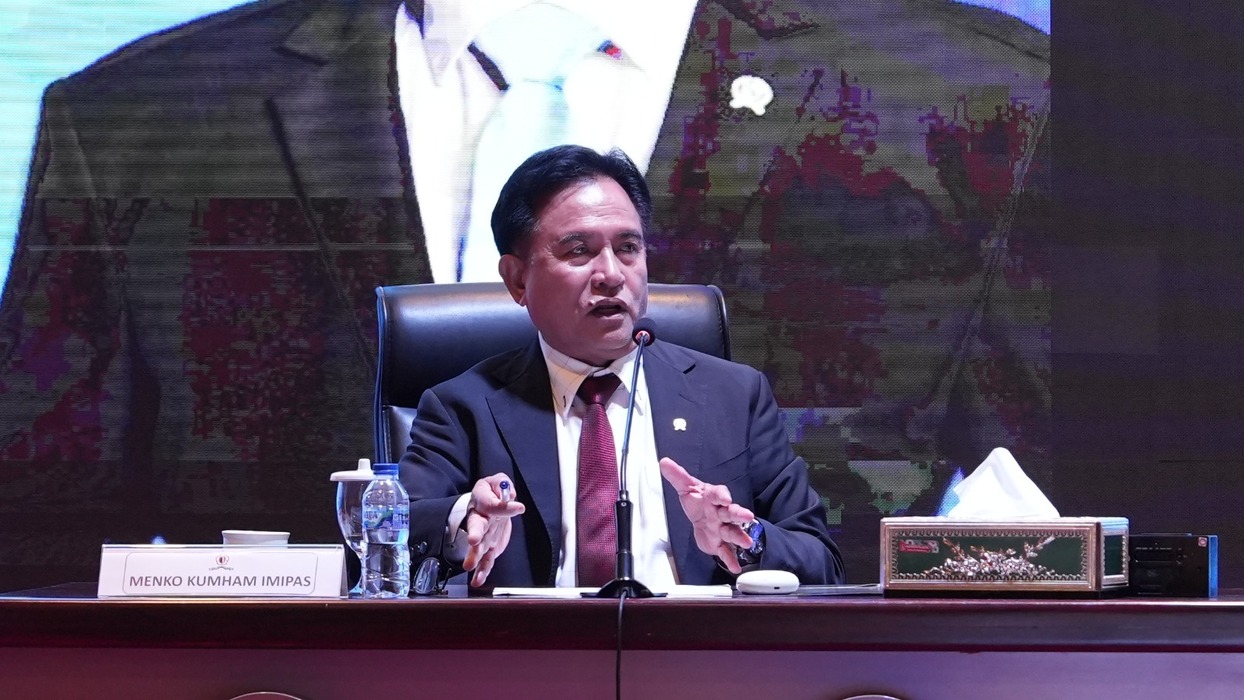
Indonesia and Malaysia are one step closer to building a modern legal cooperation mechanism focused on citizen protection. Both countries have agreed on the main points of a prisoner transfer agreement, which will serve as the legal basis for repatriating citizens to serve the remainder of their sentences in their home country.
The agreement was the main outcome of a meeting between Coordinating Minister for Law, Human Rights, Immigration, and Corrections Yusril Ihza Mahendra and Malaysian Prime Minister Anwar Ibrahim in Putrajaya on Monday (29/6). The nearly hour-long meeting also discussed strengthening cooperation in law, human rights, immigration, and corrections, with a focus on improving the protection of citizens from both nations.
“Indonesia and Malaysia are kindred nations with a long-standing friendship. The good relationship between the leaders of both countries is an important foundation for closer cooperation in various fields,” Yusril said in a statement on Tuesday (30/6).
According to Yusril, the historical closeness and fraternal relations between Indonesia and Malaysia must be translated into more concrete cooperation in dealing with cross-border issues, ranging from citizen protection and law enforcement to strengthening inter-agency coordination. “Indonesia is committed to continuing to work closely with Malaysia in facing common challenges, from protecting citizens and handling cross-border legal issues to strengthening institutional cooperation based on openness, mutual trust, and a spirit of brotherhood,” he said.
One of the main topics of the meeting was the finalisation of the prisoner transfer agreement, which had been discussed between the Malaysian Ministry of Home Affairs and the Indonesian Coordinating Ministry for Law, Human Rights, Immigration, and Corrections. Yusril revealed that there was one key issue that had been a point of difference. In the initial draft, the Malaysian government proposed that the granting of remission, amnesty, or abolition for transferred prisoners would still require the approval of the country of origin.
However, Indonesia held the view that once a prisoner is transferred to their home country, the entire rehabilitation process, including the granting of prisoner rights, falls entirely under the authority of the receiving state. “We said it should not be that way, because it becomes the full responsibility of the Indonesian government. Likewise, if Malaysian citizens are repatriated to Malaysia, their rehabilitation is the obligation of the Malaysian government,” Yusril explained. “This includes the authority to grant pardons, amnesty, or abolition. There is only an obligation to officially report that a remission or pardon has been granted. We will fully respect their authority.”
Yusril stated that this Indonesian view was ultimately accepted by Prime Minister Anwar Ibrahim. With this understanding, both countries have agreed that the authority for prisoner rehabilitation rests entirely with the state receiving its citizen. “With the Prime Minister’s directive, the issues regarding the draft prisoner transfer regulation have been agreed upon in principle and will be discussed at the next level,” he said.
Yusril assessed that the agreement not only represents progress in bilateral legal cooperation but also reflects the commitment of both countries to strengthen the protection of citizens facing legal proceedings abroad. He noted that the government has received various reports of alleged inhumane treatment of Indonesian citizens serving sentences in Malaysian correctional facilities. Therefore, the presence of a prisoner transfer agreement is expected to be an important instrument for the state to provide more optimal protection through a gradual repatriation mechanism.
“Because this is a task assigned to the Coordinating Ministry, the ministry has acted proactively. We have also repatriated many foreign prisoners to their respective countries, and now it is time for us to talk about repatriating Indonesian citizens who are abroad,” Yusril said.
Based on data from the Deputy for Immigration and Corrections Coordination as of June 2026, there are 314 Malaysian citizens facing legal proceedings in Indonesia, consisting of 47 detainees and 267 prisoners. Of these prisoners, 23 have been sentenced to death, 51 are serving life sentences, and 193 are serving various prison terms. The majority of cases involving Malaysian citizens are related to drug offences.
Meanwhile, according to data from the Malaysian government, there are 6,622 Indonesian citizens in the Malaysian correctional system, comprising 1,722 detainees and 4,900 prisoners. Two individuals have been sentenced to death, 49 are serving life sentences, and 6,571 are serving various prison terms. Of all these Indonesian citizens, 62 are categorised as vulnerable groups, including the elderly, persons with disabilities, individuals with mental disorders, children under 18, pregnant women, and women with toddlers.