
Yusril Emphasises Victim Protection in Fight Against Human Trafficking
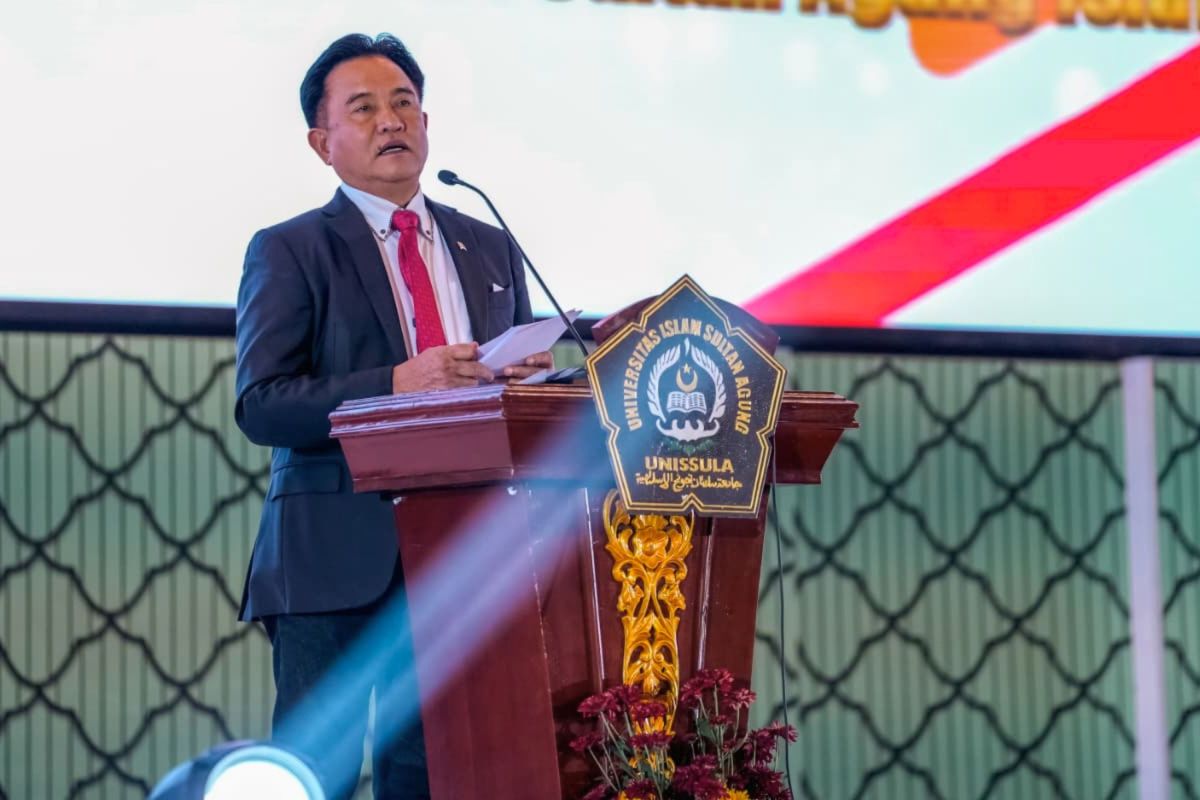
Jakarta (ANTARA) - The Coordinating Minister for Law, Human Rights, Immigration, and Correctional Affairs, Yusril Ihza Mahendra, has emphasised that the eradication of human trafficking (TPPO) must focus on victim protection in response to the increasing complexity of transnational human trafficking crimes.
Speaking at The 9th Legal International Conference & Studies (LICS) and Call for Papers in Semarang, Central Java, on Thursday (30/7), he stated that in addition to victim protection, focus must also be directed towards dismantling criminal networks and strengthening international cooperation.
“The challenges in handling human trafficking continue to evolve alongside increasing modes of exploitation, ranging from recruitment through misleading job offers and the misuse of social media to the involvement of victims in various forms of transnational cybercrime,” said Yusril, as confirmed in Jakarta on Friday.
Consequently, he stated that these conditions demand strengthened national coordination and international cooperation to ensure law enforcement can operate more effectively.
Yusril emphasised that a human being does not lose their dignity due to poverty, lack of documentation, working abroad, or having committed administrative violations. Rather, when an individual is in a vulnerable condition, the state’s responsibility to protect and enforce the law becomes even greater.
Yusril explained that the handling of human trafficking must be carried out based on the elements of criminal acts as regulated in the Palermo Protocol, so that law enforcement can be executed precisely while simultaneously providing protection to victims.
He asserted that human trafficking does not always involve cross-border movement and that not every administrative violation can be categorised as human trafficking.
Yusril revealed that Indonesia already possesses a comprehensive legal framework through Law Number 21 of 2007 on the Eradication of the Crime of Human Trafficking, which is strengthened by various international instruments, including the Palermo Protocol.
With the updating of the national criminal justice system, Yusril added that policy harmonisation must continue to be undertaken to strengthen victim protection, the provision of restitution, the tracing of criminal assets, and inter-agency and inter-state cooperation.
“The success of eradicating human trafficking is not measured by the number of activities or regulations created, but by the state’s ability to ensure that the rights of victims are met, criminal networks are dismantled, and real protection is provided to victims,” he said.
Furthermore, Yusril added that the challenges of eradicating human trafficking cannot be resolved solely through the creation of new regulations. He noted that such efforts also require collective awareness, the strengthening of societal morals, education for vulnerable groups, and collaboration among all stakeholders to ensure the public is not easily trapped in recruitment practices that lead to exploitation.
Therefore, Yusril invited academics to continue producing studies and recommendations capable of strengthening national policies in the eradication of human trafficking.
He argued that synergy between the government, universities, law enforcement agencies, civil society organisations, and international partners is key to building a legal system that is adaptive to the developments of transnational crime.
“Human trafficking turns humans into commodities; therefore, the state must restore humans as legal subjects who possess dignity, rights, and a future. That is where legal certainty meets true justice,” Yusrim stated.
The international conference was attended by leaders from Sultan Agung Islamic University (Unissula) Semarang, academics, practitioners, and doctoral students from various countries. The forum also featured speakers and participants from at least 18 countries, including Spain, Jordan, Turkey, Japan, Germany, Australia, Italy, Egypt, Morocco, and the Maldives, serving as a platform for the exchange of ideas to strengthen legal systems and international cooperation in the eradication of human trafficking.