
Yusril emphasises need for civilisational ethics and national sovereignty
Jakarta (ANTARA) - The Coordinating Minister for Law, Human Rights, Immigration, and Correctional Affairs, Yusril Ihza Mahendra, has emphasised that Indonesia’s development requires a balanced blend of the “civilisational ethics” pioneered by Mohammad Natsir and the “sovereignty of capability” envisioned by Bacharuddin Jusuf Habibie.
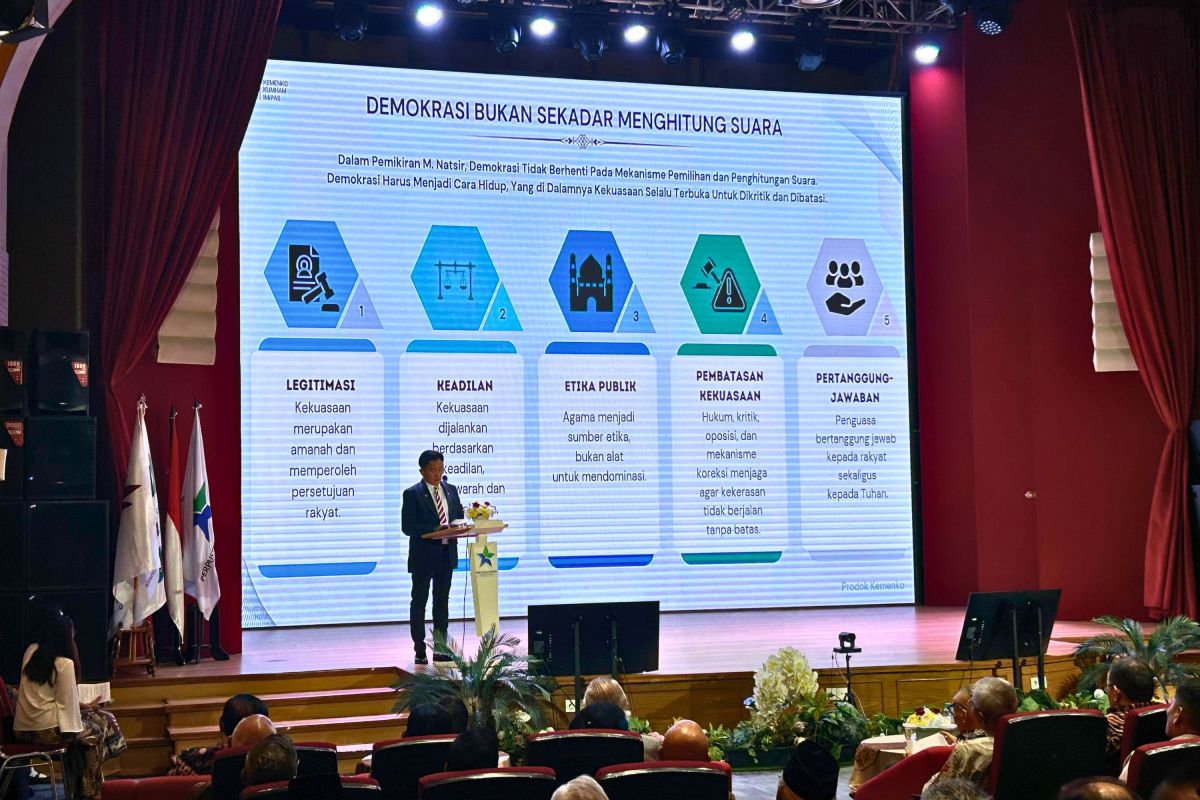
Speaking at the 5th BJ Habibie Memorial Lecture in Jakarta on Wednesday, he noted that the thoughts of Mohammad Natsir, Indonesia’s 5th Prime Minister, regarding theistic democracy, emphasise the importance of moral and ethical orientation in managing political power.
“Religion is positioned as a source of public ethics that inspires the values of trustworthiness, justice, deliberation, and the limitation of power,” said Yusril.
He noted that Habibie championed a value-added strategy of “starting from the end and ending at the beginning,” ensuring that the Indonesian nation does not merely become a consumer of foreign technology, but possesses independent industrial and research capabilities.
Yusril also detailed Habibie’s contributions during the 1998–1999 Reformation transition period, which established the foundations of modern law and democracy, including guarantees for press freedom, the Political Parties Act, the Election Act, the Regional Autonomy Act, and the Human Rights Act.
He added that Habibie also demonstrated constitutional political ethics by adhering to democratic mechanisms and gracefully stepping down when his accountability was rejected by the MPR in 1999.
“The synthesis of these two figures’ thoughts is a civilisation that is both characterised and capable,” he stated.
In his view, Natsir provides the ethical compass, while Habibie provides the engine of civilisation. Without an engine, he remarked, a compass cannot steer a ship to its destination. Conversely, an engine without a compass can accelerate a ship towards the wrong direction.
He further asserted that there are at least five core agendas for civilisational ethics leading towards 2045. First, strengthening Indonesia’s ability to produce and master science and technology. Second, strategic industrial policies must be evaluated based on capabilities that are truly developing domestically. Third, democracy must be maintained as a mechanism for correction. The fourth agenda, he continued, is the continuous internalisation of Pancasila within the practice of state life. Fifth, the law must be able to adapt to technological developments.