
Yusril: AHU Transformation Must Prioritise Data Protection
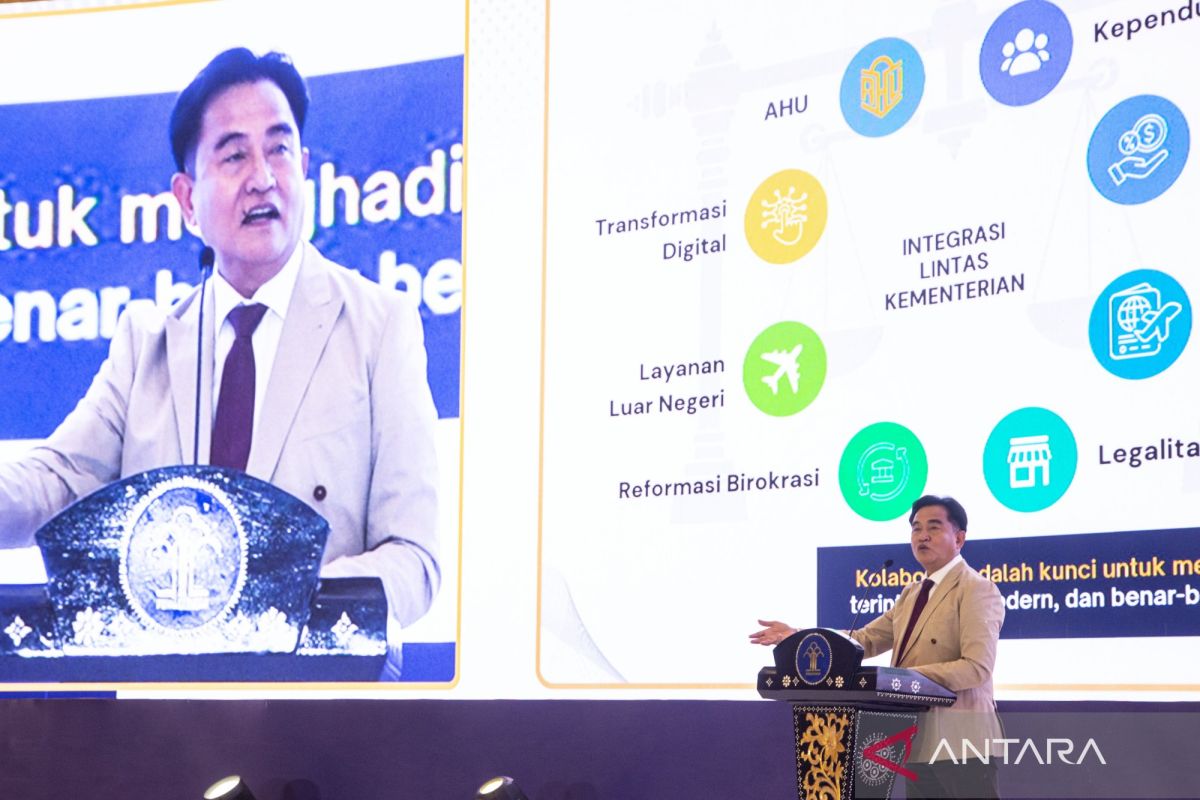
Jakarta (ANTARA) - The Coordinating Minister for Law, Human Rights, Immigration, and Correctional Affairs, Yusril Ihza Mahendra, stated that the transformation of General Legal Administration (AHU) services must continue to prioritise security and data protection.
During the “Ministerial Dialogue for Impactful AHU Services” event in Bandung, West Java, on Monday (31/8), he noted that integration does not mean all data is collected in a single location, but rather ensures that every piece of data has a clear source, controlled access, and is used according as its purpose and legitimate authority.
“The speed of service must not be paid for with a reduction in legal prudence. Data must be secure, accurate, and trustworthy, and every use of it must be accountable,” said Yusril, as confirmed in Jakarta on Tuesday.
Yusril noted that the scale of AHU services demonstrates the significant public demand for fast and certain legal services. Throughout 2025, it was recorded that 11.38 million services were completed, with an application completion rate of 99.52 per cent. Meanwhile, in the first semester of 2026, approximately 5.5 million applications had been processed.
However, according to him, the high volume of completed services is not the ultimate goal, as the success of the transformation must be measured by the impact felt by the public and the business community. He cited examples such as shorter service times, lower costs, faster legal certainty, and greater ease in conducting economic activities.
Thus, he emphasised that while the large number of transactions is an achievement, the real impact on society and the business world remains the primary objective. “AHU services must be able to provide legal certainty while simultaneously facilitating the economic activities of the community,” he said.
To realise impactful AHU services, Yusril emphasised the importance of cross-ministerial and inter-agency collaboration. It was noted that the integration of AHU services is linked to various sectors, ranging from population and immigration to payments, Non-Tax State Revenue (PNBP), Micro, Small, and Medium Enterprise (MSME) legality, overseas services, and bureaucratic reform.
In his view, the main challenge lies not solely in technology, but at the intersection of inter-agency authority. Therefore, he continued, there is a need for regulatory harmonisation, the integration of data sources and systems, and coordination mechanisms capable of resolving cross-authority obstacles.
“Collaboration is the key to providing legal services that are integrated, modern, and truly impactful for the community,” said Yusril.
He also encouraged four strategic agendas for the transformation of AHU services: mapping priority services, establishing authoritative data sources, measuring service impact, and appointing clear persons in charge. He stated that these steps should be followed by identifying services that need integration, integrating data sources and systems, harmonising regulations, strengthening coordination mechanisms, and measuring and publishing the impact of services to the public.
“The ministerial dialogue must result in real decisions and follow-up actions. We need to select priority services, build data connectivity with clear security standards, standardise provisions and procedures, and measure the real impact on time, cost, legal certainty, and the ease of doing business,” he revealed.