
Yudi Latif: Indonesia's Independence Was Built on Gotong Royong
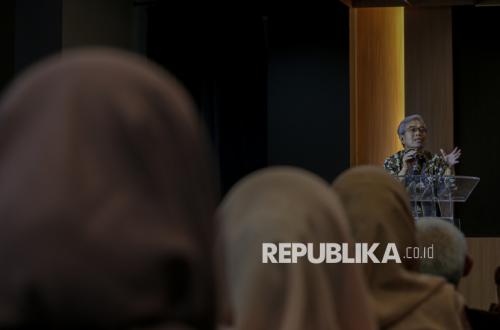
Scholar and Dompet Dhuafa patron Professor Yudi Latif has asserted that the primary force that gave birth to Indonesia and has sustained it to this day is not merely political, but rather the culture of gotong royong (mutual cooperation) that is deeply rooted in the life of the archipelago’s communities.
Yudi explained that during the colonial era, the archipelago consisted of hundreds of kingdoms and sultanates with a long history of resistance against colonialism. However, that resistance remained local and sporadic because there was no common ground capable of uniting the entire strength of the nation.
“The number of kingdoms and sultanates in the archipelago was between 250 and 390. They mounted resistance, from Maluku, Java and Sumatra to Sulawesi. But because the society was plural, it was too easily divided against itself and the resistance remained local in nature,” said Professor Yudi. He made the remarks at a National Dialogue event themed “Pancasila as the Fundamental Values of Statehood” at the Dompet Dhuafa Philanthropy Building in South Jakarta on Friday (14/8/2026).
According to him, the birth of Indonesia as a nation began with the discovery of a “common denominator” capable of uniting the diversity of ethnic groups, religions, ethnicities and ideologies.
Yudi likened the condition of the nation to fractions in mathematics, which cannot be added together without a common denominator.
“In mathematics, fractions cannot be added unless their denominators are made the same. Indonesia emerged as the common denominator that united these various differences,” he said.
He explained that the term Indonesia was originally an ethnological and geographical term, which the nation’s founders later adopted as a replacement for the name Dutch East Indies. That choice became a form of symbolic resistance against the identity inherited from colonialism.
However, according to Yudi, the name Indonesia alone is not enough. The nation needs shared values that serve as the glue of nationhood. Those values were later formulated in Pancasila.
Although it consists of five principles, Yudi quoted the view of Indonesia’s first president, Soekarno, who said that the essence of Pancasila is actually gotong royong.
“As Bung Karno said, the essence of Pancasila is gotong royong. When the various fractions unite and work together, that is where the strength of the nation is born,” he said.
Yudi considers gotong royong not merely a slogan, but a culture that has been tested throughout the history of the archipelago. He cited the view of management expert Edgar Schein of the Massachusetts Institute of Technology (MIT), who defined culture as a way of working and cooperating that is repeated continuously because it has proven successful.
“That is our culture. Gotong royong is a strength that has been tested in the history of this nation,” he said.
He cited Indonesia’s experience in dealing with the Covid-19 pandemic as an example. According to Yudi, the involvement of civil society, social organisations, Quran study groups, the PKK (Family Welfare Movement), universities and communities was an important factor in accelerating the handling of the pandemic.
“When women from Quran study groups, the PKK, universities and the community joined in gotong royong, difficult problems could be solved together,” he said.
Yudi also touched on Indonesia’s ranking as one of the most generous countries in the world. According to him, this shows that cultural strength and social solidarity are the nation’s primary assets.
On that occasion, Yudi assessed that the collaboration between Dompet Dhuafa and PARFI ’56 is a concrete example of gotong royong in modern life.
“There is PARFI, there is Dompet Dhuafa, there are many elements collaborating. If we practise gotong royong, difficult things can be resolved,” he said.
Yudi emphasised that the role of artists and cultural figures also holds an important position in Indonesia’s journey to independence. According to him, the power of culture often endures longer in the public memory than political events.
“Political events can be forgotten, but cultural and artistic memory lingers longer in the nation’s memory,” he said.
Therefore, as Indonesia marks its 81st year of independence, Yudi expressed hope that culture will once again become a unifying force for the nation amid various differences and the challenges of the times.
“The power of culture must play a major role in returning this nation to its true identity. Indonesia was built by gotong royong,” said Yudi.
Source: jawawa.id (https://jawawa.id/newsitem/yudi-latif-indonesias-independence-was-built-on-gotong-royong-1786837843)
Originally published by Republika (https://khazanah.republika.co.id/berita/tju27s430/yudi-latif-indonesia-merdeka-karena-gotong-royong), translated from Indonesian