
Yuan Surges! Strongest in 4 Years, Is China Abandoning its Cheap Currency Strategy?
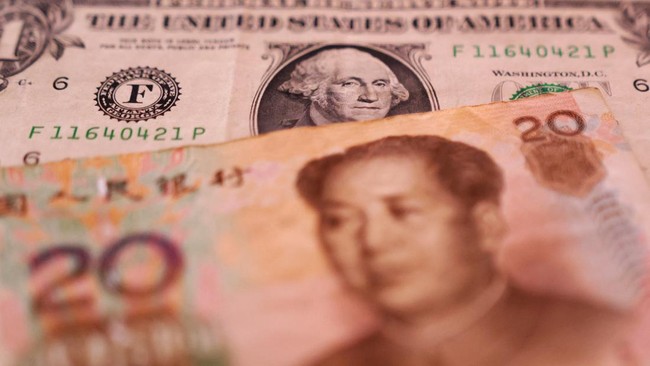
The Chinese yuan has strengthened to its highest position against the US dollar in more than four years. According to Refinitiv, on Friday (18/09/2026) at 18:42 WIB, the yuan rose by 0.15% to CNY 6.698/US$. This level represents its strongest position since July 2/2022.
This strengthening continues a trend observed since the beginning of the year. Throughout 2026, the yuan has appreciated by approximately 4.2% against the US greenback. This shift is notable because, for years, China maintained a weak yuan to ensure its exports remained competitive globally. Now, a stronger yuan is increasingly necessary to lower import costs, bolster investor confidence, and expand the currency’s global usage.
At least four factors are driving the yuan to its highest level in over four years.
- The Chinese Central Bank is Paving the Way
China’s central bank is a primary driver of the yuan’s strength. Unlike many other currencies, the yuan’s value is not entirely determined by the market. Every morning, the People’s Bank of China (PBOC) sets a central par value for the yuan against the US dollar. From this figure, the yuan’s value is permitted to fluctuate by a maximum of 2% (stronger or weaker) during trading hours.
When the central par value is set stronger, the daily trading range shifts accordingly. Market participants interpret this as a signal that the PBOC desires a higher yuan value. The PBOC has set a stronger central par value for eight consecutive trading days, the longest streak since 2023. On Friday, the par value was set at 6.7521 per US dollar, stronger than the 6.7580 recorded the previous day, pushing the yuan past the 6.70 level.
While the PBOC can also manage foreign exchange liquidity and use state-owned banks to buy or sell dollars, it does not desire an excessively rapid appreciation. A sudden surge could hurt exporter incomes and trigger volatility in financial markets. Consequently, the PBX is guiding the yuan to strengthen steadily but controlledly to avoid disrupting Chinese trade.
- Exporters are Converting Dollar Holdings
Chinese exports remain robust despite domestic economic challenges in the property and consumption sectors. Chinese-made goods, ranging from electronics and machinery to electric vehicles, batteries, and AI-based products, continue to flow globally. When Chinese companies sell abroad, they receive payments in dollars. For years, many exporters preferred holding these dollars due to higher interest rates in the US.
However, as the yuan is expected to continue strengthening, holding dollars becomes riskier, as the value of those holdings could diminish upon conversion. Consequently, some exporters have begun converting dollars to cover wages, taxes, raw materials, and production costs. Increased dollar selling drives higher demand for the yuan. China’s significant trade surplus provides a substantial reservoir of foreign exchange that acts as additional momentum for the yuan during these conversions.
Lynn Song, Chief Economist for Greater China at ING, noted that the yuan’s direction over the past year has begun to decouple from the interest rate differential between the US and China. Bank of America predicts the yuan could still appreciate by about 1.6% by the end of 2026, supported by export revenue conversion, the currency’s current undervalued state, and pressure from G7 nations for China to help reduce global trade imbalances.
- Markets Await Trump-Xi Jinping Meeting
The next factor stems from US-China relations. Presidents Donald Trump and Xi Jinping are scheduled to meet in late September. Markets hope this meeting will extend the trade war truce and pave the way for tariff reductions. If trade tensions ease, the risks to the Chinese economy also diminish. Mizuho Securities strategist Serena Zhou noted that the Renminbi is likely to receive further support from the upcoming meeting.
- China’s Ambition for Yuan Internationalisation
The strengthening yuan aligns with Beijing’s desire to reduce dependence on the US dollar. China aims to increase the use of its currency in international trade, investment, and payments. PBOC Deputy Governor Lu Lei stated that the internationalisation of the yuan is a continuous, stable, and irreversible trend.
To achieve this, China is expanding currency swap agreements with other nations and encouraging trade payments in local currencies to bypass the US dollar. China is also strengthening the Cross-Border Interbank Payment System (CIPS) as an alternative to Western-dominated systems like SWIFT. Furthermore, the use of digital yuan and cross-border QR code payments is set to expand, alongside increased foreign investor access to Chinese stock and bond markets.