
Yuan, Rupiah, Won Tumble Ahead of Fed Decision, Only 3 Currencies Survive
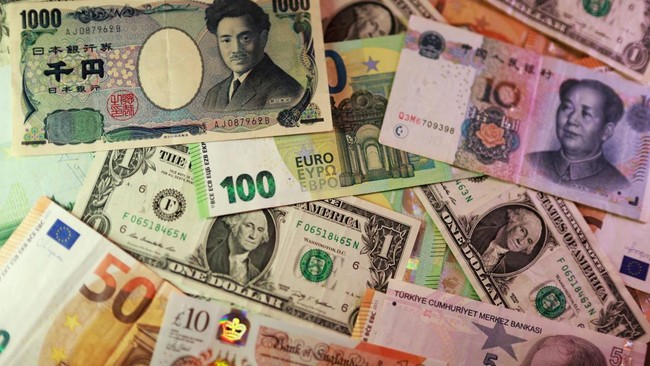
Jakarta, CNBC Indonesia - The majority of Asian currencies moved weaker against the United States (US) dollar in early trading on Wednesday (29/7/2026). Markets tended to hold positions ahead of the US central bank’s (The Federal Reserve/The Fed) interest rate decision, while renewed tensions in the Middle East continued to support demand for the US dollar.
Referring to Refinitiv data as of 09.15 Western Indonesia Time, out of 10 Asian currencies, seven experienced depreciation against the US dollar, while three others strengthened.
The rupiah was again among the currencies under pressure. The Garuda currency weakened 0.28% to a position of Rp18,105/US.ThispositionsawtherupiahweakenfurtherandbreachanewpsychologicallevelofRp18, 100/US.
The deepest pressure this morning was experienced by the Taiwan dollar, which weakened 0.35% to TWD 32.47/US.ThePhilippinepesoalsocorrectedquitedeeply, down0.17.
The South Korean won edged down 0.02% to KRW 1,453.2/US, whiletheChineseyuanweakened0.01. The Vietnamese dong and Thai baht both weakened 0.03%, to VND 26,338/US$ and THB 33.50/US$ respectively.
On the other hand, a number of Asian currencies still managed to strengthen. The Malaysian ringgit was the most prominent with a gain of 0.10% to MYR 4.085/US$.
The Japanese yen also strengthened 0.07% to JPY 163.7/US, whiletheSingaporedollaredgedup0.02.
The weakening of the majority of Asian currencies this morning occurred as the US dollar remained in high territory. The US dollar index (DXY) this morning was at 101.405, a slight weakening of 0.01%.
Although the DXY appeared to be correcting in this morning’s data, the US dollar’s position remained near its highest level in the past month. The greenback continued to receive support from safe-haven demand after tensions in the Middle East heated up again.
Currency movements at the start of Asian trading also tended to be limited. Investors chose to wait for the Federal Open Market Committee (FOMC) decision, which will be announced on Wednesday local time.
The market is currently pricing in an approximately 33% chance that the Fed will raise interest rates by 25 basis points. This probability kept the US dollar supported, although not all market participants believe the Fed will immediately raise rates at this meeting.
Fabien Yip, a market analyst at IG, assessed that the Fed still needs clearer clues on how long inflation risks will persist. “I still think the Fed will need more indications on how long the inflation risk will last,” Yip said, as quoted by Reuters.
Yip predicted the Fed would hold interest rates on Wednesday. However, he assessed that the US dollar would remain relatively strong because the uncertainty in the Middle East has not subsided. “The US dollar will be relatively strong because of the ongoing uncertainty in the Middle East. But at the same time, if you look at central bank policy, the US seems to be in a better position to maintain a hawkish stance compared to other central banks,” Yip said.
Pressure on the yen also remained a concern. The US dollar was around 101.43 against a basket of major currencies and briefly rose slightly against the yen to JPY163.88/US$. This condition maintained pressure on the yen, which is still moving around its weakest level in 40 years.
Hirofumi Suzuki, chief FX strategist at SMBC, assessed that the FOMC decision and the Fed chair’s press conference could trigger further US dollar strengthening. “There is a possibility that the FOMC policy decision and the Fed chair’s press conference could trigger further dollar strengthening, pushing USD/JPY to 164,” Suzuki said, as quoted by Reuters. He also assessed that the chance of foreign exchange intervention by Japanese authorities is quite large, especially if the yen weakens again after the Bank of Japan (BOJ) policy meeting.