
Young Generation Drives Technological Solutions to Reduce Mining Risks
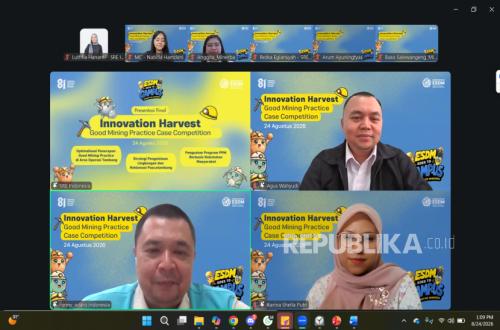
Safety, environmental, and community empowerment challenges in the mining sector have prompted a range of new ideas from university students. Several technology-based and circular economy solutions have been proposed to strengthen the implementation of good mining practice.
The ideas emerged during the final round of Innovation Harvest: Good Mining Practice Case Competition 2026, organised by the Directorate General of Mineral and Coal at the Ministry of Energy and Mineral Resources (ESDM) together with the Mineral and Coal Testing Centre (BBPMB) tekMIRA and Society of Renewable Energy (SRE) Indonesia.
The competition, part of the ESDM Goes to Campus 2026 series for the mineral and coal subsector, attracted more than 140 applicants from various universities across Indonesia. Participants were asked to formulate solutions to mining issues within the context of challenges faced by the South Kalimantan region.
Three main issues were addressed: optimising the implementation of good mining practice in mining operation areas, environmental management and post-mining reclamation, and community development and empowerment programmes (PPM) designed based on community needs.
From the proposal selection process, six teams advanced to the final round. They came from Politeknik Negeri Balikpapan, UPN Veteran Yogyakarta, Universitas Muria Kudus, Universitas Tanjungpura, Sekolah Tinggi Teknologi Kedirgantaraan Yogyakarta, and Universitas Padjadjaran.
In the final stage, each team presented their solutions, implementation strategies, and the potential sustainability of their ideas before a panel of judges. The ideas covered operational safety and efficiency, environmental and post-mining management, and community empowerment.
One prominent approach was the use of technology to anticipate hazards in mining areas. The judges noted that the finalists did not merely offer ideas but also sought to address problems with solutions that have the potential to be implemented.
Agus Wahyudi, a Young Expert Earth Investigator at BBPMB tekMIRA, said the quality of the finalists’ ideas made the judging process highly competitive. He expressed hope that the ideas developed would not stop as competition entries.
“We hope these ideas do not stop at the competition, but can continue to be pursued through to the implementation stage,” said Agus.
The assessment results named Tim Komando from Politeknik Negeri Balikpapan as the first-place winner with SIGAP TAMBANG, an AI-IoT-based automatic prediction and control system for mitigating landslide risks on highwalls in open-pit coal mines.
Second place went to Miners 24 from Universitas Tanjungpura with CARBON-HAUL, an AI-GIS-based detection and maintenance prioritisation system for haul roads aimed at improving fuel efficiency while reducing carbon emissions.
Meanwhile, CIRCL from Universitas Padjadjaran took third place with a circular economy-based compost group empowerment idea to support the self-reliance of communities around mining areas in South Kalimantan.
Anggita Miftah Hairani, Coordinator of Public Relations and Public Information at the Directorate General of Mineral and Coal, said the competition is expected to provide a space for students to understand mining issues more closely while training their ability to offer solutions.
“Through Innovation Harvest, we hope this event is not only a competition but also a space for students to learn, understand the challenges in the mining sector, and present new ideas that can be developed in the future,” said Anggita.
The series of activities will conclude with the Puncak ESDM Goes to Campus 2026 for the mineral and coal subsector on 31 August 2026 at the Lecture Theatre of Universitas Lambung Mangkurat, South Kalimantan. The winners will receive awards and have the opportunity to present their best ideas again.
The event demonstrated that the implementation of good mining practice is not only about operational compliance but also requires innovation to address safety, environmental, efficiency, and economic benefit issues for communities around mining areas.