
Young Entrepreneur Transforms Purun Grass into High-Value Products, Boosting Artisan Income by up to 150 Percent
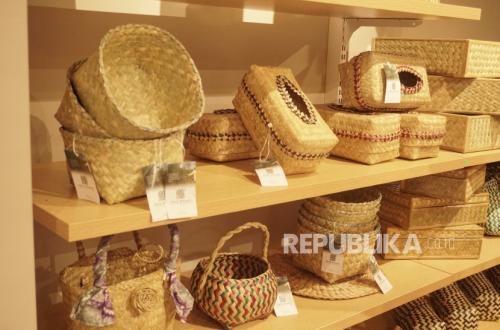
Utilising local materials can serve as a way to align environmental preservation with community economic growth. This is being demonstrated through Gaia Weave, a social enterprise that processes purun grass from the wetlands of South Kalimantan into various value-added products.
Gaia Weave was developed by Alexandra Christy Untono, a Year 12 student from ACS Jakarta, starting in 2025. The initiative was born from a problem Alexandra identified during a visit to South Kalimantan: the skills of purun artisans lacked consistent market access and value-added opportunities.
Alexandra noted that purun is closely linked to the wetland ecosystem, as the plant grows naturally in wet environments, including peatlands and swamps. “Purun thrives in wet environments. By creating economic value from purun, we want to help build incentives so that the community continues to see the value in the landscape where purun grows,” said Alexandra.
According to her, the use of purun can act as a meeting point between community economic interests and environmental sustainability. The plant can be harvested in cycles of three to six months, making it a potentially viable economic material without disrupting the wetland landscape.
Gaia Weave has built an end-to-end supply chain. Purun is processed and woven by local artisans, then developed into various products such as tech organisers, document pouches, bags, accessories, and household goods.
Currently, Gaia Weave partners with 126 artisans across 15 villages in South Kalimantan, with a production capacity of approximately 6,000 units per month. These products are available in over 100 retail outlets and are increasingly being used by corporate clients for merchandise, events, and employee gifts.
The economic impact is measurable. The partnership has reportedly increased artisan incomes by approximately 100 to 150 per cent, rising from around Rp1 million–Rp1.5 million to Rp2.7 million–Rp3 million per month. For artisans who also work as farmers, weaving serves as a supplementary source of income that can be performed from home.
One artisan, Ibu Idang, previously relied on seasonal farming with an income of about Rp40,000–Rp50,000 per day. After joining Gaia Weave, she weaves purun after working in the fields, earning an additional Rp80,000–Rp100,000 per day. “After returning from the rice fields, I usually continue weaving at home. Now, the skills we possess can provide extra income, and our woven products are being used by more people,” said Ibu Idang.
Alexandra believes that developing a circular economy is not just about how materials are reused or decomposed. She argues that the benefits to the people within the supply chain must also be a priority. “A circular economy is not only about materials that can be reused or decomposed. Equally important is ensuring that the people in the supply chain receive fair benefits,” she said.
The development of Gaia Weave is also part of Alexandra’s experience in sustainability and entrepreneurship. Previously, she interned at Birufinery, focusing on seaweed mapping in East Nusa Tenggara, and founded EcoFunCycle, a waste recycling network that has processed five tonnes of material from three schools.
Looking ahead, Gaia Weave aims to expand its network to over 1,000 artisans by 2030. This expansion will be accompanied by business-to-business (B2B) partnerships with international premium hotel sectors and the expansion of export markets.
Gaia Weave also plans to develop a QR code-based traceability system so that consumers can track a product’s journey, including information regarding its impact on artisans and the landscape of origin. “Gaia Weave wants to prove that everyday products can be part of the solution. When materials, design, and supply chains are designed correctly, a product can create economic benefits for the community while encouraging us to further appreciate the nature from which the material originates,” said Alexandra.