
Yogyakarta Hosts Asia-Pacific Metrology Symposium Attended by 20 Countries
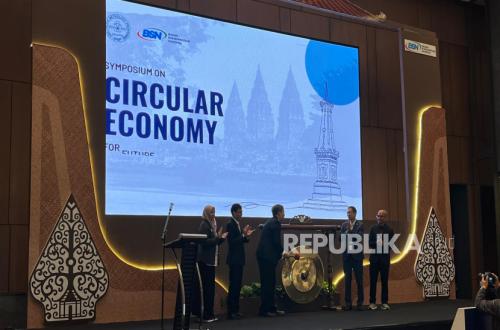
Around 20 countries from the Asia-Pacific region have gathered in Yogyakarta for an international symposium as part of the Asia Pacific Metrology Programme Mid-Year Meeting (APMP MYM) 2026. The meeting, organised by the National Standardisation Agency (BSN), aims to harmonise measurement standards between countries so that measurement results are mutually recognised, thereby supporting international trade, consumer protection, and the implementation of a circular economy.
Y. Kristianto Widiwardono, BSN’s Deputy for National Measurement Standards and Head of Indonesia’s National Metrology Institute (NMI), stated that the APMP is a cooperation forum for national metrology bodies in the Asia-Pacific region to ensure that all measurement systems in each country are traceable to the International System of Units (SI).
During the five-day APMP MYM 2026 event, participants attended technical committee meetings, an international symposium, workshops, and laboratory visits. The entire series is directed at strengthening the harmonisation of measurement systems in the Asia-Pacific region while building mutual recognition of each country’s metrology capabilities, so that cross-border trade can take place more fairly and efficiently.
“The purpose of this cooperation is to ensure that measurement traceability can be carried out, so that all measurement systems can be traceable to the international system,” Kristianto said during an interview on the sidelines of the event.
Kristianto explained that traceability is achieved through a tiered calibration process. A measuring instrument, such as a scale or thermometer, is calibrated using a more precise instrument. That instrument is then calibrated again with an even more precise instrument until it ultimately refers to the national standard held by BSN. Subsequently, Indonesia’s national standard is compared with the standards of other countries through inter-laboratory comparisons. According to him, this mechanism is important to ensure that measurement results in Indonesia have the same level of accuracy as other countries. Thus, calibration certificates and measurement results from Indonesia can be accepted internationally and do not become a barrier to trade.
To date, BSN has recorded 165 Calibration and Measurement Capabilities (CMC) that are internationally recognised. This number places Indonesia in third position in Southeast Asia and serves as important capital for national measurement results to gain international recognition, thereby supporting the smooth flow of cross-border trade. Furthermore, to ensure that domestic industry needs are met amidst the green economy transition, throughout 2025 BSN issued 2,549 calibration certificates for various strategic sectors.
“Approximately 20 countries are attending this event,” he said.
“So the calibration process is carried out repeatedly until using the most precise instrument nationally at BSN. After that, BSN conducts comparisons with equivalent metrology bodies in other countries. That is the chain of traceability to ensure that measurements made in Indonesia are truly precise and accurate. We have standards and measuring instruments that serve as national references. Internationally, there are also several countries that have primary standards. So all measuring instruments, whether scales, thermometers, or other measuring instruments, must be ensured to be accurate,” he added.
In addition to discussing the harmonisation of measurement standards, the symposium, themed “Circular Economy for Future Sustainability,” also discussed how metrology can support the transition towards a circular economy. An accurate measurement system is considered the foundation for evidence-based policymaking, industrial efficiency, and resource reuse.
APMP Chairperson Dr. Gregory Goh stated that collaboration between countries is becoming increasingly important amidst various global geopolitical disruptions. According to him, metrology plays a major role in maintaining trust in the quality of products and technology traded between countries.
“Metrology is very important for all economies. Amidst the current geopolitical disruptions, we must depend on each other. Therefore, we want to continue strengthening cooperation,” he said.