
Yogyakarta City Government Identifies 250 Students from Low-Income Families for Financial Aid
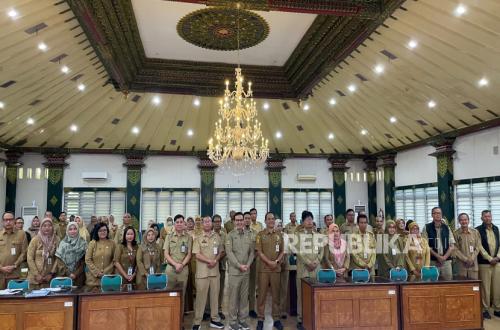
The Yogyakarta City Government has identified approximately 250 university students from families with low welfare levels. These students are potential recipients of aid through the Regional Education Guarantee (JPD) programme, titled ‘One Poor Family, One Graduate’.
Mayor of Yogyakarta, Hasto Wardoyo, stated that the programme is designed to expand access to higher education for residents facing financial constraints. The City Government had previously allocated a budget, but as absorption levels were not optimal, the government conducted a screening of student data from low-income families.
“We previously allocated a budget, but it was almost unutilised. Therefore, I instructed a search for data on individuals in Yogyakarta who are studying at university but fall within the lower deciles,” Hasto said during a socialisation session for the JPD programme at the Yogyakarta City Hall on Monday (21/9/2026).
From this screening, approximately 250 students were found. Hasto has requested village heads (lurah) to conduct direct field verifications to confirm potential recipients and to identify other residents who have the potential to attend university but are hindered by economic limitations.
The programme provides assistance of Rp 6 million per semester for each student. Of this, Rp 5 million is allocated to support university operational costs, while Rp 1 million is given directly to the student for use during their studies. Hasto noted that the number of recipients could increase if the budget and community needs allow.
“If the budget becomes available in the future, we may consider increasing the number of students in the coming years, provided there is sufficient public interest and genuine need,” he said.
Hasto added that recipients are not limited to unemployed residents. Those who have graduated from high school (SMA/SMK) and must work while studying are also eligible if they meet the assistance criteria.
During the session, Hasto also explained the City Government’s education policy from primary to higher education levels. He noted that access to primary and junior high school has relatively received sufficient government attention. At the junior high school level, high demand for public schools has even limited capacity for certain programmes.
Hasto also highlighted the situation of residents who cannot afford private schools and are not accepted into public schools. He emphasised that such conditions should not force children to opt for equivalency education due to financial issues.
Meanwhile, the Regional Secretary of Yogyakarta, Budi Santosa Asrori, stated that the ‘One Poor Family, One Graduate’ programme is also linked to the improvement of social assistance recipient data. In the last two years, the Yogyakarta City Government has utilised the National Socio-Economic Single Data (DTSEN), moving away from its previous independent data collection system.
This change in the database has impacted the realisation of social protection budgets. The Secretary noted that while the budget previously ranged from Rp 22 billion to Rp 23 billion per year, the 2025 realisation was approximately only Rp 11 billion.
“On average, we were above Rp 20 billion, around Rp 22–23 billion per year. But in the last two years, particularly 2025 and 2026, the realisation has perhaps only been half of that. In 2025, it was only Rp 11 billion,” said the Secretary.
The Secretary noted that data refinement is still required to ensure alignment between government databases and the actual conditions of the community on the ground. This is part of the effort to ensure that social protection programmes are accurately targeted.
He stated that education is one way to help break the cycle of economic hardship within families. Higher education is viewed as a means to open wider access to employment opportunities.
“Why is the ‘One Poor Family, One Graduate’ programme necessary? Because it is to break the economic problem. The assumption is that as education levels rise, access to job opportunities also expands,” he said.
Hasto added that the programme is also aimed at increasing the average duration of schooling and maintaining the achievement of the Human Development Index in Yogyakarta. He also linked it to efforts to strengthen Yogyakarta’s reputation as an ‘Education City’.
“As an education city, Yogyakarta must show its mark. Study hours must be good, and education must be high quality,” said Hasto.
In addition to documenting university students, Hasto requested that village governments begin monitoring residents aged 15 to 25 who are not in school, not in university, and not working. This data is considered vital for identifying young residents who require government attention.