
Yen and Rupiah Strengthen, Why is the Philippine Peso Hitting Record Lows?
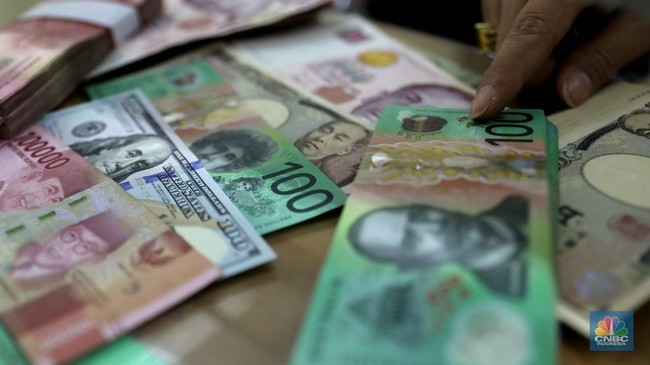
The majority of Asian currencies strengthened against the US Dollar this week, including the Indonesian Rupiah. The Rupiah exchange rate closed the final trading session of the week with gains against the US Dollar. According to Refinitiv data, on Friday’s close, the Rupiah appreciated by 0.11% to a position of Rp17,630/US$. This position places the Rupiah at its strongest level in the last 15 weeks. Over the course of the week, the Rupiah strengthened by 0.31%, marking five consecutive weeks without any depreciation.
Not only the Rupiah, but most Asian currencies gained this week. Most currencies strengthened after pressure on the US Dollar increased following Federal Reserve Governor Christopher Waller’s indication of the possibility that interest rates might be maintained at this month’s meeting. Waller stated he tends to support a decision to maintain interest rates if subsequent economic data shows that inflationary pressures are beginning to subside.
The Yen became the fastest-strengthening currency this week. Six weeks after reaching a four-decade low against the US Dollar, the Yen’s downward trend appears to be reversing. Several factors have finally prompted traders, who for years bet against the Japanese currency, to begin altering their strategies. Previous interest rate hikes by the central bank and record-scale currency interventions failed to provide long-lasting support for the Yen.
However, fresh momentum is now emerging, ranging from capital repatriation and the reversal of carry trades to political pressure from the United States, prompting speculators betting on Yen weakness to reconsider their long-term strategies. “The market psychology towards the Yen seems to be changing,” said Rong Ren Goh, fixed-income portfolio manager at Eastspring Investments, to The Japan Times. According to him, investors are increasingly reluctant to engage in aggressive Yen selling, particularly due to the prospect of Bank of Japan (BOJ) interest rate hikes in September, which adds risk to such trades.
The BOJ is expected to raise its benchmark interest rate by 25 basis points (bps) this month. The market is even considering the possibility of a 50 bps hike or a series of rate increases in the coming months. Nevertheless, a 50 bps hike in September is considered highly unlikely, especially under the cautious leadership of BOJ Governor Kazuo Ueda. This shift in sentiment is also supported by capital flows. Citigroup data shows that investor positioning towards the Yen has shifted from bearish to bullish since early August. Interbank flow data indicates that leveraged funds, banks, and real money investors all made net purchases of the Yen this week.
The combination of central bank policy, investment flows, and changes in speculative positioning has increased Yen volatility. The Japanese currency also strengthened by nearly 2% against the Euro and the Australian Dollar throughout the week. Stephen Jen, CEO and co-CIO of Eurizon SLJ Asset Management, stated that the risk of a rapid reversal in Yen-based carry trades is increasing. He noted that the conditions are similar to 1998, when the collapse of Long-Term Capital Management (LTCM) forced banks and hedge funds to undergo rapid deleveraging. The Yen has long been a favourite currency for carry trades, where investors borrow funds in low-cost Yen to invest in other assets. “When a currency is highly undervalued and investor positions are extreme, movements like this will occur more frequently before a major movement emerges,” said Jen.
Conversely, the Philippine currency continues to collapse. The Philippine Peso is hovering near historic lows amidst a combination of various domestic economic challenges and global geopolitical turmoil. On Friday, the currency reached an all-time low of PHP 62.71 per US Dollar. The Peso has continued a weakening trend since the beginning of the year, having declined approximately 6% against the US Dollar since 1 January.
The currency has hit several record lows in recent months, amid rising oil prices and various other negative pressures resulting from the US-Israel-Iran geopolitical tensions. The Peso previously touched a record low of PHP 61.847 per US Dollar on 24 July, before weakening again to PHP 62.265 last Friday. The decline continued this week; the Peso closed at PHP 62.565/US$ on Wednesday and slipped again to 62.71 on Friday.
Why has the Peso fallen so deeply? The Peso faces several negative trends in the Philippine economy, alongside the strengthening US Dollar. Before the conflict, the Philippines imported almost all of its oil needs from the Gulf region. In March, Manila was even forced to declare a national emergency when the closure of the Strait of Hormuz by Iran disrupted oil supplies. When oil prices rise, Philippine importers must exchange more Pesos for US Dollars to purchase crude oil, which is priced in Dollars. This condition further pressures the domestic currency.
On the other hand, rising yields on US Treasuries have encouraged international investors to exchange emerging market currencies for safer, dollar-denominated assets. This has further pressured the Peso. These pressures are exacerbated by tight Philippine government finances and a large trade deficit. “The weakness of the Philippine Peso primarily stems from the large fiscal and current account deficits experienced by the economy, added to the high inflation that the Philippine central bank (BSP) is currently managing,” said Philip McNicholas, Asia sovereign strategist at Robeco Singapore, to Reuters. According to him, these conditions make the Peso vulnerable to changes in global risk sentiment.
Source: jawawa.id (https://jawawa.id/newsitem/yen-and-rupiah-strengthen-why-is-the-philippine-peso-hitting-record-lows-1788587715)
Originally published by CNBC Indonesia (https://www.cnbcindonesia.com/research/20260905100747-128-765185/yen--rupiah-perkasa-mengapa-peso-filipina-jatuh-ke-rekor-terendah), translated from Indonesian