
Yatsi Madani Assists Housewife Group in Building Production Chain
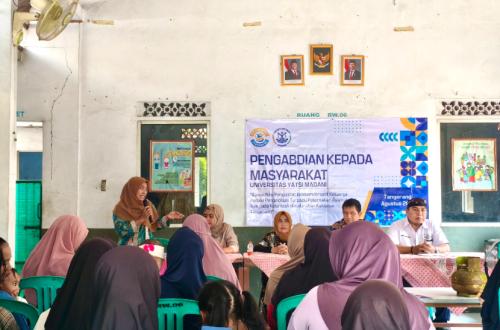
The potential of chicken farming and freshwater fish cultivation in Kutajaya Village, Pasar Kemis District, Tangerang Regency, is being developed into a value-added source of income for families. Lecturers from Universitas Yatsi Madani are mentoring the RISDANA (Rezeki Bunda Kedaung) group to develop the business through integrated management, from production, processing, and packaging to marketing.
The mentoring is carried out through the Community Service Programme (PKM) for the 2026 funding year with the theme ‘Value Chain for Strengthening the Family Creative Economy through Integrated Management of Chicken and Fish Farming in the RISDANA Group in Kutajaya Village, Tangerang’.
The PKM programme leader, Mohamad Yamin, said the programme stems from potential already possessed by the community. However, chicken farming and fish cultivation outputs have largely been marketed in raw form, meaning the economic value received by the community has not been maximised.
‘We see that the community already has potential in chicken farming and fish cultivation, but the results are still mostly sold in raw form. Therefore, we are directing this mentoring so that this potential can be processed into products with higher selling value while opening business opportunities for families,’ Yamin said in a press release on Friday (21/8/2026).
Through the programme, chicken and fish are being developed into various processed products such as nuggets, fillets, and frozen food. Product development is carried out to extend the value chain while opening broader marketing opportunities.
Business strengthening is not only carried out through the provision of equipment, but also through improving the community’s ability to manage the entire business process.
‘We want to build a business model that connects production, processing, packaging, and marketing. In this way, economic activity does not stop at selling raw materials, but can create added value that returns to families and business groups,’ said Yamin.
In the programme, the men’s group is directed to strengthen chicken and fish production. Meanwhile, the women’s group in RISDANA takes a greater role in product processing and marketing.
To support production activities, partners received several appropriate technologies, such as a chest freezer, vacuum sealer, electric meat grinder, barcode printer, industrial gas stove, and stainless steel sink table and rack. The equipment is used for processing, storage, packaging, product identification, and maintaining production hygiene.
In addition to equipment support, partners received training in branding, packaging design, creative thinking, business management, simple bookkeeping, and digital marketing through various marketplace platforms.
Yamin said that increasing community capacity is key to ensuring the business development can run sustainably.
‘Equipment is a support, but the most important thing is the community’s ability to manage the business. We want the group to have production skills, financial management, packaging, branding, and marketing so that the business can develop independently,’ he said.
The programme targets the creation of at least three variants of processed chicken and fish products, the formation of a family business team, the availability of standard operating procedures (SOPs) for production, and increased partner capacity in managing and marketing products.
The activity partner, RISDANA (Rezeki Bunda Kedaung), is a group of housewives led by Lusy Rizky Dwi Wulansari. The group is located in Kutajaya Village, Pasar Kemis District, Tangerang Regency, with a development focus on production and marketing aspects.
The mentoring activity is carried out by a Universitas Yatsi Madani team consisting of Mohamad Yamin as programme leader, together with Eka Uliyanti Putri BR Bangun and Irfan Maulana. The mentoring process also involves students Khairan Ramadhan and Cahya Kamila.
Yamin hopes the development can bring together local potential, community skills, and simple technology to produce a new economic chain that directly benefits families.
‘The hope is that the potential already present in the community can develop into a more productive business. From the coop and pond, then into the processing stage, packaged well, and marketed more widely. With this model, we hope the family economy can grow through a jointly managed business,’ said Yamin.
This programme is part of the Community Service Programme for the 2026 funding year with support from the Directorate of Research and Community Service, Directorate General of Research and Development, Ministry of Higher Education, Science, and Technology.