
YARSI Transforms Former Rubbish Dump into Economic Resource
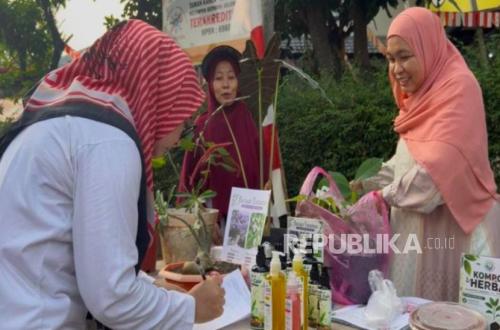
A public facility plot of around 500 square metres in Cluster Nusantara, Tangerang, which was previously abandoned and used as a rubbish dump, is now being utilised as a productive space. Universitas YARSI is developing the land into a circular economy ecosystem that combines environmental management, empowerment of cleaning staff, and the development of products with economic value.
Dr Juniarti, a lecturer at the Faculty of Medicine and instructor in the Biomedical Sciences Master’s Programme at Universitas YARSI’s Postgraduate School, said the land use began with arranging it into a garden equipped with basic infrastructure and herbal plants.
“Limited land is not only a green space, but also a space for learning, community empowerment, and environment-based economic development,” Juniarti said on Wednesday (19/8/2026).
One of the main activities is processing plant waste from the garden and the Cluster Nusantara environment into organic fertiliser. Cleaning staff are involved from the collection of organic materials to the processing stage.
Plant cuttings are shredded using a machine, then placed into 200-litre drums fitted with taps. The material is mixed with an EM4 solution that has been diluted with water, then fermented for about one month.
“The process produces liquid organic fertiliser that can be harvested through the tap at the bottom. The solid material is then further processed with the addition of burnt rice husk, fermented animal manure, and dolomite to help balance the pH,” she said.
The finished compost is then packaged for marketing, while the liquid organic fertiliser is reused for plants in the garden. The liquid organic fertiliser, diluted about 20 times, is also used for plant care.
According to Juniarti, the community service programme received a grant from Kemdiktisaintek as well as funding support from the YARSI Foundation. The programme continues the empowerment of limited land carried out in the previous year.
Other organic materials used come from fruit peels. The fruit peels are fermented into eco-enzyme using a mixture of fruit peels, molasses, and water in a ratio of 3:1:10.
The fermentation process lasts about three months. After being harvested and filtered, the eco-enzyme is processed into derivative products such as hand soap and floor cleaner.
These products began to be introduced to the public through the Merdeka Bazaar. In addition to compost, liquid organic fertiliser, and eco-enzyme products, medicinal plants and ornamental plants from the garden are also marketed.
Going forward, product marketing will be developed through social media and the Universitas YARSI Herbal Research Centre website, which is currently being prepared.
The circular economy concept is also being extended to other elements in the garden. A fish pond will be stocked with tilapia and integrated with a hydroponic system that is now entering the nursery stage.
Meanwhile, the garden irrigation system is being developed using Internet of Things technology through collaboration with students from Universitas YARSI’s Faculty of Information Technology.
“In this way, the garden is developing into an open space that brings together the environment, technology, education, community empowerment, and economic activity in a single ecosystem,” Juniarti said.