
Xinhua Silk Road: China Opens Major River-to-Sea Canal, Creating Trade Shortcut to Southeast Asia
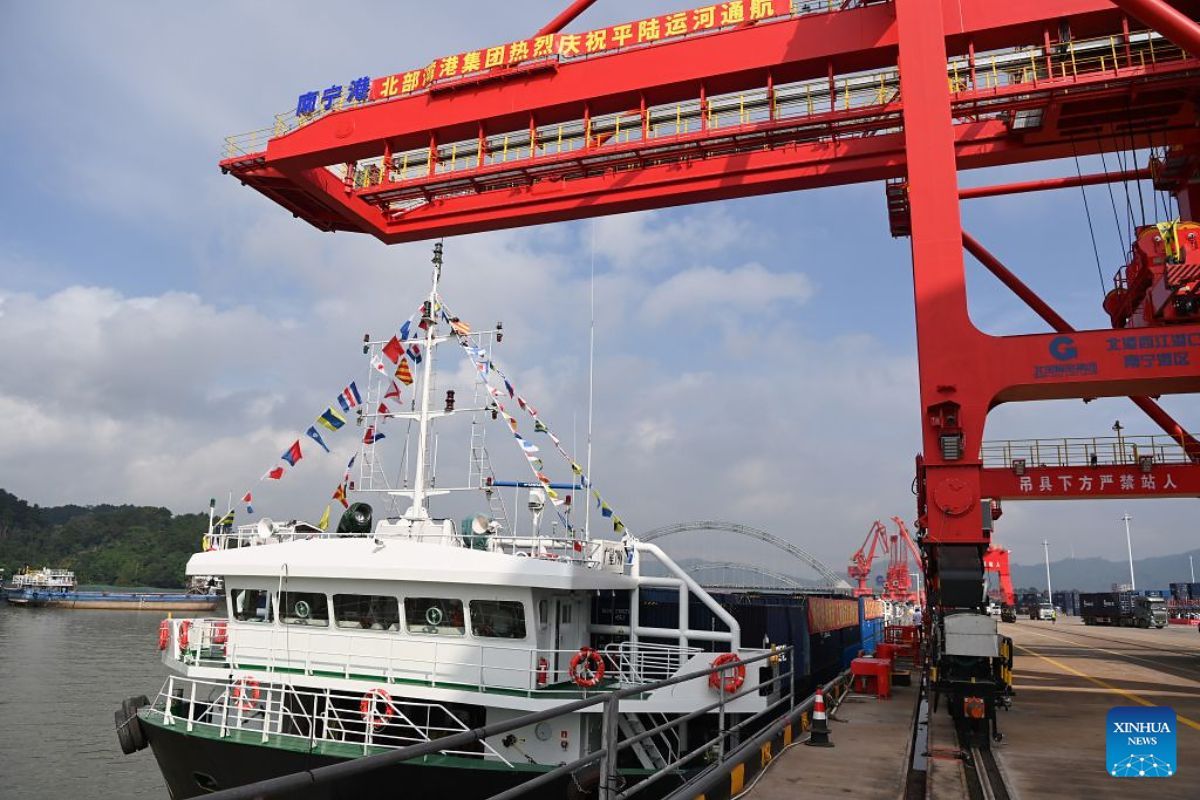
Beijing, (ANTARA/PRNewswire) - China opened the Pinglu Canal last Wednesday. Through this move, China provides a shortcut for its southwestern inland regions to reach coastal areas and overseas markets, particularly member states of the Association of Southeast Asian Nations (ASEAN), China’s largest trading partner.
Built at a cost of RMB 72.7 billion (approximately US$ 10.75 billion), the canal spans 134.2 kilometres from Nanning, the capital of the Guangxi Zhuang Autonomous Region in southern China, to the Beibu Gulf, the sea exit route closest to most of China’s southwestern regions.
The canal is situated along the New International Land-Sea Trade Corridor, a strategic trade route connecting China’s inland regions with ASEAN and other global markets. This project is the first canal to connect a river to the sea that has been planned and coordinated at the national level since the founding of the People’s Republic of China in 1949.
The canal is designed to accommodate vessels weighing up to 5,000 tonnes. Furthermore, the canal reduces the travel distance by more than 560 kilometres via waterways from China’s southwestern regions to the sea, compared to the conventional route through ports in Guangdong Province. The canal is also expected to reduce logistics costs by 18–30% and save more than RMB 5 billion in transportation costs annually.
According to Lu Xinning, Vice Chairman of the Guangxi Regional Government, the canal creates a new connecting link between China’s market of 1.4 billion people and nearly 700 million ASEAN consumers. Lu also noted that the impact extends beyond the movement of goods, as it will also drive new cross-border investments and deepen regional supply chain integration.
The construction of the canal took over four years. Most of the canal was built by widening, deepening, and straightening existing waterways, while a small portion had to be excavated through land and mountainous terrain.
One of the greatest engineering challenges was the water surface height difference of up to 65 metres, roughly equivalent to the height of a 20-storey building. Three navigation centres, all equipped with double lock systems, were constructed to raise and lower ships along the canal.
Environmental conservation was also a priority during the canal’s construction. More than 98% of the approximately 315 million cubic metres of earth and rock excavated during construction was reused. The canal also features a fish passage of over 480 metres, as well as specialised crossings for land animals, including leopards and squirrels.
Source: jawawa.id (https://jawawa.id/newsitem/xinhua-silk-road-china-opens-major-river-to-sea-canal-creating-trade-shortcut-to-southeast-asia-1789729275)
Originally published by Antara (Indonesian) (https://www.antaranews.com/berita/5747545/xinhua-silk-road-tiongkok-buka-kanal-utama-dari-sungai-ke-laut-ciptakan-jalur-pintas-perdagangan-ke-asia-tenggara), translated from Indonesian