
Xi Jinping’s Party Purge: 33 Officials Expelled
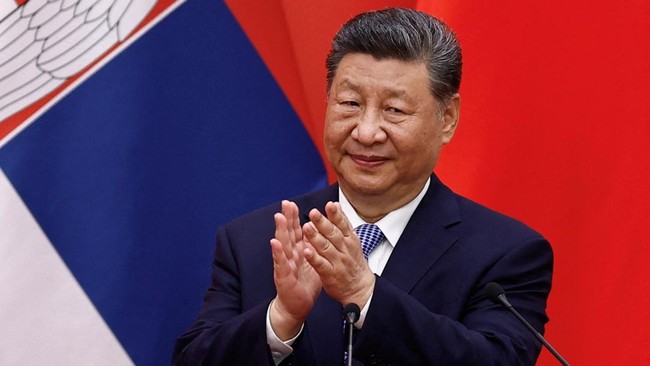
Jakarta, CNBC Indonesia — Chinese President Xi Jinping has launched another sweeping reshuffle within the Chinese Communist Party (CCP). A total of 33 senior officials were formally expelled from the party at an elite meeting held this week.
The number of officials removed has drawn attention for setting a record at the meeting. The large number of vacant seats at an important party forum also points to an expanding wave of action against officials in China’s government and military.
According to The Guardian, the expulsions were approved at the Fifth Plenum, held from 26 to 29 October 2026.
The figure was not the only point to attract attention. Of the 376 full and alternate members of the CCP Central Committee appointed in 2022, only 279 attended this meeting.
That means 97 people, or around 25.8% of the original membership, were absent. This was the highest rate of non-attendance in the modern history of CCP plenums, particularly since the end of Mao Zedong’s leadership.
Some are known to have been removed through disciplinary action and anti-corruption measures. However, not all absences have been officially explained.
The number of attendees has, notably, continued to fall in recent years.
At the Third Plenum in July 2024, 364 Central Committee members and alternate members attended. The figure fell to 315 at the Fourth Plenum in October 2025, before dropping again to 279 in October 2026.
The decline reflects the growing number of officials no longer attending important party meetings, as investigations and disciplinary measures expand across China’s government.
Among the 33 officials whose expulsions were approved this time were several prominent figures who had previously held important positions.
One was Zhang Youxia, formerly the second-highest-ranking figure in China’s military leadership after Xi Jinping. Another was Ma Xingrui, former Communist Party secretary in Xinjiang.
Others included Liu Jianchao, a former senior Chinese diplomat; Jin Zhuanglong, a former industry minister; and Yi Huiman, former chairman of the China Securities Regulatory Commission.
Of the 33 officials expelled, 16 were from the military. This indicates that the purge has extended beyond the civil government to the highest ranks of China’s armed forces.
China’s purge of officials deepens, setting a new record
Xi Jinping’s efforts to purge party officials are not new.
Since taking office in 2012, he has made the fight against corruption one of the central priorities of his government.
However, the number of officials expelled at Central Committee meetings has risen sharply in recent years.
A review by CNBC Indonesia of official CCP communiqués found that the expulsions of 10 officials were approved at the Fifth Plenum in 2015. At a similar meeting in 2020, no approval of expulsions was mentioned in the official communiqué.
The issue resurfaced at the Third Plenum in 2024, when three officials were confirmed as expelled from the party.
A year later, the figure rose to 14 at the Fourth Plenum in October 2025.
In October 2026, the number of approved expulsions surged to 33, more than double the previous year’s total.
This sweeping purge represents only a small part of China’s anti-corruption and disciplinary campaign over more than a decade.
At a press conference on Friday (30 October 2026), Zhang Fuhai, deputy secretary of the CCP Central Commission for Discipline Inspection, said Chinese oversight bodies had handled 8.105 million cases and sanctioned 7.922 million people since Xi came to power in 2012.
Of those, 963 were officials under the direct management and supervision of the CCP Central Committee.
The figures illustrate the breadth of China’s enforcement drive. It has affected not only lower-level officials but also people in important government and party positions.
However, the millions sanctioned were not all dismissed or imprisoned. Disciplinary measures vary according to the nature and severity of each violation.
The Chinese government regards discipline enforcement as essential to strengthening the party and ensuring that officials at every level implement central government policies.
At the same time, the expanding purge has raised questions about its effects on China’s leadership structure.
Neil Thomas, a senior fellow at the Asia Society think tank, said the growing number of vacant seats at the meeting demonstrated the importance Xi places on internal party discipline.
Other observers have questioned whether the campaign is solely aimed at fighting corruption or is also being used to remove officials seen as disloyal to Xi’s leadership.
Regardless of the debate, the effects of the sweeping changes are becoming apparent in China’s military leadership.
The Central Military Commission, the highest body in command of the People’s Liberation Army, originally had seven members appointed in 2022.
Following a series of dismissals, only two remain: Xi Jinping and Zhang Shengmin.
Notably, Zhang Shengmin, who plays an important role in overseeing discipline and anti-corruption efforts in the military, was promoted at this week’s meeting.
He was appointed to the CCP Politburo, one of the party’s highest decision-making bodies. With the appointment, Zhang is now the Politburo’s sole military representative.
The major changes are unfolding as China begins preparations for the 21st CCP National Congress, scheduled for the second half of 2027.
Held every five years, the congress will provide an opportunity for the CCP to renew its leadership, including the membership of the Central Committee and Politburo.
Xi is expected to continue in office for a fourth term, extending his tenure as China’s leader beyond that of any leader since Mao Zedong.
Nevertheless, the number of officials removed also presents a challenge.
Some analysts say a purge on such a broad scale could leave a smaller pool of officials ready to fill important posts.
This issue is becoming more pressing ahead of the leadership reshuffle in 2027. Vacated positions will need to be filled by officials capable of implementing government policy and retaining the party leadership’s confidence.
China’s challenge will therefore be not only to sustain its anti-corruption drive, but also to ensure that mass dismissals do not disrupt government operations and national decision-making.
This is particularly important as China faces economic and geopolitical challenges that require coordination and decisions from its most senior leaders.
The 2027 CCP National Congress will consequently be a key moment for seeing how Xi Jinping rebuilds the leadership after the wave of dismissals in recent years.
Source: jawawa.id (https://jawawa.id/newsitem/xi-jinpings-party-purge-33-officials-expelled-1793458242)
Originally published by CNBC Indonesia (https://www.cnbcindonesia.com/news/20261031171854-4-781161/xi-jinping-bersih-bersih-internal-partai-33-pejabat-dipecat), translated from Indonesian