
Xi Jinping's Message of Civilisational Dialogue Echoes from Ancient Chichen Itza
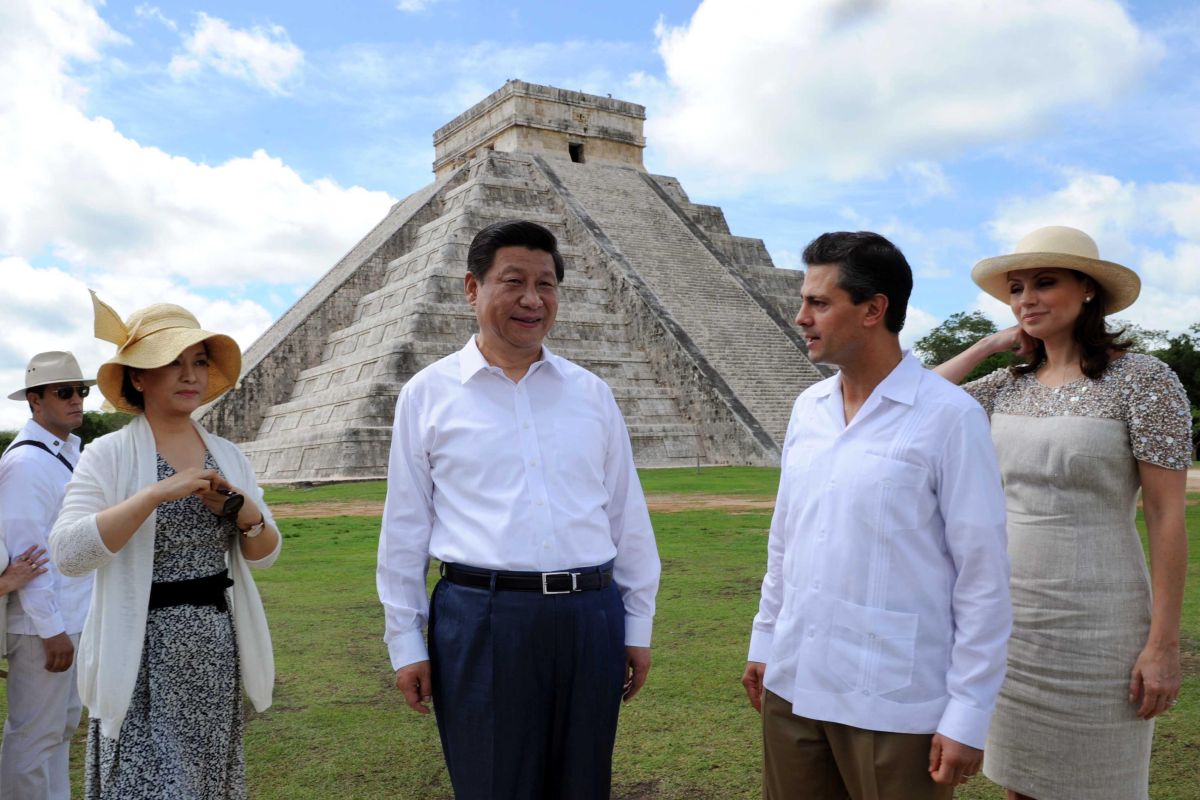
At the ancient Maya archaeological site of Chichen Itza in Mexico, the stone pyramids and temples still tell the story of a remarkable civilisation that flourished centuries ago.
The historic site, which dates back to the 5th century AD, bore witness to a dialogue between civilisations when Chinese President Xi Jinping visited it during his state visit to Mexico more than a decade ago.
In June 2013, Xi and his wife, Peng Liyuan, visited the site on Mexico’s Yucatan Peninsula, accompanied by then Mexican President Enrique Pena Nieto and his wife.
As they walked through the site, including the Kukulkan Pyramid, the Great Ball Court and the Temple of the Warriors, Xi listened attentively to explanations about Maya history and culture.
He asked about the meaning behind the patterns carved into the ruins and showed interest in the similarities between certain Maya cultural elements and Chinese traditions, including dragon-related imagery.
The encounter reflected a simple yet profound idea: civilisations may differ in their histories and traditions, but they can learn from and enrich one another through dialogue and mutual respect.
“Different cultures and civilisations, while maintaining their own uniqueness, should tolerate one another and coexist with an open attitude in order to achieve common development and prosperity,” Xi said, according to Xinhua.
Over the years, the Chinese President has consistently called for drawing wisdom and strength from different civilisations, while joining forces with others to address the common challenges facing humanity.
“There is a horizon wider than the sea, and that is the sky; there is a horizon wider than the sky, and that is the human soul,” Xi said, quoting Victor Hugo, the renowned French writer, in his historic speech at the United Nations Educational, Scientific and Cultural Organization (UNESCO) in Paris in 2014.
“Indeed, we need a mindset broader than the sky when we interact with different civilisations,” Xi said.
The visit to Chichen Itza was one example of Xi’s broader vision of inter-civilisational exchange.
In Paris, Xi recounted stories of mutual learning between Eastern and Western civilisations.
“China’s Four Great Inventions — papermaking, gunpowder, movable-type printing and the compass — brought changes to the world, including the Renaissance in Europe. Chinese philosophy, literature, medicine, silk, porcelain and tea spread to the West and became part of people’s daily lives,” he said.
These examples show that inter-civilisational exchange is not a one-way process, but rather a source of progress driven by mutual learning.
“It is a conviction I feel deeply that an attitude of equality and humility is required if one wishes to truly understand different civilisations,” he said.
“Being condescending towards a civilisation will not help anyone appreciate its essence, but may instead breed hostility. Both history and reality show that arrogance and prejudice are the two greatest obstacles to exchange and mutual learning between civilisations,” he added.
This approach is also reflected in Xi’s diplomatic travels around the world, where encounters with different cultures have become an important part of his visits.
In Trinidad and Tobago, he played the steelpan with local musicians. In Fiji, he listened to indigenous songs while wearing a traditional Bula shirt. In Uzbekistan, he visited the ancient city of Bukhara, known as a “living fossil of the Silk Road”.
In Bukhara, Xi’s respect for local traditions left a deep impression on Anvar Kurbanov, a master craftsman from the ancient city.
“I still remember President Xi carefully observing the handicrafts on display. I could feel his sincere desire to understand and respect our culture,” Kurbanov said, recalling Xi’s visit to the city in 2016.
“Since that visit, more and more Chinese tourists have come to Bukhara.”
In recent years, China has stepped up efforts to promote closer understanding and mutual appreciation among different civilisations. China has organised cultural and tourism exchange programmes, conducted joint archaeological research, and promoted the translation of classic works with various countries including Russia and Egypt.
China has also hosted the Conference on Dialogue of Asian Civilisations and the Dialogue on Exchanges and Mutual Learning among Civilisations, and proposed the Global Civilisation Initiative to provide China’s insights for strengthening exchanges and mutual learning between civilisations.
On various international occasions, Xi has outlined the principles of harmony in diversity, inclusiveness and mutual learning, while stressing that every country has the right to choose a development path suited to its own national conditions and the needs of its people.
“I have often stressed that China’s goal is to be a great learning nation. We must avoid complacency and self-importance. Instead, we should be humble and unassuming, study diligently, and continuously improve our capabilities,” Xi said in his speech at the Indian Council of World Affairs in New Delhi, India, in 2014.
“It is this spirit of learning, characterised by humility and inclusiveness, that has enabled the Chinese nation to keep making progress over thousands of years,” he added.