
Xi Jinping's Different Treatment of Trump and Putin: Who Does He Favour?
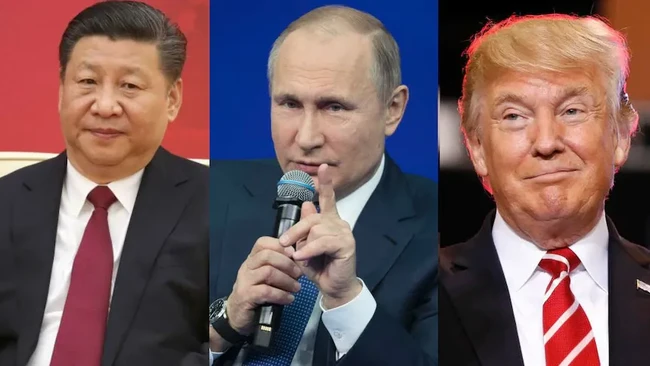
Xi Jinping’s Different Treatment of Trump and Putin: Who Does He Favour?
Jakarta, CNBC Indonesia - President Xi Jinping of China showed noticeably different approaches when hosting United States President Donald Trump and Russian President Vladimir Putin in Beijing.
Although both leaders were greeted with ceremonial state honours at Tiananmen Square, complete with guards of honour, a military band, and children waving flowers and Chinese flags, the nature of the discussions and outcomes of the meetings revealed stark differences in China’s relations with Washington and Moscow.
When receiving Trump, Xi placed a premium on symbolism and diplomatic cordiality. The American president was even taken on a tour of Zhongnanhai, the elite compound used by China’s leadership that is rarely opened to foreign guests.
George Chen, a partner at The Asia Group’s Greater China practice, said Xi understood that Trump values symbolic respect. “Xi knows this is what Trump values: to be treated like a VIP, to be respected in front of the cameras,” Chen told The Associated Press on Friday (22 May 2026).
In addition, the focus of Xi and Trump’s talks was on stabilising the relationship between the two nations following a period of strain caused by trade tensions and strategic competition. Xi pressed for the United States to view China as a partner, not an adversary. Both leaders also agreed to build a China–U.S. relationship that is “constructive and strategically stable.”
By contrast, Xi’s dealings with Putin were more substantive and strategic. Putin spent more time with Xi inside the Great Hall of the People. The two leaders reviewed the China–Russia relationship exhibition, drank tea together, and discussed long‑term cooperation.
“Reaffirming their friendship treaty, signing new energy‑related agreements, and emphasising their ‘unbounded’ partnership,” Chen said.
The results were far more concrete. China and Russia signed more than 40 cooperation agreements across trade, technology, energy, and media. The two countries also issued a joint declaration describing China and Russia as “centres of power in a multipolar world.”
Meanwhile, Trump and Xi did not sign a joint declaration or publicly announce major deals during the visit. After Trump left Beijing, the U.S. said China had agreed to buy agricultural products from the United States worth US$17 billion per year and to purchase 200 Boeing aircraft.
Analyst Claus Soong of the Mercator Institute for China Studies in Berlin assessed that the Trump outcome appeared less clear than Putin’s. “China and Russia achieved more agreements, and with China and the U.S., what were the agreements? Even that is not very clear,” he said.
There were also differences on Taiwan. Xi told Trump that Taiwan is the most sensitive issue in the China–U.S. relationship and cautioned that missteps could spark a conflict.
Trump himself did not discuss Taiwan much in Beijing. However, on the way home to the United States, he referred to arms sales to Taiwan as a “very good bargaining tool” against China.
Conversely, Russia openly backed China’s position on Taiwan. In the Xi–Putin joint declaration, Moscow reiterated its opposition to Taiwan independence “in any form” and supported Beijing’s efforts toward national reunification.
(luc/luc) Add as a preferred source on Google [Gambas:Video CNBC]