
Xi Jinping warns of ‘new historical injustice’ in AI. What does he mean - and can it be prevented?
analysis East Asia
Xi Jinping warns of ‘new historical injustice’ in AI. What does he mean - and can it be prevented?
The warning by China’s president draws on a long-standing domestic narrative about the costs of falling behind in previous technological revolutions, say analysts.
SHANGHAI: Chinese President Xi Jinping’s warning against a “new historical injustice” in artificial intelligence (AI) is a message that the next technological revolution must not repeat past patterns of inequality, say analysts.
That injustice, they say, would come if developing countries again supply data, resources and labour while others capture the wealth, influence and rewards created by AI - a divide that already appears to be forming.
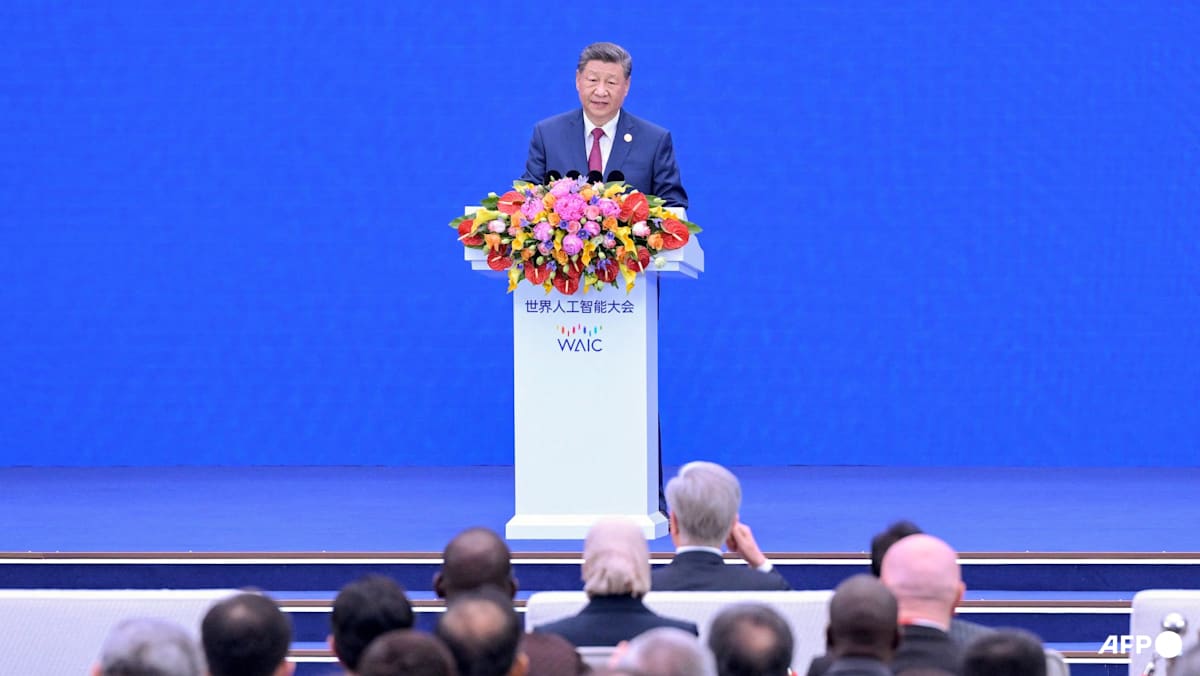
Xi made the warning on Jul 17 in his very first keynote address at the World AI Conference (WAIC) in Shanghai, where he also outlined a vision of China as a steward of global AI governance.
Analysts say Xi’s broader message at WAIC served a dual purpose - presenting China as a champion of an inclusive AI order while signalling that Beijing does not intend to lag behind in another major technological transition.
“I’m not going to just be a follower, I want to be a leader,” George Chen, partner and chair of digital practice at policy advisory firm The Asia Group, said of Xi’s message, adding that the Chinese leader expressed this in a “very diplomatic way”.
But observers warned that China faces a series of challenges in translating that vision into practice, from doubts over the durability of its open-source approach to ensuring that its push does not create new forms of dependence.
WHAT INJUSTICES WAS XI ALLUDING TO?
Held over four days, the ninth edition of WAIC drew 1,117 exhibiting companies, more than 4,400 exhibits and over 400,000 visits, with delegates from 102 countries and international organisations, according to organisers and state media.
Much of the attention, however, centred on the opening ceremony, where Xi delivered his speech - including a warning about a potential new global divide in AI.
“We must carry out extensive international cooperation and help Global South countries with capacity building to bridge the AI and digital divides, promote sustainable development, and prevent creating new historical injustice in AI,” Xi said.
While Xi did not define what he meant by historical injustice, analysts said the context makes it clear.
“In almost every instance that Xi is addressing the Global South, it’s the digital divide that he’s talking about,” Kendra Schaefer, a partner at Beijing-based policy consultancy Trivium China, told CNA.
The Chinese leader has been fairly consistent, she said, in positioning China as the champion of the Global South on the digital divide - and as the country that will ensure its neighbours share in the fruits of Beijing’s development.
Chinese officials have broadly defined the Global South’s “historical injustices”.
In August 2024, China’s ambassador to the UN cited centuries of Western colonial rule, the slave trade, racial discrimination and resource plunder, calling them the root of Africa’s historical injustices. Africa is a major part of the Global South.
In the context of technology, however, analysts traced the reference through successive industrial revolutions that enriched their owners and left latecomers dependent - from colonial-era railways built to move minerals to ports, to 20th-century patent regimes that limited affordable access to certain medicines and technologies.
“Previous technological revolutions created wealth, but not equally,” said Rachel Adams, CEO of the Global Center on AI Governance, an Africa-based research organisation.
“Colonial infrastructure was largely built to extract resources rather than develop local economies, and later digital platforms captured enormous value from Global South markets without building comparable local industries.”
The result, she noted, is that “many countries remain consumers of technology rather than producers of it”.
For The Asia Group’s Chen, Xi’s message about preventing another “historical injustice” in AI reflects Beijing’s determination not to repeat its internet-era experience.
“The existing internet, from the very beginning, was a very American thing,” said Chen, pointing to its origins in US military-funded research.
“China didn’t really get a chance to participate at all in writing the rules and the standards … mainly because China was a poor developing country.”
That memory carries particular weight in China’s own political narrative, which links the country’s 19th and early 20th-century weakness - a period officially remembered as the “century of humiliation” - in part to not keeping pace with industrial and technological advances.
“China was behind in the previous three industrial revolutions, and China knew the consequences,” Chen said, referring to the eras of steam power, electricity and digital technology.
“What Xi is trying to say is: no, I’m not going to let history repeat itself, because if we let AI go down the same path as e-commerce and the internet, you can foresee the rich countries will get richer, and then the world will become more and more unequal,” he added.
IS AN AI DIVIDE ALREADY FORMING?
Signs are already emerging, data suggests.
Some 118 countries - mostly in the Global South - are absent from major global AI governance discussions, according to a 2025 report by UN Trade and Development, a United Nations body.
Just 100 companies, mostly American and Chinese, account for 40 per cent of global corporate spending on research and development, the same report found, while fewer than a third of developing countries have national AI strategies.
The foundations were uneven before AI even entered the picture. An estimated 94 per cent of people in high-income countries were online in 2025, against 23 per cent in low-income countries, according to the International Telecommunication Union, a UN agency.
Adams from the Global Center on AI Govern
Source: jawawa.id (https://jawawa.id/newsitem/xi-jinping-warns-of-new-historical-injustice-in-ai-what-does-he-mean-and-can-it-be-prevented-1784796627)
Originally published by CNA (https://www.channelnewsasia.com/east-asia/xi-jinping-ai-historical-injustice-china-global-south-waic-6272671)