
Xi Jinping Gathers China’s Elite for Major Meeting: Should Indonesia Be on Alert?
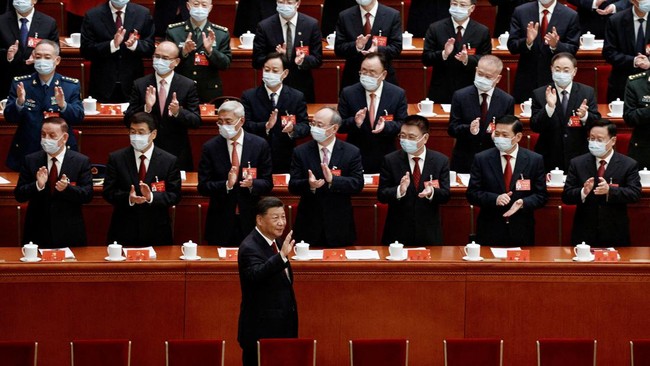
Jakarta, CNBC Indonesia — China is holding one of its most important political meetings of the year. President Xi Jinping has gathered hundreds of senior Chinese Communist Party (CCP) officials for a four-day closed-door meeting from 26 to 29 October 2026.
The meeting is known as the Fifth Plenum, or the Fifth Plenary Session of the 20th CCP Central Committee. Its outcome could offer a picture of China’s leadership and policies over the coming years.
Although it is an internal party event, decisions made at the meeting have a significant influence on the direction of China, the world’s second-largest economy.
The meeting comes as Xi Jinping tightens oversight of party officials and prepares China’s leadership ahead of the National Congress of the Communist Party in 2027.
What is a Plenary Session of the CCP Central Committee?
A plenary session, or plenum, is a meeting of members of the Chinese Communist Party’s Central Committee to discuss and decide on important matters, ranging from politics, the economy and development to national leadership.
To understand the meeting’s importance, it is necessary to recognise that China has a political system in which the Communist Party is the central force in government.
This means many major decisions on the country’s development and policies are first discussed and determined within the party’s leadership structure.
The CCP has several levels of leadership. One is the Central Committee, which comprises hundreds of senior party officials.
Members of the Central Committee are selected at the National Congress of the Chinese Communist Party, held every five years.
After the congress, the Central Committee holds a series of meetings known as plenary sessions during its term.
There are generally around seven plenums during a five-year term, although each meeting has a different agenda.
Broadly, the plenums serve the following functions:
The first plenum is usually held soon after the conclusion of the National Congress. It focuses on selecting the party’s top leaders, including the general secretary, members of the Politburo and the Politburo Standing Committee.
The second plenum generally discusses government appointments and the organisation of state institutions, including candidates later put forward through the formal government process.
The third plenum has traditionally been one of the most important meetings for discussing economic reform and changes to China’s development policies.
The fourth plenum is usually concerned with governance, internal party rules or other strategic issues.
The fifth plenum is generally used to discuss the direction of China’s economic and social development in the next five-year plan.
The sixth plenum often addresses ideology, party history, discipline or the strengthening of leadership.
The seventh plenum is usually the final meeting before the next National Congress, with preparations for the congress and an assessment of leadership over the preceding five years on its agenda.
This division of responsibilities is not fixed, however. The agenda of each plenum can change according to the needs and decisions of party leaders.
That is what has happened with the October 2026 meeting.
It is called the Fifth Plenum because it is the fifth session of the Central Committee formed after the 20th National Congress of the Chinese Communist Party in October 2022.
At that congress, Xi Jinping was re-elected as CCP general secretary for a third term.
The Central Committee formed in 2022 initially comprised 205 full members and 171 alternate members. Its membership has since changed following the replacement or removal of several officials.
Around 300 full and alternate members of the Central Committee are expected to attend this meeting.
How does a plenum work?
Unlike government meetings, which are often reported publicly, CCP plenary sessions are held behind closed doors.
Participants usually discuss reports on the party leadership’s work, review previous policies and consider decisions to be implemented by the government.
Several aspects of the meeting’s procedures are worth noting.
Participants include full and alternate members of the Central Committee, including senior officials from the party, government and military.
The session is held privately over several days, so the public and media cannot follow its discussions directly.
The party leadership, including the Politburo, prepares the agenda for discussion by the Central Committee.
After the meeting concludes, the party usually issues an official statement setting out the decisions and policy direction agreed upon.
Although it may look like a routine internal meeting, history shows that plenary sessions have sometimes marked the beginning of major change in China.
One of the best-known examples came in December 1978, when the Third Plenum of the 11th Central Committee paved the way for economic reforms under Deng Xiaoping.
That meeting became a landmark in China’s shift towards an economy more open to market activity, trade and investment.
The reforms launched at the time helped drive China’s industrial growth and economic development over the following decades.
Another example was the Third Plenum in July 2024, when the CCP discussed a range of reforms to support economic modernisation.
A year later, in October 2025, the Fourth Plenum discussed the direction of the 15th Five-Year Plan for 2026–2030.
The plan identified strengthening industry, technological innovation, production self-reliance and high-quality economic development as key priorities.
Plenums are therefore more than routine gatherings of party officials. They are also forums for important decisions that can shape China’s political and economic direction over the long term.
What is being discussed at the October 2026 Plenum?
According to China’s official news agency Xinhua on Monday (26 October 2026), Xi Jinping opened the Fifth Plenum in Beijing with a report on the Politburo’s work and discussions on strengthening the CCP’s internal governance.
Unlike usual, this year’s Fifth Plenum is not focused on a five-year development plan, as the direction of China’s development for 2026–2030 was discussed at the Fourth Plenum in October 2025.
This time, the main focus is strengthening party discipline and internal oversight, with four key items on the agenda: tackling corruption, improving discipline among officials, reforming the bureaucracy and strengthening party governance.
Through this agenda, Beijing aims to ensure that officials properly implement central government policies. Xi Jinping’s anti-corruption campaign in recent years has reached a number of senior officials, including those in the military.
The meeting is also drawing attention because it takes place ahead of the 21st National Congress of the Chinese Communist Party in 2027, which will determine the party’s leadership for the following five years.
The outcome of this plenum is expected to be announced after the closed-door meeting ends on Thursday (29 October 2026).
Source: jawawa.id (https://jawawa.id/newsitem/xi-jinping-gathers-chinas-elite-for-major-meeting-should-indonesia-be-on-alert-1793094706)
Originally published by CNBC Indonesia (https://www.cnbcindonesia.com/research/20261026152756-128-779547/xi-jinping-kumpulkan-elite-china-gelar-rapat-besar-ri-perlu-waspada), translated from Indonesian