
Xi Jinping and Kim Jong Un Begin High-Level Summit in Pyongyang
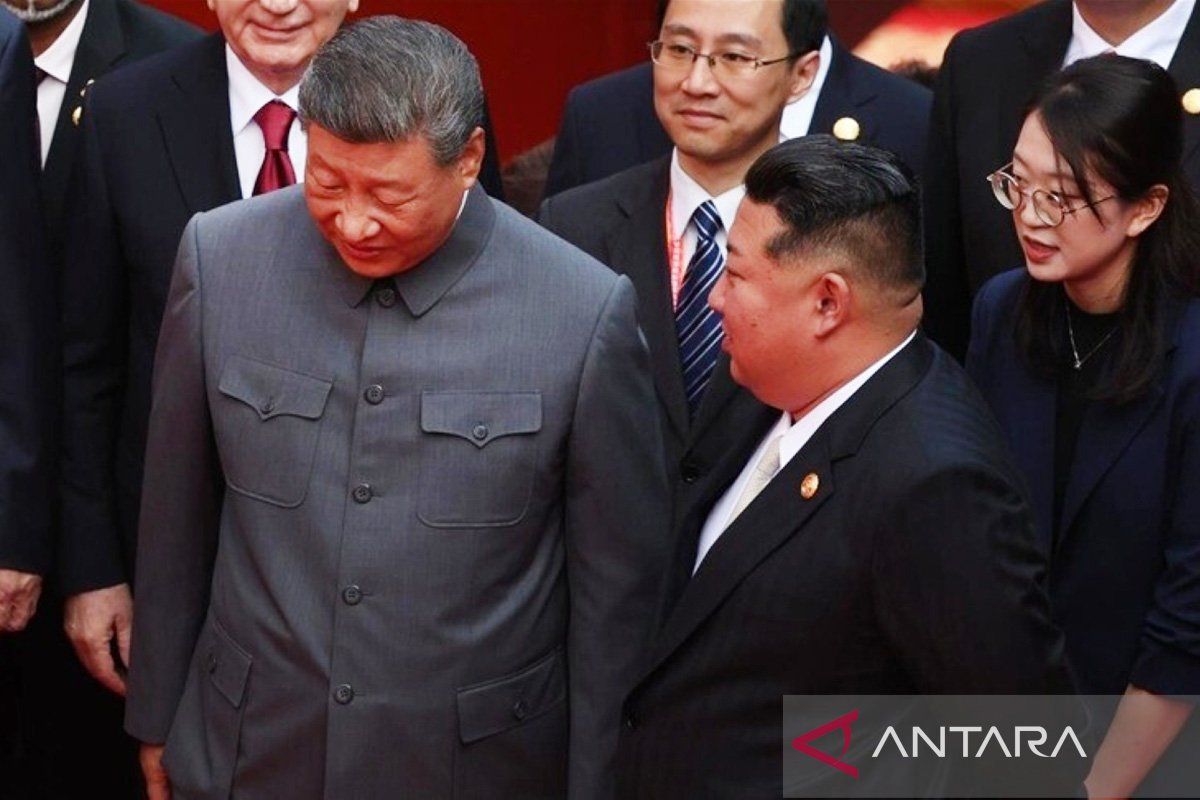
Beijing (ANTARA) - Chinese President Xi Jinping and North Korean leader Kim Jong Un have commenced their high-level summit in Pyongyang on Monday, according to Chinese media.
Observers are closely monitoring whether Xi and Kim will discuss North Korea’s nuclear programme, an issue that China has recently refrained from criticising. Xi is conducting a two-day visit to North Korea until Tuesday (9/6), marking his first visit since 2019. The summit is expected to reaffirm the commitment of both China and North Korea to deepen strategic cooperation, following an agreement to strengthen bilateral ties at the Beijing Summit in September 2025.
Following a meeting between Xi Jinping and US President Donald Trump in Beijing in mid-May, the White House stated that both leaders reaffirmed their shared goal regarding the denuclearisation of North Korea. However, China did not specifically mention the issue in its official statement. Regarding questions as to whether Beijing has tacitly accepted Pyongyang as a nuclear state, Chinese Foreign Ministry Spokesperson Lin Jian reaffirmed during a press conference on Monday that China’s policy regarding the Korean Peninsula prioritises continuity and stability.
Xi Jinping’s meeting with Kim Jong Un follows his recent discussions with Trump and Russian President Vladimir Putin in Beijing last May. On Sunday (7/6), North Korean state media quoted Kim Yo Jong, the sister of Kim Jong Un and a senior official in the ruling party, describing statements from Trump and Xi regarding North Korean denuclearisation as “false information.” This statement suggests that Pyongyang does not intend to discuss its nuclear programme during the summit.
Mitsuhiro Mimura, a professor at Niigata Prefecture University and an expert on North Korean affairs, suggested that Trump may have requested Xi to act as an intermediary for a potential US-North Korea summit without making denuclearisation a prerequisite. While Xi is unlikely to abandon China’s ultimate goal of eliminating nuclear weapons from the Korean Peninsula, Mimura explained that Beijing’s fundamental stance allows Washington and Pyongyang to resolve the issue themselves.
In an article published Monday in the Rodong Sinmun, the official mouthpiece of the ruling Workers’ Party of Korea (WPK), Xi stated that China and North Korea must oppose hegemonism and power politics. He also urged North Korea to reject any schemes or actions aimed at reviving militarism and undermining regional security and stability. Xi’s remarks appear to be directed towards the United States and Japan.
Recently, Beijing has become increasingly critical of Tokyo’s defence strengthening policies, led by Prime Minister Sanae Takaichi, amidst bilateral disputes following Takaichi’s comments in parliament last November regarding Taiwan. Takaichi stated that a mainland Chinese attack on Taiwan could be viewed as a “threat to Japan’s survival,” potentially triggering a response from the Japan Self-Defence Forces to support the United States.
Upon arrival at Pyongyang airport, Kim Jong Un and his wife, Ri Sol Ju, welcomed Xi Jinping and his wife, Peng Liyuan. Following Xi’s disembarkation, Kim warmly shook hands with the Chinese leader, according to Xinhua News Agency. North Korean children presented flowers to Xi and Peng, who arrived accompanied by senior diplomat Wang Yi and Cai Qi, a top figure in the Communist Party of China.
North Korean and Chinese flags were widely displayed along the main streets of Pyongyang to welcome Xi Jinping. An editorial in the Rododng Sinmun on Monday reported that North Korea will continue to move forward hand-in-hand with China. The Treaty of Friendship, Cooperation, and Mutual Assistance between China and North Korea, signed in 1961, contains provisions guaranteeing military support and other assistance in the event of an armed attack on either nation.
Relations between China and North Korea have recently improved after a period of tension caused by North Korea’s close military cooperation with Russia, characterised by the deployment of North Korean troops to assist Moscow in the war against Ukraine. China remains North Korea’s closest and most influential economic ally. The two Asian nations fought together during the Korean War (1950-1953) against UN forces led by the US, and have long described their relationship as one of “comrades-in-arms.”