
Xi and Trump Summit Amidst Mutual Suspicion
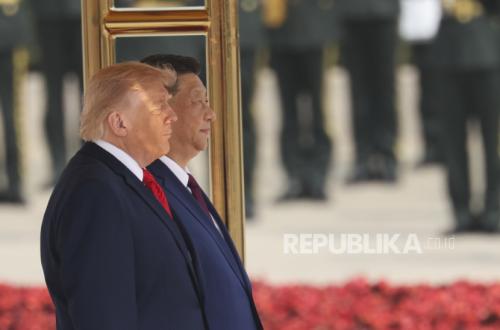
The visit of President Donald Trump to Beijing on 13-15 May 2026 does not seem to be intended to produce a new “grand bargain” between the United States and China. From the outset, expectations for the summit were relatively low. The Economist magazine even called it a summit of suspicion, a meeting amid growing mutual distrust between the world’s two largest powers.
However, that is precisely the significance of this summit. In an increasingly unstable global situation, as marked by the ongoing war in Ukraine, the escalating Iranian conflict, global economic fragmentation, and increasingly sharp technological rivalry, Washington and Beijing seem to realize that their relationship is too important and too dangerous to be left without direct communication at the highest level.
Therefore, even though it did not produce major breakthroughs, the Trump-Xi summit so far appears to have been quite successful in one important thing: keeping the strategic rivalry between the two countries under control. The world today seems more afraid of the escalation of US-China relations to a worse direction than hoping for the birth of a new friendship between the two countries.
From the atmosphere and symbolism side, Beijing gave Trump a very grand welcome. A full state ceremony, official banquet, and symbolic visit to the Temple of Heaven showed that China wants to present itself as a major power that is confident, stable, and open to dialogue.
The official Chinese media consistently used language such as “cooperation,” “stability,” and “strategically stable relationship.” Xi Jinping even asserted that China and the United States “must be partners, not rivals.” In Beijing’s view, the image of stability appears to be an important part of China’s diplomatic message to the world, especially when many other regions are experiencing conflict and uncertainty.
However, behind the warm atmosphere, the strategic reality remains tough. Taiwan remains the most sensitive issue in the relationship between the two countries. Xi openly warned that mishandling Taiwan could lead the two countries towards conflict. At the same time, Washington continues to maintain various technology restrictions on China, including in the fields of semiconductors and artificial intelligence.
In other words, the current US-China relationship does not seem to be moving towards a new friendship, but towards something more realistic: strategic rivalry that is managed to prevent it from getting out of control. Many Western analysts see that both sides are now increasingly understanding the risks of escalation that goes too far.
The economic interdependence between the United States and China is no longer viewed solely as a source of stability, as in the era of optimism about globalization. Instead, economic dependence is increasingly seen as a potential strategic vulnerability that can be used as a tool for political or economic pressure.
Therefore, both Washington and Beijing are now trying to reduce dependence in sectors that are considered vital, ranging from semiconductors, artificial intelligence, rare earths, to strategic supply chains. In such a context, the Trump-Xi summit is more appropriately understood as an effort to manage rivalry so that it does not turn into an open confrontation, rather than an effort to reconcile the relationship between the two countries.
Interestingly, China’s bargaining position in this summit seems not weak. The Iranian conflict and tensions in the Strait of Hormuz have made global energy stability a major issue again. In that context, Beijing understands that Washington also needs China’s cooperation, at least to help maintain global economic stability.
In addition, China currently holds an important position in rare earths, supply chains, and various strategic technology sectors. Many Western analysts are even starting to see that the US-China rivalry has now gone far beyond a mere trade war. The competition between the two countries now includes technology, AI, strategic minerals, maritime security, space, and global geopolitical influence.
However, interestingly, amid this rivalry, the two sides are likely to meet more and more often. Trump has reportedly invited Xi Jinping to make a return visit to the White House in September 2026. In addition, the two are also expected to meet again at the APEC Summit in Shenzhen in November 2026 and the G-20 Summit in Miami in December 2026.
This series of meetings shows one important reality: the current US-China relationship may be full of suspicion, but both sides seem to be aware that high-level communication is still needed to prevent rivalry from turning into an open crisis. The many summits do not mean that the relationship between the two has improved fundamentally. On the contrary, it can be read as follows: their rivalry is now too big and too dangerous to be left without a diplomatic “safety net.”
For the world, especially middle-sized countries like Indonesia, this development is important to watch. Because the world does not seem to be moving towards a “new Cold War” in the classic sense, but towards an era of long-term strategic competition that is still marked by economic interdependence.
In such a situation, the challenge for many countries is not to choose one side, but to maintain their own strategic room for maneuver. Because both Washington and Beijing are now increasingly seeing international relations not only as a matter of cooperation, but also as a matter of influence, resilience, and balance of power.