
WWII-era bomb explodes in Biak, revealing wartime history
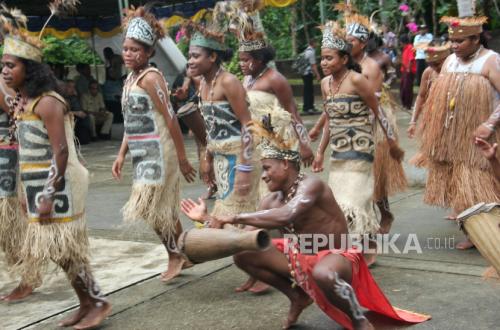
An explosion on Biak Numfor island in Papua that killed five civilians last Sunday is believed to have been caused by a World War II-era bomb. How did this Pacific island chain come to harbour such wartime remnants? Republika visited Biak Island some time ago to investigate this history. There, I met Didimus Nowar (80), one of the few surviving eyewitnesses of the 1940s conflict. He is a local cultural figure who composes wor lyrics, a traditional form of vocal art. Tete Didi recounted how he vividly remembers the time when ‘amyas ampero’ — meaning ‘blazing fire’ — engulfed the entire island. ‘War everywhere. East, north, west,’ said Tete Didi, wearing thick glasses and with intact teeth stained red from chewing betel nut. Tete Didi also recalls the ‘myumbo dare’ — killings — he witnessed. Some were carried out with rifles, others with swords. Journeys have unexpected ways of bringing people together. Unplanned, I encountered Tete Didi and his wor singing troupe right in front of the World War II Memorial Monument in Parai, Biak Island, in late 2015. The Parai Monument was my first stop to trace WWII’s legacy on Biak. Officially inaugurated in 1994, it is a complex the size of half a football pitch, half-covered by a shell-shaped structure. Beneath the shell-like roof sit three sets of concrete tables and seats, while dozens of small cube and cylinder-shaped monuments stand on the open ground outside. Japanese forces first landed in Parai as part of their campaign to conquer the Indonesian archipelago in early 1942. Biak Island lies at the northern tip of Cendrawasih Bay, directly facing the Pacific Ocean — a strategic reason for its occupation, given its current population of around 150,000. According to Biak’s Tourism and Culture Head, Andries Kafiar, the Japanese arrival coincided with the Koreri festival, a local celebration of the arrival of a mythical ruler. The Japanese mistook the festival for resistance, sparking conflict. Outgunned, Biak’s local population was forced to retreat into the forests. In May 1944, US forces led by General Douglas MacArthur arrived in Biak. One of the fiercest battles between Japanese troops and the US Navy for control of the Pacific island chain occurred at the monument site. Japanese soldiers attempting to hold the fort at the monument location were overwhelmed, later fleeing through a tunnel now overgrown with vegetation behind the monument. Japanese caves…