
WWF sees Indonesia's domestic market as strategic for sustainable palm oil
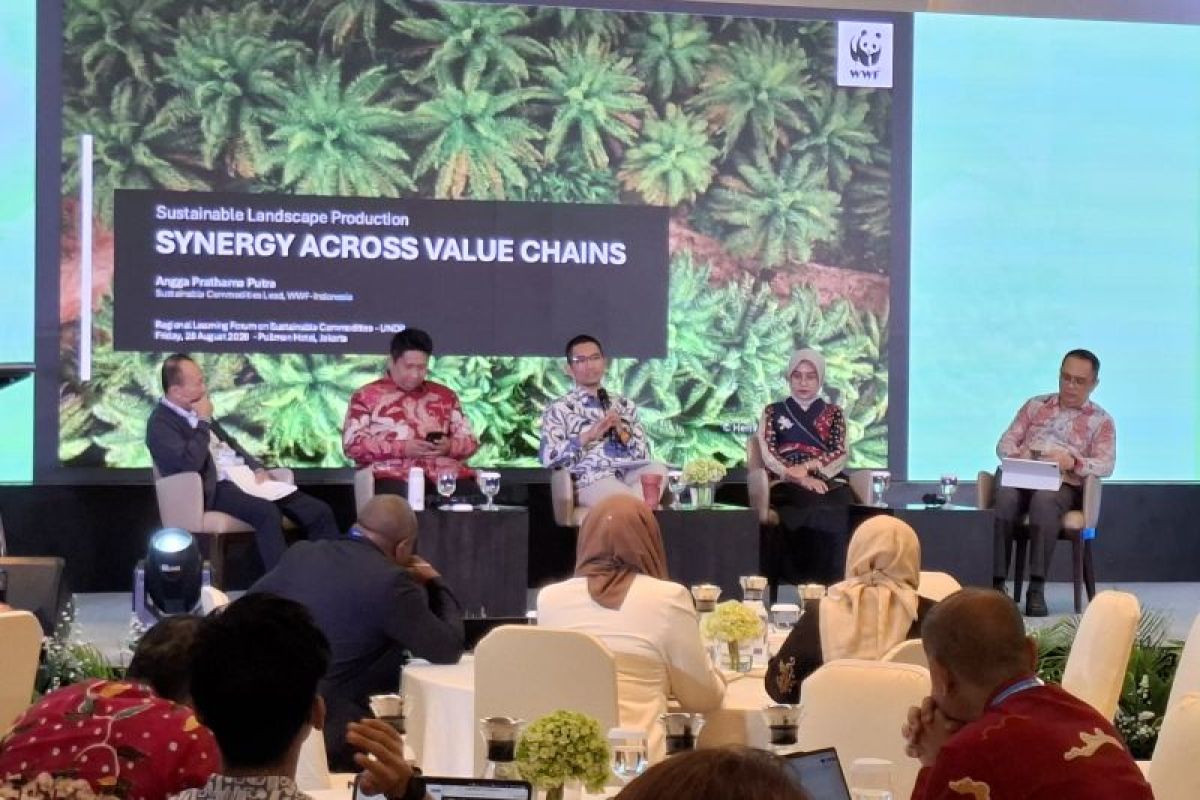
The conservation organisation World Wide Fund for Nature (WWF) Indonesia assesses that the large domestic palm oil market can become a lever for demand for sustainable palm oil products in Indonesia.
Sustainable Commodities Lead WWF Indonesia Angga Prathama Putra said strengthening the domestic market is one part of the market transformation strategy, alongside strengthening producers on the upstream side and developing the global market.
“The domestic market is also important,” Angga said at the Regional Learning Forum on Sustainable Commodities in Jakarta, Friday.
WWF data places Indonesia as the world’s largest producer and consumer of palm oil. WWF also includes developing the domestic market for sustainable commodity products as one of the directions for strengthening sustainability.
The size of the market base is visible from domestic consumption. Data from the Indonesian Palm Oil Association (Gapki) shows domestic consumption during January–June 2026 reached 12.99 million tonnes, up 5.48 percent compared with the same period in 2025 of 12.27 million tonnes.
In June 2026 alone, domestic consumption reached 2.20 million tonnes. Biodiesel was the largest user with 1.13 million tonnes, followed by the food sector at 878 thousand tonnes and oleochemicals at 192 thousand tonnes.
The role of the domestic market is also growing along with the implementation of the B50 biodiesel mandate since 1 July 2026.
The Ministry of Energy and Mineral Resources (ESDM) said the programme increases absorption of crude palm oil (CPO) while strengthening the use of domestic resources for energy security.
Angga said WWF’s market transformation strategy does not stop at home. India, China, and Japan are also markets to be developed, while strengthening on the upstream side is carried out so that producers, including smallholders, are increasingly ready to meet market needs.
According to WWF, the large domestic consumption provides room to expand the application of sustainability principles among companies, commodity users, and the Indonesian retail sector.
A WWF Indonesia study with Accenture released in May 2026 shows the retail sector and commodity users in Indonesia have growing opportunities to integrate sustainability principles into supply chains, including for palm oil commodities.
The study serves as a foundation for the organisation to strengthen private sector engagement, multi-stakeholder collaboration, and accelerate the adoption of sustainable commodity practices in the domestic market.
However, Angga stressed that market development must go hand in hand with supply chain readiness and upstream producers.
WWF notes that sustainable production challenges include incomplete land registration, low smallholder productivity, limited financing, weak traceability, and limited digital systems.
“Supply chain transparency is the key word for market transformation,” Angga said.
WWF’s presentation also places traceability and sustainable raw material sourcing, credible certification, incentives for smallholders to offset certification costs, conservation financing, and domestic market development within a single framework for strengthening sustainable commodities.
In April 2026, the Coordinating Ministry for Food and WWF Indonesia also collaborated on palm oil governance transformation that emphasises the application of good agricultural practices and sustainability principles, including strengthening assistance for independent smallholders.
Angga assessed that the transformation cannot be carried out by one party because it requires the involvement of smallholders, the government, businesses, financial institutions, and other stakeholders.
From the government side, the Coordinating Ministry for Food places inclusive, transparent, and accountable governance strengthening as an important part of maintaining palm oil competitiveness while ensuring smallholder welfare and national food security.
The government, among other things, focuses the transformation on optimising existing land, strengthening independent smallholders, and applying sustainability standards.
The Coordinating Ministry for Food notes Indonesia accounts for around 58 percent of global palm oil production with a volume of 46–51.6 million tonnes of CPO in 2024–2025.
Source: jawawa.id (https://jawawa.id/newsitem/wwf-sees-indonesias-domestic-market-as-strategic-for-sustainable-palm-oil-1787918080)
Originally published by Antara (Indonesian) (https://www.antaranews.com/berita/5715588/wwf-nilai-pasar-domestik-ri-strategis-bagi-sawit-berkelanjutan), translated from Indonesian