
WWF: ISPO can be strengthened to support EUDR compliance
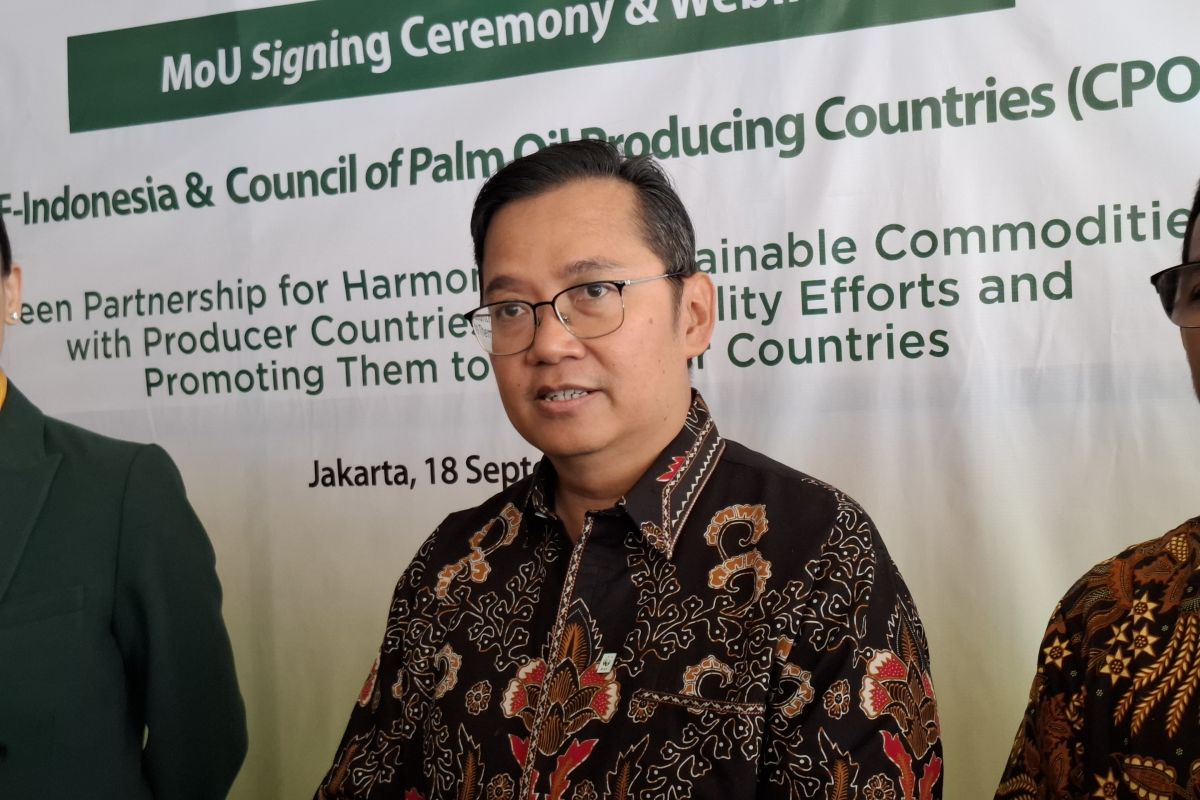
Jakarta (ANTARA) - The conservation organisation WWF-Indonesia believes that the Indonesian Sustainable Palm Oil (ISLE) certification system (ISPO) can be strengthened, particularly regarding deforestation-free aspects, to support compliance with the European Union Deforestation Regulation (EUDR).
CEO of WWF-Indonesia, Aditya Bayunanda, stated that this assessment is one of the key directions for cooperation between WWF-Indonesia and the Council of Palm Oil Producing Countries (CPOPC) to bridge the gap between global market sustainability demands and the conditions in producing countries.
“In the context of Indonesia with ISPO, it is not actually far-fetched to ensure ISPO can be used for EUDR compliance. This means ensuring the deforestation-free aspect becomes part of the standard,” said Aditya in Jakarta on Friday.
WWF-Indonesia and CPOPC signed a memorandum of understanding on Friday regarding a knowledge partnership for sustainable commodities.
According to Aditya, the cooperation is not aimed at creating a new standard or system, but rather at strengthening existing standards. The scope of the cooperation includes strengthening global acceptance of sustainable palm oil, implementing sustainability throughout the supply chain, multi-stakeholder dialogue, increasing understanding of the EUDR, and enhancing the capacity of smallholders.
Aditya assessed that meeting EUDR requirements is possible for most plantations in Indonesia. However, government support remains essential to ensure smallholders are not left behind in meeting requirements and continue to have market access.
“At the very least, in the Indonesian context, EUDR compliance is possible for most plantations. With government efforts, smallholders will not be left behind, ensuring they have equal opportunities and access to that market,” he said.
As part of the preparations for the EUDR, the Ministry of Trade previously prepared a pilot project with an exporter to build a model for meeting these regulations for Indonesian commodities. This model is designed with reference to European Union requirements, including commodity traceability aspects.
The government is also developing the Indonesian Sustainable Palm Oil Information System (SI-ISPO) to integrate the certification process and product traceability. The system is designed to link certification data with geolocation information, transaction types and volumes, and information required by buyers or importers, while integrating data from various ministries and agencies.
The EUDR covers seven commodities, including palm oil and several of its derivatives. The regulation requires products within its scope to be deforestation-free and produced in accordance with the laws of the country of origin.
Generally, the EUDR will begin implementation for large and medium-sized operators on 30 December 2026, while micro and small operators will follow on 30 June 2027. Micro and small operators previously covered by the EU Timber Regulation will begin implementation on 30 December 2026.
In its implementation, certification and third-party verification schemes can be used as supporting information in the risk assessment process. However, certification does not replace the responsibility of operators to conduct due diligence based on the EUDR.
CPOPC Secretary General Izzana Salleh stated that national sustainable certification systems, including ISPO, reflect the efforts of producing countries to strengthen sustainable practices through a structured and increasingly comprehensive approach. According to Izzana, ISPO certification already covers more than 7 million hectares.
Nevertheless, further strengthening is needed to ensure smallholders have the resources, capacity, and opportunities to participate fully in the sustainable supply chain. “Sustainable palm oil cannot be achieved without smallholders,” said Izzana.
She noted that smallholders manage approximately 41 per cent of Indonesia’s palm oil area. Data from the Ministry of Agriculture shows that by 2025, the national palm oil plantation area will reach approximately 16.83 million hectares, with 6.93 million hectares being smallholder plantations.
Meanwhile, data from the National Standardization Agency (BSN) presented by the Coordinating Ministry for Economic Affairs noted that as of June 2026, ISPO certificates have been issued to 1,053 business entities, covering 7.52 million hectares. Of these, 881 certificates are still valid.
Specifically for the smallholder category, ISPO certificates have been issued to 144 business entities, covering 355,122.33 hectares. From that number, 114 certificates are still valid, covering 283,135.56 hectares.
Izzana stated that the cooperation between CPOPC and WWF-Indonesia is aimed at increasing understanding of the EUDR from the policy level to field implementation and strengthening smallholder capacity. She added that the sustainability approach must remain credible from an environmental perspective, while being inclusive, economically viable, and practically applicable for producers, especially smallholders.