
WWF-Indonesia Promotes Landscape-Based Finance for Sustainable Plantations
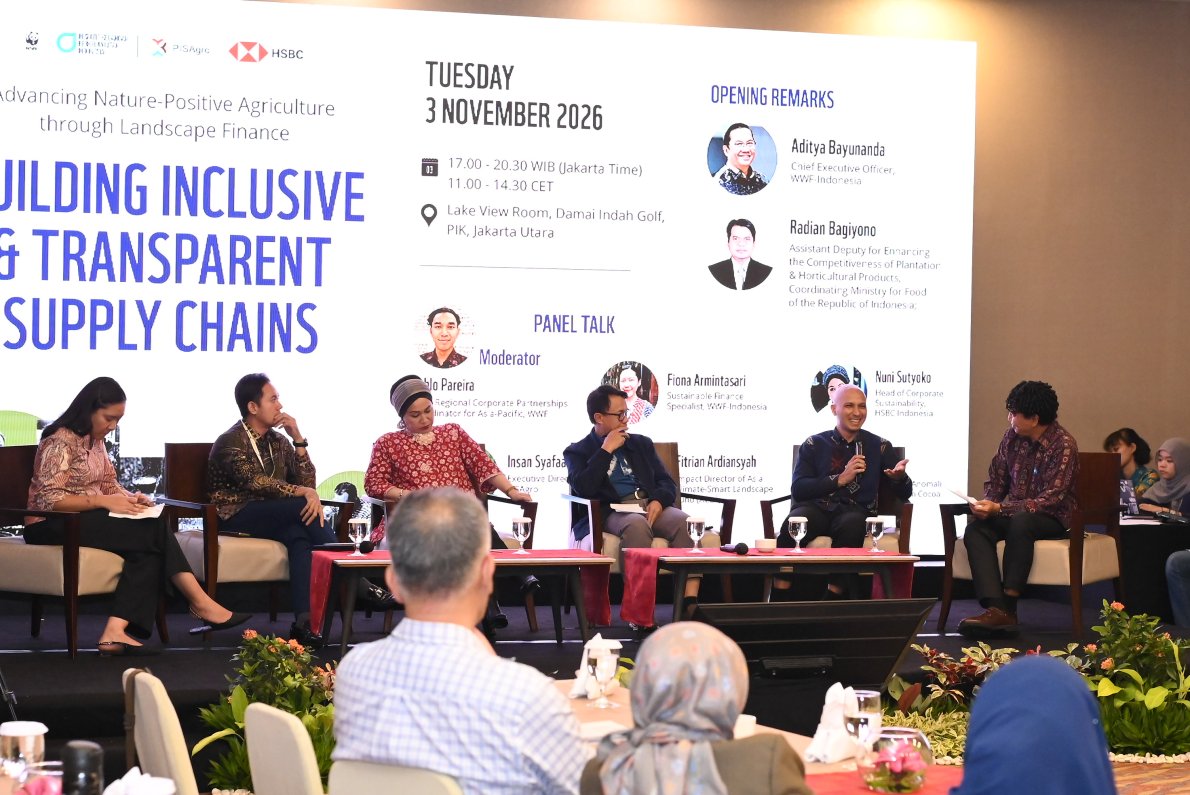
WWF-Indonesia is promoting a Landscape Finance Approach to increase plantation productivity while protecting forests, water resources and biodiversity.
The approach is considered to require collaboration among the government, financial institutions, businesses, farmers and civil society organisations, so that investment in the plantation sector does not drive land expansion that puts pressure on natural ecosystems.
WWF-Indonesia chief executive Aditya Bayunanda said agricultural productivity should be improved by optimising land already in use, rather than expanding plantations into forests and natural ecosystems.
“Forests, water resources, biodiversity and wildlife habitat connectivity are important components of landscape resilience, which supports sustainable production and people’s livelihoods. Investment in sustainable agriculture must therefore go hand in hand with investment in ecosystem protection and restoration,” Aditya said at a multi-stakeholder discussion in Jakarta on Tuesday (3 November 2026).
The discussion, entitled “Advancing Nature-Positive Agriculture through Landscape Finance: Building Inclusive and Transparent Supply Chains”, was organised by WWF-Indonesia in partnership with the Indonesia Sustainable Finance Initiative (IKBI) and the Partnership for Indonesia’s Sustainable Agriculture (PISAgro).
Aditya explained that landscape-based finance could combine several funding sources, including commercial investment, low-interest financing, public funding and blended finance. The mix would be tailored to the characteristics and needs of each landscape.
Under this approach, investment would be directed not only towards higher productivity and more efficient supply chains, but also towards sustainable plantation practices, forest conservation, water protection, ecosystem restoration and stronger local livelihoods.
The plantation sector makes a substantial contribution to the economy. WWF-Indonesia data cited at the event show that the plantation subsector contributed more than Rp1,075.29 trillion to gross domestic product in 2025. Coffee, rubber and cocoa are also sources of foreign exchange and support livelihoods in many regions.
However, the sector faces a number of challenges, including pressure on ecosystems, climate change, low farmer productivity and growing market demands for responsible production practices.
WWF-Indonesia also highlighted the limited access that independent smallholders continue to have to capital, technology, advisory support and market information. Yet farmers’ participation is essential to the transition towards nature-positive agriculture.
Landscape-based finance is expected to connect farmers’ needs with the interests of industry, investors and the government. Farmers would not be treated merely as beneficiaries, but would also be involved in decisions on landscape and commodity supply-chain management.
PISAgro executive director Insan Syafaat said changing global market requirements should be addressed through collaboration between the government, businesses and the entire supply chain. Raising productivity without opening up new land is one way to meet market demand while protecting ecosystems.
According to Insan, partnerships from upstream to downstream are needed to strengthen farmers’ capacity, widen access to finance and provide incentives for sustainable production.
He said most PISAgro members had adopted an Inclusive Closed Loop model, which was said to have increased farmer productivity by up to threefold and incomes by up to fivefold. Guaranteed markets from buyers, or offtakers, also provide an incentive for farmers to maintain sustainable production practices.
Insan added that regulations such as the European Union Deforestation Regulation (EUDR), along with sustainability principles, should be implemented through collective efforts so they do not become trade barriers that place a burden on smallholders.
Source: jawawa.id (https://jawawa.id/newsitem/wwf-indonesia-promotes-landscape-based-finance-for-sustainable-plantations-1793814622)
Originally published by ecobiz.asia (https://ecobiz.asia/wwf-indonesia-dorong-pembiayaan-berbasis-lanskap-untuk-perkebunan-berkelanjutan-butuh-kolaborasi/), translated from Indonesian