
Write-In Candidate Proposed as Safety Valve Against Single-Candidate Elections
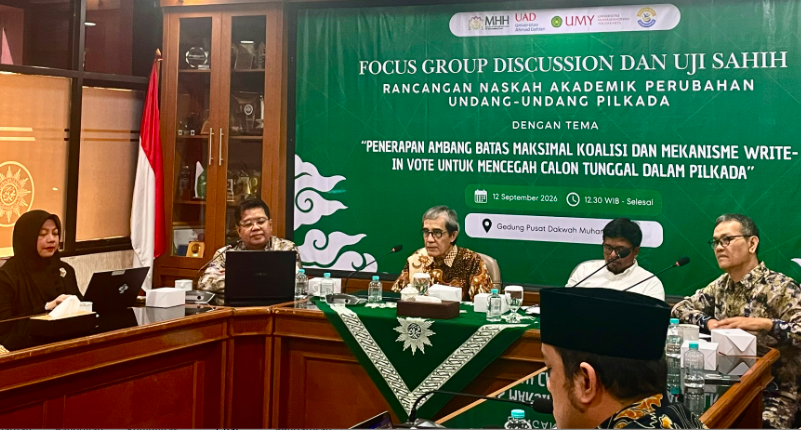
The Central Board (PP) of Muhammadiyah has proposed a ‘write-in candidate’ mechanism to serve as a safety valve in instances where single-candidate elections persist, such as when a candidate pair is disqualified shortly before voting. Under this system, voters would be given the opportunity to write in the name of a candidate who meets specific requirements in a provided column.
Rahmat Muhajir Nugroho, Vice Chairman of the Legal and Human Rights Council (MHH) of PP Muhammadiyah, stated that this mechanism could be utilised in specific circumstances, particularly when a designated candidate pair is disqualified before the election, leaving only one remaining candidate.
“If a disqualification occurs near the election, resulting in a single candidate again, the public should be permitted to write in the name of a candidate pair in the blank column,” said Rahmat. Therefore, the write-in candidate is offered as a mechanism to present alternative candidates without immediately necessitating a re-election. Rahmat explained that this could utilise a ‘registered candidate’ model, where names are drawn from previously registered candidates who meet certain criteria. “This write-in candidate mechanism can use the registered candidate model as a final safeguard to prevent single-candidate regional elections,” he emphasised.
Responding to this, KPU Commissioner Idam Holik noted that the idea of write-in voting or write/in candidates is worthy of study within the reform of the regional election system. He suggested that such a mechanism could serve as an option when the nomination design leads to a situation where only one candidate remains.
“I do not yet know if there will be a judicial review considering the write-in voting method, but the Constitutional Court might consider it. The idea regarding write-in voting is not new,” said Idam. He noted that the presence of single candidates limits the competition of ideas in regional elections. Therefore, a mechanism allowing voters to have alternative candidates should be included in the evaluation of regional election designs. “The Court actually wants to prioritise that regional elections must be competitive, as this relates to the contestation of ideas,” he asserted.
Netgrit Executive Director Hadar Nafis also assessed that write-in voting could serve as an alternative to expand voter choice when available candidates do not reflect public aspirations. However, he warned that its implementation requires serious study, particularly regarding constitutionality and technical voting aspects. “It is one idea. However, the challenges to implement this are significant, and I see that its constitutionality could also be questioned,” expressed Hadund.
Hadar noted that write-in voting allows voters to do more than just accept candidates produced by the political party nomination process. However, the mechanism must be carefully designed to avoid creating new issues in the voting and counting process.
At the same time, Deputy Secretary-General of the Gerindra Party, Andi R. Wijaya, viewed write-in voting as an interesting subject for study as an instrument to expand voter choice. He even mentioned that the mechanism could be considered alongside other innovations in the voting system.
“I might prefer to push for e-voting, but if that variable is included, write-in is also good,” said Andi. He believed that the choice regarding the write-in mechanism must be directed towards ensuring that democracy does not stop at the voting procedure, but also provides space for meaningful competition and public participation.
Meanwhile, University of Indonesia Election Law Expert Titi Anggraini does not view the write-in vote as the primary solution, but opens the door for the mechanism as a corrective instrument. According to her, write-in can play a role when candidates pushed by party elites do not align with the aspirations of cadres or voters. “If the candidate pushed by party elites does not align with members and cadres, then the write-in vote can play a role,” said Titi.
Titi also proposed that the ‘none of the above’ mechanism be studied as an alternative. She believes this could serve as an instrument to clearly measure voter rejection, even if it does not always lead to a re-election.
“I agree more that ‘none of the above’—where there is no choice among the available options—could be an instrument, even though the consequence of ‘none of the above’ does not necessarily have to result in a re-election if there is more than one candidate,” she said. Titi noted that voter rejection must be distinguishable from apathy or failure to vote. With a clearer mechanism, the public’s rejection of all candidates can be measured as a political expression. “Truly, political expression becomes measurable and can serve as a performance driver for parties to not abandon their voters,” she concluded.