
‘Worried’ and ‘confused’: Sarawakians grapple with worst haze since 2019
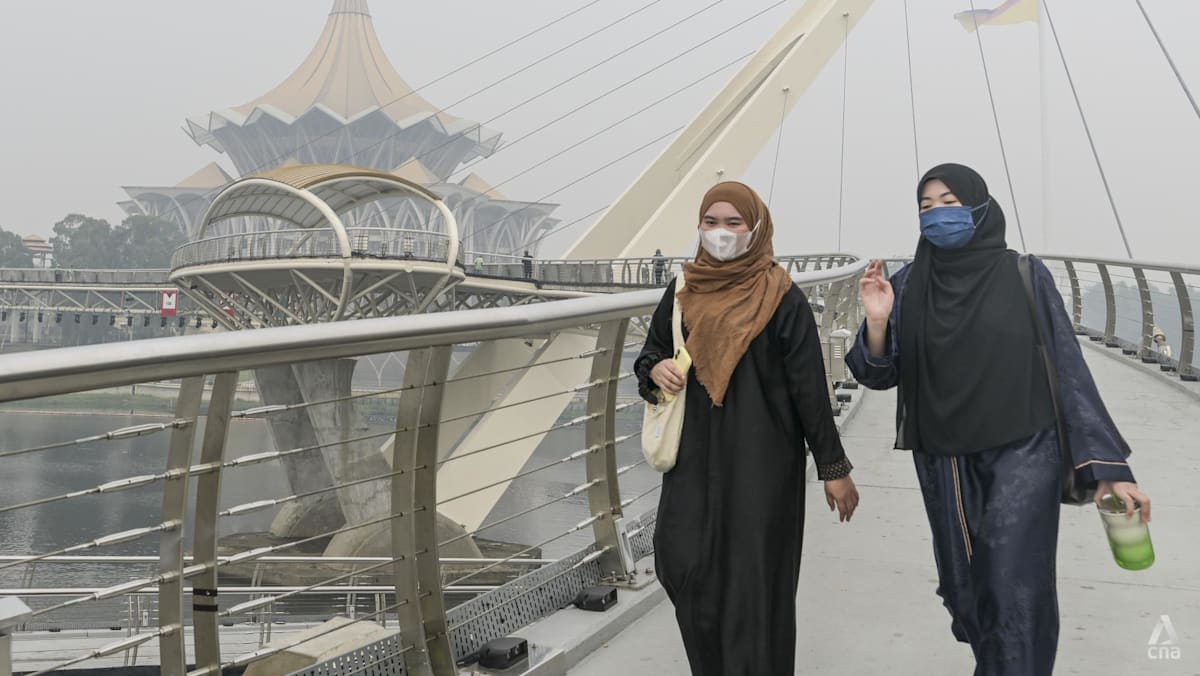
‘Worried’ and ‘confused’: Sarawakians grapple with worst haze since 2019
Among Malaysian states, Sarawak has been the worst hit by transboundary haze linked to forest fires in neighbouring Indonesia. CNA speaks to locals and businesses in the Borneo state to find out how they are coping.
KUCHING: For 39-year-old Azie Nurazrin Aziz, who is in her third trimester, the haze blanketing Sarawak has made her daily life feel “restricted”.
The Kuching resident, who has asthma and whose doctors have classified her pregnancy as “high-risk”, attends as many as three clinic and hospital appointments a week while also running her own restaurant.
But with the deteriorating air quality, she now carefully plans her errands to limit the amount of time she spends outdoors.
“I have to divide my errands so I am not too exposed outside, it’s suffocating,” Azie told CNA.
“I am worried, I am anxious, what if I get an asthma attack? It’s quite dangerous for me, I have to be really careful.”
Among Malaysian states, Sarawak has been the worst hit by transboundary haze linked to forest fires in neighbouring Indonesia.
Sarawak, alongside Sabah, shares a land border with Indonesia on Borneo Island.
Parts of Sarawak have recorded deteriorating air quality over the past week, with Serian becoming the first district to declare a haze-related state of emergency this year on Friday (Sep 4), after its Air Pollutant Index (API) exceeded 500.
Under Malaysia’s API scale, readings above 400 are classified as “very hazardous”. Readings up to 50 are classified as good, 51 to 100 as moderate, 101 to 200 as unhealthy, 201 to 300 as very unhealthy, and 301 to 400 as hazardous.
The Malaysia Meteorological Department (MetMalaysia) told CNA that this is Sarawak’s “worst” haze episode since 2019. The API had then recorded a reading of 405.
The deteriorating air quality has disrupted daily life across the state. Outdoor events, including carnivals, community runs and sporting activities, have been cancelled, while poor visibility has disrupted some flights.
Authorities also announced on Friday that 647 schools across 12 districts, including Serian and the state capital Kuching, will close for five days from Sep 7 to Sep 11.
“Based on our monitoring throughout the school holiday this week, the (haze) situation has clearly not changed much,” said Sarawak’s education director Omar Mahli, as quoted by news outlet Malay Mail.
A total of 563 primary and 84 secondary schools are affected.
Meanwhile, businesses say their takings have been affected as residents spend less time outdoors, while clinics have reported a sharp increase in patients with respiratory symptoms. Masks are also sold out at many pharmacies.
Some residents have compared the disruption to the COVID-19 pandemic, as they once again adjust their routines, limit outdoor activities and grapple with uncertainty over how long the situation could last.
STATE OF EMERGENCY IN SERIAN
In Serian, where air quality has been among the worst in the country, locals are facing a new reality of living under a haze-related state of emergency, though some told CNA that they remain unclear of the rules.
“Many of us are confused. We have still not been properly told what can and cannot be done during this emergency,” 26-year-old Yasmina R.C Holland told CNA on Friday.
Serian’s API breached the 500 mark at 9am on Friday, with a reading of 510, before climbing to 515 by 5pm as the haze worsened.
Conditions improved by Saturday morning, when the API fell to 390, though air quality remained hazardous. As of 1pm, Serian’s API reading was 287.
Following the emergency declaration announced by Malaysia’s Prime Minister’s Office, Sarawak Deputy Premier Douglas Uggah Embas said that the emergency area would be confined to a 20km radius in Serian as identified by the environment department and would not affect other divisions, Dayak Daily reported.
This would mean that government and private offices and other workplaces within the affected area, including industries, plantations, construction sites and quarries, are required to close while only essential services are allowed to continue operating, Free Malaysia Today reported.
According to The Star, supermarkets, petrol stations, banks and security services are among those that can remain open.
“The emergency is not a lockdown like the movement control order during the COVID-19 pandemic. It is with the intention of keeping the public at home,” Douglas told reporters on Friday.
But on the ground, some Serian residents whom CNA spoke to said there was still confusion over how the restrictions would apply to their daily lives.
For 28-year-old clerk Juliana Nurus Tahir, that includes whether the emergency affects daily commute from Serian to her workplace in Kuching. Serian is located about 60km southeast of Kuching.
“I understand that I still have to travel to my office in Kuching every morning as there is no emergency declared there. I think those who have to work (outside of Serian) will not see much impact,” she told CNA.
Juliana said life in the district appeared unchanged on Friday evening, with residents yet to receive clear instructions on what activities were prohibited.
“We just knew from the news that an emergency was declared and we cannot go out,” she said.
“It is still uncertain whether market traders and roadside vendors for example could continue operating.”
For the mother of two children aged five and two, there is a more immediate concern: protecting them from the hazardous air.
“They have been coughing, they are sensitive so I am scared their asthma will be triggered,” said Juliana, adding that she would ensure that they stay at home.
Another Serian resident, Venissa Ingreade, said the haze had made her fall sick more easily, and the emergency would further restrict her movements.
“Under the current state of emergency, I feel very restricted. I can’t go out for recreational activities or go anywhere,” she said.
For Yasmina, the emergency has a