
World's Strongest Earthquake in Indonesia: Buildings Destroyed in 41 Seconds, 1,117 Killed
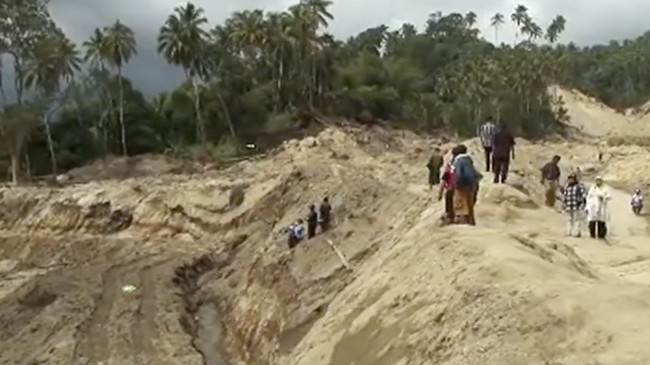
A Mw7.4 earthquake struck Colombia on Monday (10/8/2026), destroying thousands of buildings and killing at least 250 people.
Relevant agencies revealed the earthquake was caused by internal deformation or faulting within the Nazca Plate as it subducts beneath the South American Continental Plate. In technical terms, this event is known as an intra-slab earthquake, which occurs within the body of a subducting plate, rather than at the interface between two plates or in the megathrust zone.
According to Daryono of the Indonesian Disaster Experts Association (IABI), Indonesia has experienced a similar process, namely the Mw7.6 Padang-Pariaman Earthquake of 30 September 2009.
“It appears the 2009 Padang-Pariaman Earthquake remains the strongest intra-slab earthquake in the world, with 1,117 fatalities and 2,180 injuries,” Daryono stated in information obtained by CNBC Indonesia, quoted on Wednesday (12/8/2026).
History records that the Padang-Pariaman Earthquake occurred on 30 September 2009 at 17:16 WIB. According to records from the Padang City Regional Disaster Management Agency (BPBD), the Mw7.6 earthquake shook West Sumatra with an epicentre approximately 50 kilometres northwest of Padang City and a hypocentre around 71 kilometres deep.
In just 41 seconds, most of West Sumatra experienced severe shaking. Buildings unable to withstand the tremors collapsed immediately. This was witnessed first-hand by one of the victims, Anuar.
Speaking to the Tzu Chi Foundation, Anuar recounted that many buildings collapsed during the earthquake, including the tutoring centre attended by his child, Adit. Upon arriving at the location, he saw the building was already in ruins. The ground floor had collapsed, while the second and third floors had sunk downwards in a shapeless condition.
When the evacuation team arrived, the students’ parents and local residents found Adit still conscious. However, his leg was pinned under collapsed building debris and ultimately had to be amputated.
Why Was the Shaking So Strong?
According to Daryono, one factor influencing the earthquake’s occurrence was the downward pull of the plate, or slab pull, as well as stress from plate bending, or bending stress. Changes in conditions within the subducting plate, including mineral dehydration processes, can trigger faulting and the release of large amounts of energy.
In the Padang-Pariaman Earthquake, faulting occurred within the Indo-Australian Oceanic Plate subducting beneath the Eurasian Plate. The earthquake source was at an intermediate depth of approximately 80 to 90 kilometres.
Despite being relatively deep, the characteristics of the dense and rigid oceanic plate rock allowed seismic waves to propagate strongly. As a result, the shaking reaching the surface felt very jarring and produced high ground acceleration.
“From a seismological perspective, the dense, homogeneous and rigid oceanic plate rock serves as a highly efficient conductor of seismic waves, allowing high-frequency waves to propagate to the surface without significant attenuation,” said Daryono.
The impact was then exacerbated by local conditions. Padang City, for example, sits on relatively soft alluvial deposits, which can experience amplification or strengthening of shaking.
Additionally, the earthquake triggered landslides in the hilly areas of Pariaman. The combination of earthquake strength, wave characteristics, soil conditions, and building vulnerability made the impact enormous, even though it did not trigger a tsunami and was not classified as a megathrust event.
Furthermore, Daryono added, the 2009 West Sumatra earthquake disaster was worsened by a series of major earthquake events. On 30 September 2009, a major earthquake occurred around Pariaman with a magnitude of approximately Mw7.6 (BMKG recorded M7.9), at a depth of around 70-80 km.
A day later, on 1 October 2009 at 08:52 WIB, an earthquake of approximately M6.6 occurred around Sungai Penuh at a shallow depth.
“Both events occurred within an interval of less than 24 hours, but had different tectonic sources,” said Daryono.
“The two earthquakes were not merely ‘two earthquakes in relatively close locations’. Tectonically, their sources were different. The Pariaman earthquake occurred at an intermediate depth in a subduction environment, while the Sungai Penuh earthquake was a shallow earthquake related to the Sumatra Fault system,” he explained.
As a result, according to BPBD data, 1,117 people died and 2,180 were injured. Thousands of buildings, roads and other facilities were destroyed in less than one minute.
Source: jawawa.id (https://jawawa.id/newsitem/worlds-strongest-earthquake-in-indonesia-buildings-destroyed-in-41-seconds-1-117-killed-1786514028)
Originally published by CNBC Indonesia (https://www.cnbcindonesia.com/news/20260812093353-4-758489/gempa-terkuat-dunia-di-ri-bangunan-hancur-dalam-41-detik-1117-tewas), translated from Indonesian