
World's Maritime 'Arteries' Blocked by War: Strait of Hormuz Closed and Panama Heating Up
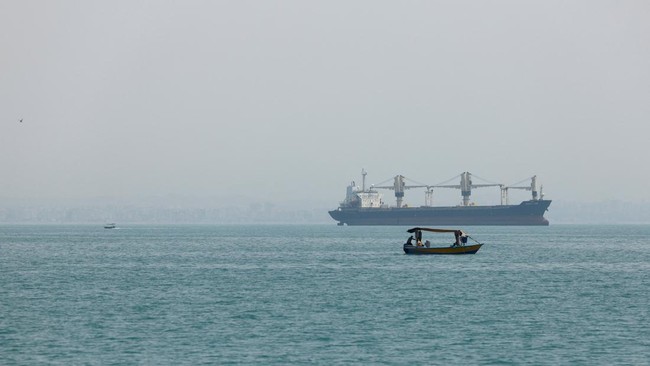
A series of attacks and security threats around the Strait of Hormuz, the Red Sea, the Black Sea, and the Sea of Azov continue to disrupt global commercial shipping routes. Disruptions at these crucial chokepoints have a profound impact on the global economy, given that approximately 80% of international trade volume is transported via sea lanes.
According to reports, the threat of advanced weaponry, such as drones and missiles, has transformed vital maritime corridors into new battlefronts. This situation not only delays cargo deliveries and tightens supplies but also drives up insurance premiums, triggering surges in the prices of energy, food, and consumer goods worldwide.
David Roche, President and Global Strategic Observer at Quantum Strategy, assesses the war in the Black Sea and the Sea of Bogat as the first maritime offensive conducted almost entirely using drones and missiles. The use of relatively inexpensive weapons allows smaller military forces to threaten ships and ports, creating a massive economic burden. Quantum estimates that approximately 25% of Russian wheat exports and 25% to 30% of its oil exports in the Black Sea are potentially at risk. Given that Russia produces more than one-fifth of the world’s traded wheat, these disruptions risk exacerbating the global food price crisis.
Yevgeniya Gaber, Senior Researcher at the Atlantic Council, explained that maritime supply through the Sea of Azov is a vital alternative to the land corridors connecting Russia with Crimea. The Russian closure of the Kerch Strait has essentially crippled a vital maritime corridor for transporting crude oil, wheat, coal, and steel. Gaber added that Ukraine’s success in exploiting Russian maritime and economic vulnerabilities has been one of the most significant blows to military and commercial fleets since World War II.
Similar threats loom over the Strait of Hormuz, where shipowners must make independent decisions based on the risk of attack and crew safety. Daejin Lee, Head of Global Research at Fertistream Freight, emphasised that the Strait of Hormuz, the Red Sea, and Bab el-Mandeb are no longer isolated incidents but have become new battlegrounds in the transition of the world order.
Observers warn that the next geopolitical flashpoint is expected to shift from the Middle East to the Panama Canal. This strategic link between the Pacific and North Atlantic Oceans is currently caught in geopolitical disputes between the US, China, and Panama regarding spheres of influence. Lars Jensen, CEO of Vespucci Maritime, stated, “If you are talking about the next flashpoint, I would not look at the Strait of Hormuz. I would look at the Panama Canal.” Jensen added that potential shipping restrictions due to extreme weather later this year could further exacerbate geopolitical tensions in the Panama Canal due to reduced transit capacity.
Kevin O’Marah, Chief Research Officer at Zero100, explained that vessel traffic through the Strait of Hormuz is currently estimated to be running at only half its normal capacity. As a mitigation measure, global shipping companies are actively rerouting through land pipelines in the Arabian Peninsula, land routes to Turkey, and building up inventory buffers. O’Marah noted that the war in the Middle East is becoming a long-term issue regarding freedom of navigation, leading to planned transport uncertainty and additional costs related to rerouting and surcharges.
Meanwhile, representatives from the insurance brokerage Gallagher confirmed that war risk insurance remains available for vessels passing through, though few shipowners are willing to risk the Strait of Hormuz due to skyrocketing premiums.
Alain Bejjani, a Dubai-based business executive and investor, asserted that the structural effects of maritime warfare are much larger than widely realised. The Gulf region is now flanked by two problematic straits, Hormising and Bab el-Mandeb, forcing businesses to redesign global logistics architecture. “War has migrated from territories to logistics. A strait does not close when a missile flies; it closes when insurers stop providing coverage. The straits will reopen, but the assumption that these routes remain open for free will never return,” Bejjani stated.
Bejjani concluded that this crisis is giving rise to a new architecture involving land corridors, bypass pipelines, and buffer storage near major markets, which requires high costs and up to a decade to implement. While sea routes will remain superior in terms of volume, the shipping sector is predicted to lose its monopoly of trust in the global business world.
Source: jawawa.id (https://jawawa.id/newsitem/worlds-maritime-arteries-blocked-by-war-strait-of-hormuz-closed-and-panama-heating-up-1785513290)
Originally published by CNBC Indonesia (https://www.cnbcindonesia.com/news/20260731141009-4-755482/lautan-nadi-dunia-diblokir-perang-selat-hormuz-tutup-panama-panas), translated from Indonesian