
World's Largest Zero-Emission Autoclave Launched in Morowali, Anchoring Global Green Nickel Hub
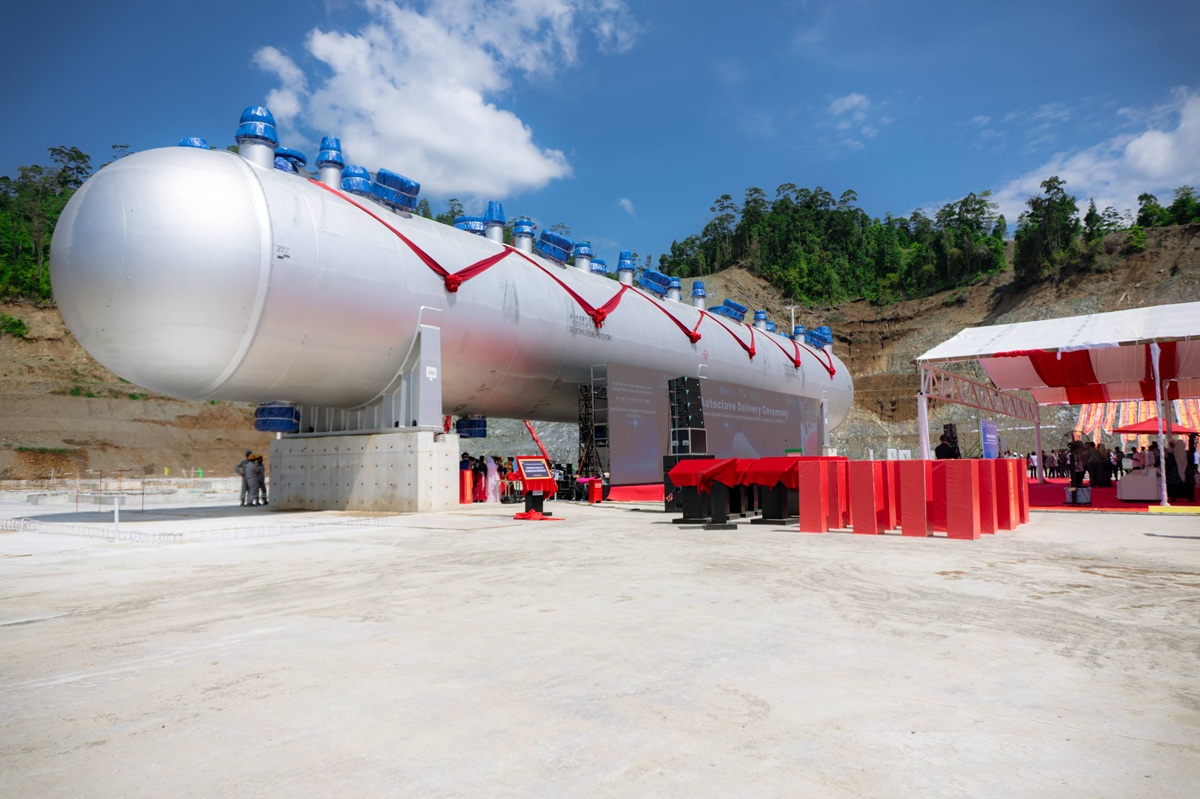
PT Bahodopi Nickel Smelting Indonesia (BNSI) has officially commissioned a High Pressure Acid Leaching (HPAL) reactor with a capacity of 1,268 cubic metres at the International Green Industrial Park (IGIP) in Sambalagi Village, Morowali, Central Sulawesi, on Wednesday (22/7).
The newest and largest autoclave in the world marks a milestone in world-class hydrometallurgy technology and a significant step towards commercial production of this national strategic project, valued at US$1.845 billion.
The BNSI project, part of Indonesia’s National Strategic Projects (PSN), is targeted to have a production capacity of 90,000 tonnes of Mixed Hydroxide Precipitate (MHP) per year.
Once fully operational, the project is projected to generate around US$1.5 billion in export value each year. The HPAL reactor commissioned today is not only the largest in the world, but also employs the latest environmentally friendly technology.
GEM Co., Ltd. CEO and Founder Prof. Kaihua Xu explained that the autoclave achieves the highest nickel and cobalt recovery rates in the world.
“This is the latest environmentally friendly technology, capable of further reducing carbon emission levels. Our aim is to establish a plant with zero carbon emissions,” he said.
One of the most revolutionary breakthroughs of this latest HPAL technology lies in its ability to process laterite nickel ore with very low grades (low-grade nickel ore).
This flexibility allows the processing of ore material previously considered to have no economic value.
“Another innovation is the plant’s ability to process nickel ore at lower grades, from the previous 1.0–1.1% down to 0.6–0.4%. This is considered capable of extending the lifespan of Indonesia’s nickel reserves and reducing the impact of mining,” Prof. Kaihua explained.
The ability to process such ultra-low grades provides a remarkable strategic advantage for Indonesia. Low-grade nickel ore, previously discarded as mining waste or overburden, now carries high economic value.
This not only saves on mining operating costs, but significantly extends the usable life of Indonesia’s nickel reserves for decades to come.
Regarding the operational timeline, Kaihua stressed that each of these massive autoclave units is designed to produce 30,000 tonnes of nickel metal per year. All project construction will be completed by the end of this year, followed by full operations in the first quarter of next year.
Kaihua also praised Indonesia’s investment climate, which he considers highly conducive and investor-friendly. For him, the alliance between South Korea, Indonesia and China at Sambalagi represents one of the world’s most ideal models of green investment cooperation.
The comprehensively designed industrial estate is projected to absorb up to 88,000 workers once the entire area is fully operational.
Minister of Investment and Downstreaming/Head of BKPM Rosan Perkasa Roeslani, who attended the commissioning, stated that the IGIP estate has been designed with a net zero emission commitment, using solar power and solar panels to protect the environment.
“Including the nickel downstreaming model in Indonesia, which will not stop here. The value chain we are building is very long,” Rosan said.
He affirmed that the presence of this project marks the starting point of the government’s commitment to ensuring that incoming investment is not only on time, but also delivers tangible and holistic positive impacts.
Development is not merely about corporate profitability or macroeconomic indicators, but prioritises direct benefits for local communities.
What sets the Sambalagi industrial estate apart is its inclusive development approach. Before plant operations began, various social facilities and public amenities for local residents had already been completed and were being directly used by surrounding communities.
These facilities include a sports arena, a mosque, a modern market and a football pitch. “This is what distinguishes this industrial estate from others. The social approach was carried out from the very beginning. This aligns with the government’s vision of achieving the Net Zero Emission (NZE) target by 2060,” he said.
“Indeed, in this estate, including at PT Bahodopi, there is a strong commitment towards zero, neutral emissions with positive and sustainable impacts for future generations,” Rosan continued.
The government also hopes that the integrated estate development model combining emission solutions, environmental conservation and social integration, as seen in Morowali, can be widely replicated across Special Economic Zones (KEK) and other industrial estates throughout Indonesia.
Central Sulawesi Deputy Governor Reny Arniwaty Lamadjido welcomed the presence of the estate. According to her, the humane approach adopted by the developer — embracing surrounding communities and providing places of worship and sports facilities — sets an exemplary standard for ideal industrial estate development.
The Central Sulawesi Provincial Government is now focusing on upskilling local human resources through vocational training and professional certification programmes so that local workers can be fully absorbed into the projected demand for thousands of workers at the estate.
Regarding environmental management, the Deputy Governor highlighted the presence of artificial water retention lakes within the estate, designed to be clear and visible along the main road. These lakes serve as transparent visual proof that the facility’s wastewater treatment is managed cleanly and in an environmentally friendly manner without polluting the surrounding ecosystem.
“High-value green industries such as the BNSI project are believed to be the main driver of economic progress in Central Sulawesi and Morowali towards sustainable modern regions,” she said.
Full support has also come from the Morowali Regency Government. Morowali Regent Iksan Baharudin Abdul Rauf said industry in his region is now heading towards low-emission green technology.
“There are a great many industries in Morowali Regency; today investors are truly heading in an environmental, truly green direction. We very much welcome this, because a region will not progress without industry,” he affirmed.
The presence of the IGIP estate has not only affected upstream industries, but has also been directly felt by surrounding residents.
One of them is Dewi Rahmawati, a resident of Sambalagi Village, who said she has experienced tangible benefits. “Previously I relied on fishing and farming with uncertain income. Since the IGIP estate arrived, I have secured a permanent job at a village-owned construction company and now have a steady income,” she said.
Local businesses have also felt a fresh breeze. Chairman of the Morowali Regency Chamber of Commerce and Industry (KADIN), Tasrun, said the IGIP approach has opened up wider opportunities for local entrepreneurs.
“The presence of IGIP provides greater partnership opportunities for local businesses, particularly in the logistics, transport and construction sectors. A model like this has a direct impact on community economic growth,” he explained.
The project, an alliance between South Korea (Ecopro), Indonesia (PT Vale) and China (GEM), is targeted for completion by the end of 2026 and to begin operations in the first quarter of 2027.
For PT Vale Indonesia, the Sambalagi HPAL Plant is considered to have the highest productivity and efficiency, with the lowest capital intensity ratio among similar facilities ever built in Indonesia.
PT Vale Indonesia Tbk President Director & CEO Bernardus Irmanto explained how the partnership maintains competitiveness amid global nickel price fluctuations.
“This cost structure advantage provides the project with extraordinary economic resilience in facing commodity market turbulence,” he said.
Beyond corporate economics, PT Vale Indonesia’s position as holder of a Special Mining Business Licence (IUPK) provides a very substantial direct contribution scheme for the region.
Source: jawawa.id (https://jawawa.id/newsitem/worlds-largest-zero-emission-autoclave-launched-in-morowali-anchoring-global-green-nickel-hub-1784778654)
Originally published by Media Indonesia (https://mediaindonesia.com/nusantara/913844/autoclaves-raksasa-nol-emisi-hadir-di-morowali-jadi-poros-hilirisasi-hijau-dunia), translated from Indonesian