
World’s 30 Biggest Banks: US Lags Far Behind China
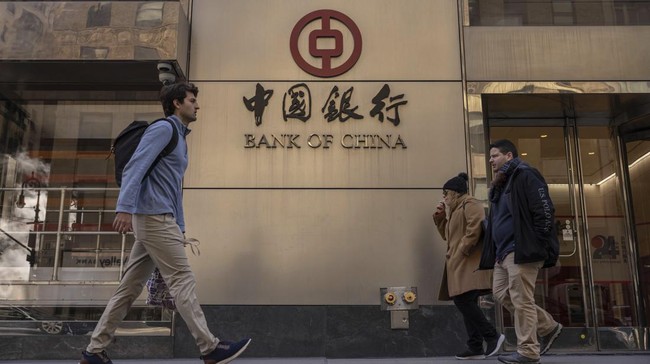
Jakarta, CNBC Indonesia – China is not merely a major player in global banking; it dominates the top of the hierarchy.
The world’s four largest banks in 2026 are all Chinese, while JPMorgan Chase, the biggest bank outside China, ranks fifth. This dominance underlines the scale of China’s banking system compared with US financial giants.
The ranking was published by S&P Global Market Intelligence in April 2026 and is based primarily on year-end 2025 financial reports. Banks are ranked by total assets, including loans, investments and cash. Here is the list of the world’s largest banks:
Industrial and Commercial Bank of China (ICBC) ranks first, with assets of US$7.65 trillion, or around Rp137.78 quadrillion (US$1 = Rp18,010).
That gives ICBC assets about 73% greater than JPMorgan Chase, which holds US$4.42 trillion.
Three other Chinese banks complete the top four: Agricultural Bank of China, with US$6.97 trillion in assets; China Construction Bank, with US$6.52 trillion; and Bank of China, with US$5.48 trillion.
Together, the four banks manage more than US$26 trillion in assets, almost twice the combined assets of the five largest US banks: JPMorgan Chase, Bank of America, Citigroup, Wells Fargo and Goldman Sachs.
Outside China and the US, BNP Paribas is Europe’s largest bank, with US$3.28 trillion in assets, ahead of HSBC, with US$3.21 trillion.
BNP Paribas rose to the top of the European rankings after a series of acquisitions, including AXA Investment Managers. HSBC, meanwhile, has sold several businesses to focus on Asia and the Middle East.
ICBC’s scale is also reflected in its customer base. At the end of 2025, the bank served 782 million individual customers—more than twice the population of the US—as well as over 14.7 million corporate customers.
How China Built Banking Giants
China’s financial system channels large amounts of household savings and company funds into banks. These deposits finance lending, making banks one of the main pillars of economic financing.
The government also influences how credit is allocated. When lending to the private sector weakens, state-owned banks expand financing for technology, green investment and other strategic industries.
In March 2026, Beijing announced plans to issue 300 billion yuan in special government bonds to strengthen the capital of ICBC and Agricultural Bank of China, which has US$6.97 trillion in assets.
The additional capital is intended to bolster financial buffers and support lending, even as low interest rates weigh on banks’ profitability.
US Relies on Capital Markets
The US takes a different approach to business financing. In 2025, securities such as bonds accounted for 77.5% of outstanding debt held by non-financial companies.
By issuing shares and bonds, companies can raise funds directly from investors rather than relying solely on bank loans.
This model creates significant income opportunities for Wall Street banks through share and bond issuance, arranging acquisitions and providing services to investors. JPMorgan led the global investment banking fee market in 2025, with an 8.4% share.
That year, JPMorgan posted net profit of US$57 billion and generated US$87 billion in non-interest revenue from activities such as trading, investment management and other services.
The comparison shows that Chinese banks dominate global rankings by assets, while US banks have more diversified sources of income.
Source: jawawa.id (https://jawawa.id/newsitem/worlds-30-biggest-banks-us-lags-far-behind-china-1792209017)
Originally published by CNBC Indonesia (https://www.cnbcindonesia.com/research/20261017075738-128-777057/30-besar-bank-terbesar-di-dunia-amerika-kalah-telak-dari-china), translated from Indonesian