
World Press Freedom Day: Women's Journalists Forum highlights threats to journalists
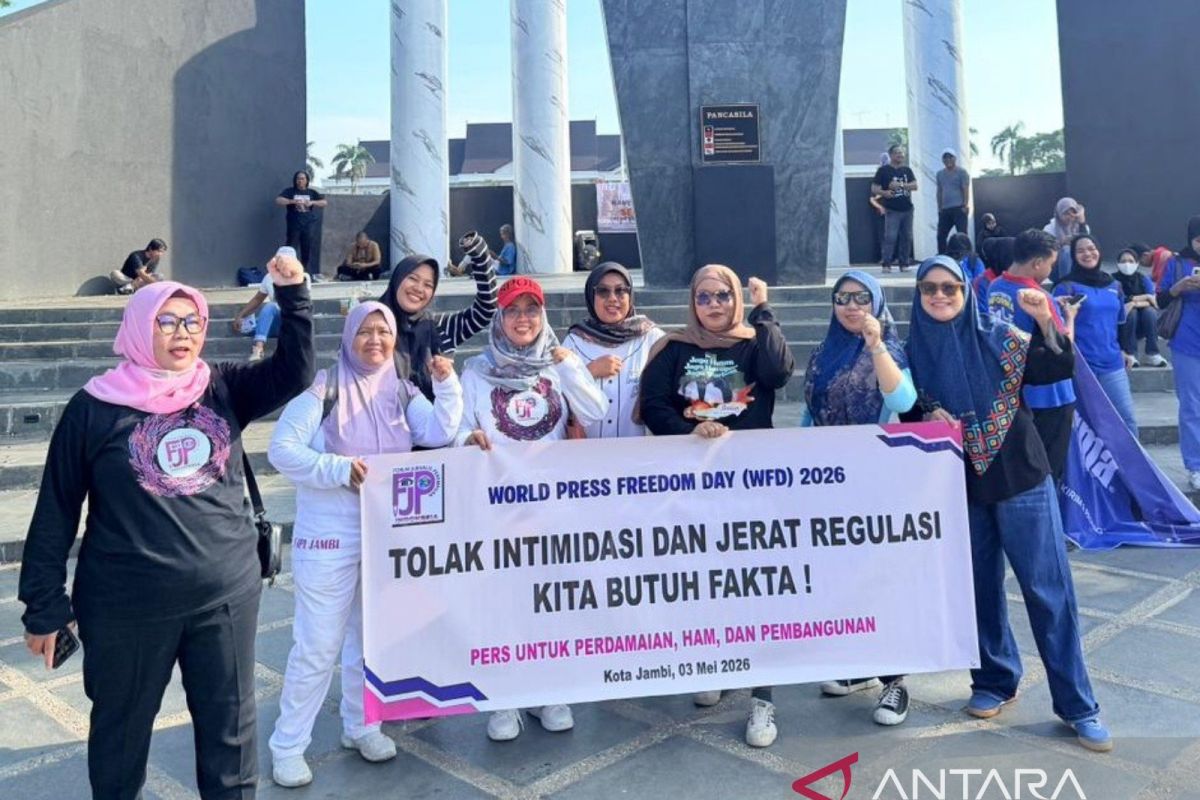
Jambi City (ANTARA) - To commemorate World Press Freedom Day, the Indonesian Women’s Journalists Forum (FJPI) in Jambi province held a peaceful oration emphasising the protection of journalists amid the increasingly declining and worrying state of press freedom.
“Today, we stand not to celebrate, but to speak out loudly about the increasingly worrying conditions,” said Chair of FJPI Jambi Province, Yusnaini Rany, in Jambi on Sunday.
She revealed that Indonesia’s press freedom index has continued to decline, from rank 108 in 2023 to 111 in 2024, rank 127 in 2025, and now in 2026 at position 129 out of 180 countries according to Reporters Without Borders (RSF).
This means that the higher the number, the worse the condition, indicating that press freedom tends to weaken or is difficult. According to her, this figure is not just a statistic, but a blurred mirror of the reality faced every day as journalists, especially as female journalists.
Rany stated that a study by AJI in March 2025 involving 2,020 journalists in Indonesia found that 75.1% of journalists have experienced violence, both physical and digital.
In addition, female journalists are considered vulnerable to violence and discrimination, as well as potentially facing double risks due to their positions as journalists and as women.
According to data, 85.7% of 1,256 female journalists across Indonesia have experienced various acts of violence, while collaborative research by AJI and PR2Media in 2022 revealed that 82.6% of 852 female journalists in 34 provinces stated they had experienced sexual violence.
The forms of violence experienced include online harassment, sexual threats, public dissemination of information without permission (doxing), and attacks on personal reputation, which have serious impacts on their safety, mental health, and career sustainability.
She also mentioned that in the last one to two years, the tendency towards restrictions on press freedom is considered increasingly palpable. There is a shift towards more subtle censorship, with decreasing accountability.
Rany added that based on this reality, the FJPI Jambi Branch stated several important points to various parties, including stopping all forms of intervention in journalistic work, repealing or revising regulations that could criminalise journalism, and implementing real protection for female journalists.
To media companies, FJPI Jambi requested that companies build mechanisms for preventing and handling violence against journalists, including sexual violence in the workplace.
“Protect your female journalists, both in the field and in the newsroom,” she said.