
World Oil Prices Surge, Nearing US$120 as War Threat Grows
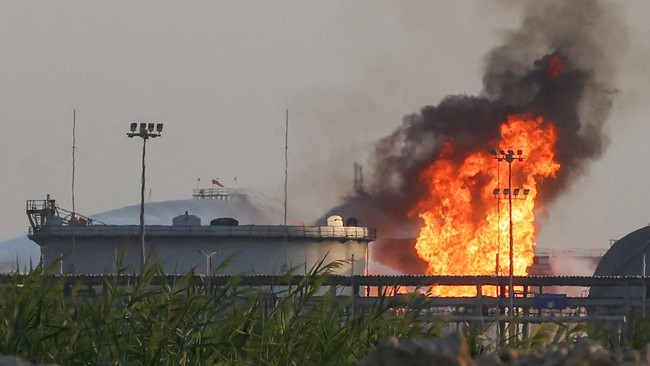
World oil prices rose more than 2% in trading on Friday (30 October 2026), reaching their highest level since late April 2026.
The surge came amid fears that the Iran war could escalate after the US midterm elections, particularly following an attack on a tanker in the Strait of Hormuz.
Brent crude futures for December delivery, which expired on Friday, closed up US$2.76, or 2.4%, at US$117.64 a barrel. Brent briefly reached US$118 a barrel, approaching US$120.
Brent rose 0.79% over the week, extending its gains to four consecutive weeks.
US West Texas Intermediate (WTI) crude also gained US$2.12, or 2.08%, to US$104.12 a barrel.
WTI rose 0.82% over the week, also marking a fourth consecutive weekly gain.
In October, Brent surged 13.6%, while WTI advanced 15.2%.
Dennis Kissler, senior vice-president of trading at BOK Financial, said market attention would remain focused on oil shipments from the Middle East and the possibility of the US military and its allies escalating the conflict.
“Market participants will continue to monitor oil flows from the Middle East and the potential for conflict to escalate involving US forces and their allies,” Kissler said.
Tanker attack brings fresh tensions to the Strait of Hormuz
Supply concerns intensified after a tanker in the Strait of Hormuz was struck by an explosive device planted from a small boat, the UK Maritime Trade Operations (UKMTO), a British maritime security agency, said on Friday.
At the time of the report, responsibility for the attack was unknown. The strait is a strategic sea route and a key channel for crude oil and fuel shipments from the Gulf.
Maritime sources said the incident was the first known successful use of a magnetic mine, or limpet mine, in the Strait of Hormuz since the US-Israeli war against Iran began in February.
The explosives are attached to a ship’s hull from a small boat and can threaten shipping safety and the smooth flow of global energy supplies.
Regional tensions also rose after the US government ordered non-emergency government employees and their families to leave Saudi Arabia from 23 October. The US Embassy in Riyadh said the measure was taken because of security risks, including Houthi attacks on civilian airports and other critical infrastructure.
Yemen’s Iran-backed Houthi group claimed on Thursday to have attacked several sites in Saudi Arabia, including the Ras Tanura and Rabigh oil refineries, as well as the Abqaiq production facility operated by state oil company Saudi Aramco.
The Saudi-led coalition also said it had intercepted a Houthi cruise missile launched towards the kingdom’s western region.
Diplomatic efforts to ease the conflict continued amid rising security risks. Qatari mediators returned to Tehran on Friday as part of coordinated efforts to reach an agreement between the US and Iran, according to an official familiar with the talks who spoke to Reuters.
US President Donald Trump had earlier said Vice-President JD Vance had contacted Iran to help arrange medical supplies. The statement followed US media reports that Vance had sent a letter to Iran’s top security official in an effort to revive peace talks.
Iran’s semi-official Tasnim news agency reported that Tehran had received the letter but had not responded. Iran was said to want the US to meet its conditions and to reject any position that conflicted with its demands.
Saxo Bank warned that oil prices could become more volatile in the coming weeks, with elections in Israel and the US midterm elections on 3 November.
The Danish bank forecast that crude prices would remain in a higher range of US$70-US$90 a barrel even after the conflict ends. Before the war, prices had been expected to trade at around US$60-US$70 a barrel.
Saudi oil exports rise, but estimates differ
Against the backdrop of threats to energy supplies, Saudi crude exports were reported to have risen in October compared with September by two of three shipping-tracking firms.
Saudi oil exports include supplies from state-owned Saudi Aramco.
TankerTrackers.com estimated that Saudi Arabia exported an average of around 7.9 million barrels per day (bpd) during the first 29 days of October, up from 5.8 million bpd in September.
The provisional figures included exports of 3.32 million bpd from the kingdom’s west coast and 4.55 million bpd from its eastern region.
Another ship-tracking firm, Petro-Logistics, also recorded an increase in exports from the Red Sea port of Yanbu after a decline in September.
Virginie Bahnik of Petro-Logistics said the volume of oil passing through the Strait of Hormuz had fallen by around 2 million to 3 million bpd from the peak recorded in early October.
“Overall, however, Saudi exports remain strong and will end October at a higher level than in September,” she said.
In contrast, Kpler put Saudi Arabia’s total crude exports at just 5.72 million bpd in October, down from 6.70 million bpd in September.
The divergent figures illustrate how difficult it is to establish actual export volumes. Shipping-tracking data can vary and change as new information becomes available, particularly when maritime activity is harder to monitor.
Strait of Hormuz increasingly difficult to monitor
Uncertainty has grown as many tankers have switched off their tracking signals amid worsening security risks in the Gulf.
Analysts therefore cannot rely solely on ship-tracking data. They also use satellite imagery, observations of port activity and other sources to estimate oil flows.
The decline in oil volumes passing through the Strait of Hormuz is a significant concern because the waterway is one of the world’s key energy trade routes. A prolonged disruption could constrain oil and fuel shipments to global markets.
Meanwhile, higher Saudi exports do not necessarily mean global supplies are secure again. Discrepancies in tracking data are making it difficult for market participants to establish how much oil has actually been shipped.
US output rises as Libya faces disruption
Outside the Middle East, US energy data showed that the number of oil rigs had increased by two, an indicator of potential future production.
The US Energy Information Administration (EIA) reported that US crude oil production rose in August. However, demand for crude oil and petroleum products declined.
Supply disruptions also occurred in Libya. The Libyan National Oil Corporation said an armed group had shut a valve on the main Hamada crude oil pipeline on Friday. The pipeline connects the Hamada oil field with the Zawiya refinery.
The closure halted flows of around 15,000 barrels of oil per day.
The combination of tanker attacks, threats to energy facilities, infrastructure disruptions and diplomatic uncertainty has once again left the oil market exposed to geopolitical risks.
Source: jawawa.id (https://jawawa.id/newsitem/world-oil-prices-surge-nearing-us-120-as-war-threat-grows-1793415047)
Originally published by CNBC Indonesia (https://www.cnbcindonesia.com/research/20261031065414-128-781111/minyak-dunia-mengamuk-hampir-tembus-us-120-ancaman-perang-membesar), translated from Indonesian