
World Leaders Gather to Discuss the Planet’s Future at Climate Summit
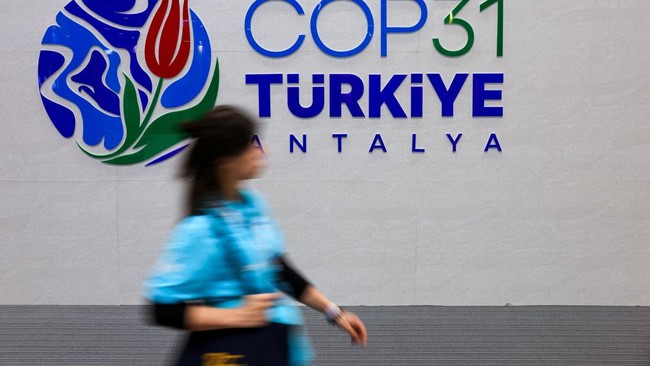
Jakarta, CNBC Indonesia – World leaders have gathered for the United Nations Climate Change Conference, or the 31st Conference of the Parties (COP31), taking place in Antalya, Türkiye, from 9 to 20 November 2026.
One of its main events is the World Leaders’ Summit on 11 and 12 November, bringing together heads of state and government and leaders of international organisations to set out their priorities for tackling the climate crisis.
The meeting, themed “Towards a Sustainable, Resilient and Equitable Future”, emphasises the importance of turning climate commitments into concrete action.
As host, Türkiye is pushing for COP31 to become an “Implementation COP”, focused on delivering agreements already reached.
The urgency is growing as the global climate deteriorates. According to the World Meteorological Organization (WMO), the average global temperature from January to September 2026 was about 1.47°C above pre-industrial levels, nearing the 1.5°C threshold set by the Paris Agreement.
Amid rising climate threats and geopolitical tensions, world leaders have outlined a range of priorities, from accelerating the energy transition and cutting emissions to climate finance and protecting vulnerable countries.
Here are some of the world leaders who set out their views at COP31.
What did they say?
1. António Guterres: The climate crisis is moving faster than the world’s response
UN Secretary-General António Guterres warned that the climate crisis is worsening while efforts to address it are not moving fast enough.
He pointed to record global emissions in 2025, rising temperatures and the impact of climate disasters on communities and economies.
“The harsh reality is that the climate crisis is moving faster than we are. Emissions in 2025 reached an all-time high. Temperature records keep being broken,” Guterres said, Reuters reported on Wednesday (11 November 2026).
Guterres also criticised the huge profits made by the fossil fuel industry amid the climate crisis. He called for a faster phase-out of fossil fuels, stronger early-warning systems and contributions from oil companies through taxes on windfall profits.
2. Recep Tayyip Erdoğan: Global conflicts must not obstruct climate cooperation
Turkish President Recep Tayyip Erdoğan stressed the importance of international solidarity in addressing climate change amid mounting geopolitical conflicts, migration, hunger and poverty.
“Our struggle against climate change is unfortunately taking place at a time when the international system is facing increasingly serious problems. Nature, as well as people, must bear the heavy consequences of armed conflicts,” Erdoğan said.
As host of COP31, Erdoğan called for climate commitments to be implemented in practice, including by improving vulnerable countries’ access to funding. He also said developed countries should take greater responsibility for cutting emissions and providing climate finance.
3. Luiz Inácio Lula da Silva: Wars and trade tariffs are pushing climate issues aside
Brazilian President Luiz Inácio Lula da Silva criticised the decline in international attention to climate change since COP30 in Brazil in 2025. He said the climate agenda was increasingly being sidelined by geopolitical conflicts, trade policies and security concerns.
“We have started talking more about weapons and trade tariffs than about the survival of future generations,” Lula said.
He also noted that climate change was receiving less attention at G7 and G20 forums. Lula warned that geopolitical competition and economic interests must not obstruct international climate cooperation.
4. Han Zheng: Developed countries must lead emissions cuts
Chinese Vice-President Han Zheng emphasised the principle of common but differentiated responsibilities, under which countries share responsibility but have different obligations based on their capacities and circumstances.
“Developed countries must lead emissions reductions and fulfil their climate finance commitments,” Han said.
He also urged all countries to meet their Nationally Determined Contributions (NDCs) and increase their emissions-reduction ambitions. His remarks reinforced China’s call for developed countries to take a greater role in tackling climate change.
5. Anthony Albanese: Pacific island nations need practical action
Australian Prime Minister Anthony Albanese highlighted the threat climate change poses to Pacific island nations, particularly through rising sea levels. He cited Tuvalu, whose land sits an average of only about 1.83 metres above sea level.
“COP31 must be a place where our cooperation delivers real results, unlocks investment in clean energy technologies, accelerates electrification, speeds up action for our oceans and opens up climate finance for those who need it most,” Albanese said.
Albanese added that although projections for global warming had fallen from about 4°C before the Paris Agreement to around 2.6°C, the world remained far from the 1.5°C target. Australia is also pushing to accelerate the energy transition and provide adaptation finance for Pacific countries.
6. Abiy Ahmed: Climate damage is reducing education and health budgets
Ethiopian Prime Minister Abiy Ahmed highlighted the economic impact of climate change, particularly on countries forced to devote an increasing share of their budgets to repairing damage caused by disasters.
“The more we spend on addressing climate damage, the less funding is available for education, healthcare and opportunities for young people,” Abiy said.
He said countries with the greatest historical responsibility for emissions and stronger economic capacity should lead deeper emissions cuts during this decade.
7. Nataša Pirc Musar: The energy transition must not be postponed any longer
Slovenian President Nataša Pirc Musar criticised the slow implementation of global climate commitments. She said a gradual approach to the transition must not be used as an excuse to keep delaying emissions reductions.
“A gradual transition must not be an excuse for endless delay. We must stop being overly cautious and start fulfilling our commitments,” Pirc Musar said.
She also criticised the dominance of major oil companies’ interests and short-term financial gains in climate policy, calling for the protection of people and the environment to be made the top priority.
8. Ursula von der Leyen: The EU backs global electrification
European Commission President Ursula von der Leyen said the energy transition was essential both to address climate change and to strengthen global energy security.
“The world is seeing the consequences of maintaining the status quo, both for our climate and for our energy security,” von der Leyen said.
She said the European Union supported the 35-by-35 Global Electrification Pledge, an initiative targeting a global electrification rate of 35% by 2035, and urged other countries to speed up the shift to clean energy.
9. Mohamed Muizzu: Vulnerable countries should not have to borrow to tackle the climate crisis
Maldivian President Mohamed Muizzu called on developed countries to meet their climate finance commitments, especially for small island nations facing the threat of rising sea levels.
“We should not be forced to borrow our way out of a crisis we have done little to cause. Building resilience must not be paid for with unsustainable debt,” Muizzu said.
He stressed that climate finance should be new, additional and predictable, and provided as grants so that it does not worsen vulnerable countries’ debt burdens.
10. Massoud Pezeshkian: Environmental damage caused by war must be accounted for
Iranian President Massoud Pezeshkian highlighted the environmental impact of armed conflict and called for climate responsibility to include damage caused during wars.
“We expect the global community to build a real and meaningful link between climate commitments in peacetime and responsibility in wartime,” Pezeshkian said.
He called for an international mechanism to document, assess and compensate for environmental damage caused by military aggression.
WMO data show the urgency of global action
Alongside speeches by world leaders, COP31 has also provided a forum for updates on the state of the global climate.
WMO Secretary-General Celeste Saulo said Earth’s energy imbalance had reached its highest level since monitoring began in 1960. This means Earth is absorbing more energy than it releases back into space, causing heat to accumulate in the climate system.
The WMO also reported that concentrations of the three main greenhouse gases – carbon dioxide (CO₂), methane (CH₄) and nitrous oxide (N₂O) – reached record highs in 2025. Their levels that year were compared with those of the pre-industrial era in 1750.
The increase in greenhouse gas concentrations reinforces the urgency of tackling climate change. The WMO said ocean heat content and sea levels had reached record highs, while ice continued to shrink and freshwater reserves declined.
With climate risks increasing, stronger early-warning systems are an important way to reduce the impact of disasters. Over the past decade, the number of countries with early-warning systems has more than doubled.
The WMO said disaster mortality rates in areas with strong early-warning systems were six times lower than in areas with weak systems.
COP31 urged to deliver practical implementation
The leaders’ statements show that the climate challenge is not only about cutting emissions, but also about finance, economic development, energy security and geopolitical relations.
Developed countries are being urged to accelerate the energy transition and honour their financing commitments, while developing countries are stressing the need for fair access to funding and support for the most vulnerable communities.
UN Climate Change Executive Secretary Simon Stiell said COP31 was being conducted through two main tracks: negotiations between countries and the Global Climate Action Agenda, which involves implementing climate action in real economic activity.
The agenda focuses on turning targets into practical solutions, tripling adaptation finance and improving access to climate funding.
With this agenda, COP31 is a test of the world’s ability to turn climate commitments into policy, investment and concrete action as the risks of global climate change intensify.
Source: jawawa.id (https://jawawa.id/newsitem/world-leaders-gather-to-discuss-the-planets-future-at-climate-summit-1794473513)
Originally published by CNBC Indonesia (https://www.cnbcindonesia.com/research/20261112101528-128-784537/ramai-ramai-pemimpin-dunia-bicara-nasib-bumi-di-pertemuan-iklim), translated from Indonesian