
World at Risk as the Amazon, the ‘Lungs of the Earth’, Is Damaged and Burns
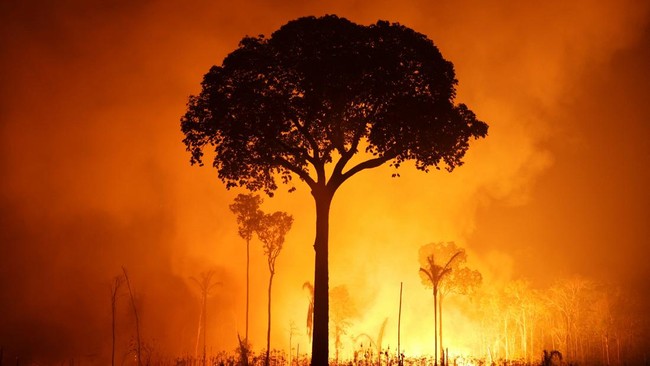
Ozone pollution, wildfires, extreme heat and drought are weakening the Amazon’s ability to absorb CO2, increasing the risks of climate change.
A deforested area of Amazon rainforest burns during the dry season in Autazes, Amazonas state, Brazil, on Monday, 12 October 2026. The situation is being exacerbated by ozone pollution from fires, extreme temperatures and drought, which are further reducing the forest’s ability to absorb carbon dioxide (CO2). Two recent studies indicate that the decline in the tropical forest’s carbon uptake could worsen climate change.
The Amazon and other forests absorb more than a quarter of annual CO2 emissions caused by human activity, or more than 11 billion metric tonnes. However, an increasing area of forest is releasing more CO2 than it absorbs, particularly during droughts and heatwaves.
Research published in the journal Communications Earth & Environment found that smoke from forest fires, agricultural burning and deforestation leads to the formation of ozone, which damages leaves, including in areas far from the fires.
The impact of fires is compounded: they release CO2 directly while also reducing the remaining trees’ capacity to absorb carbon. This reduction in carbon uptake is equivalent to about 24 per cent of the carbon released by fires.
Meanwhile, a study published in the journal Earth’s Future found that the extreme heat and drought affecting the Amazon and other tropical forests during the 2023 and 2024 El Niño could occur almost every year over the next 20 to 30 years. Such conditions could reduce CO2 absorption and disrupt the moisture cycle between forests and the atmosphere.
The study recorded unusually high temperatures across all tropical forests for an average of 18 months overlapping with El Niño, while 80 per cent of forest areas were drier than average. The Amazon was among the hardest-hit regions. After two years of drought, water levels at the port of Manaus, Brazil, fell to their lowest point in more than a century of records.
Johanna Van Passel of Ghent University in Belgium warned that recurring extreme heat could trigger prolonged declines in rainfall. When forests are under stress, their ability to support rain formation diminishes, affecting surrounding forests as well. Even if human carbon emissions were eliminated or offset by 2075, the risk of extreme heat and drought in tropical regions by the end of the century is projected to be six times higher than over the past 25 years.
Under a high-emissions scenario, extremes like those of 2023 and 2024 are projected to occur annually across much of the tropics by the 2040s, with or without El Niño. Uncontrolled agricultural fires also release nitrogen oxides, which react with organic molecules to form ozone. Although ozone damage declined between 1997 and 2024 as CO2 levels rose, the effects of fires, drought and high temperatures remained greater.
Researcher Flossie Brown of ETH Zurich in Switzerland described extreme drought as one of the biggest threats to the Amazon, which has evolved in a humid environment. To reduce the damage, she stressed the need for better management of agricultural burning, alternatives to burning, and efforts to slow deforestation and forest degradation.
Source: jawawa.id (https://jawawa.id/newsitem/world-at-risk-as-the-amazon-the-lungs-of-the-earth-is-damaged-and-burns-1791949828)
Originally published by CNBC Indonesia (https://www.cnbcindonesia.com/news/20261014073742-7-775898/dunia-terancam-penampakan-hutan-paru-paru-bumi-rusak-terbakar), translated from Indonesian