
Workers Reject 36% Pay Rise as Mass Protests Erupt Again
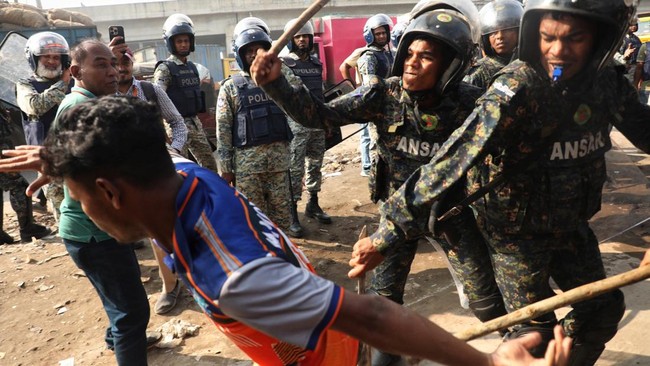
Dhaka, CNBC Indonesia — A new wave of workers’ protests has erupted in Bangladesh after the government approved a 36% increase in the garment industry’s minimum wage on Wednesday (25 November 2026). The increase is the smallest in four decades and remains far below workers’ original demands.
The six-member wage board set the new minimum wage at 17,000 taka, or about US$138 a month. The decision followed weeks of demonstrations that led to factory closures, road blockades, property damage and disruptions to production.
The garment industry is the backbone of Bangladesh’s economy, employing more than four million people. It accounts for more than 80% of the country’s export earnings and supplies products to global retail brands including H&M, Zara, Walmart, Target and Gap.
Reuters reported that workers initially demanded a minimum wage of 32,000 taka (US$257) a month, later lowering their demand to 18,000 taka during negotiations. Factory owners initially offered 15,000 taka before raising their offer to 17,000 taka.
In percentage terms, this is the smallest increase since Bangladesh first set a minimum wage for the garment sector in 1986. By comparison, garment workers’ wages rose by 56% in 2023, 51% in 2018 and 77% in 2013.
“Negotiations like this repeatedly result in wages that keep workers living in poverty,” said Anne Bienias, living-wage coordinator at the Clean Clothes Campaign.
Bienias said the newly set minimum wage remains far below a living-wage standard.
Workers’ protests continue
The decision by the wage board, established by the Bangladeshi government, was reached at about 2am local time on Wednesday after nearly 12 hours of negotiations between worker and employer representatives. It did little to ease tensions.
Workers again blocked a major road in Gazipur, one of the garment industry’s hubs on the outskirts of the capital, Dhaka. Police then fired tear gas and stun grenades to disperse the crowds.
Babul Akhter, the workers’ representative on the wage board, said the new wage structure was approved in a 4–2 vote.
Four board members supported setting the minimum wage at 17,000 taka, while two backed the workers’ demand for 18,000 taka. The board includes two worker representatives and two employer representatives, among others.
Under the new four-grade wage structure, workers in Grade 4 will receive a minimum of 17,000 taka a month, while those in Grade 1 will receive 21,500 taka.
The minimum wage for the lowest-paid grade has risen by 4,500 taka from the 12,500 taka set in 2023.
The new rules will take effect on 1 December 2026, with workers due to receive wages under the revised structure in January 2027.
Global brands also under scrutiny
Labour rights campaigners say the increase is not enough to meet workers’ basic living needs.
The Clean Clothes Campaign also criticised global brand owners for failing to firmly support a larger increase or commit to covering the additional labour costs through the prices they pay suppliers.
Ahead of the new wage decision, ACT, a group comprising brand owners and trade unions, called for workers’ rights to be respected and for wages to be set closer to a living-wage level.
ACT said its member companies, including Inditex, H&M and Primark, were committed to ensuring that wage increases for workers are reflected in the prices they pay supplier factories.
Wage data published on H&M’s official website show that Bangladesh has the lowest minimum wage among the company’s eight main production countries.
H&M sources products from 142 factories in Bangladesh, which employ a total of 510,704 people.
The Swedish company said workers’ wage costs are protected and excluded from price negotiations with suppliers.
“We take our responsibility to ensure our purchasing practices support higher wage levels very seriously,” an H&M spokesperson said in a statement.
Inditex, Zara’s parent company, had not responded to a request for comment.
The recent weeks of demonstrations have caused major losses for Bangladesh’s garment industry.
The Bangladesh Garment Manufacturers and Exporters Association (BGMEA) said 397 factories were unable to operate on Tuesday. Another 84 remained closed under the country’s labour-law provision known as “no work, no pay”.
A BGMEA survey estimated that 317 factories suffered production losses of about US$428 million during 18 days of operational disruption. Meanwhile, buyers shifted orders worth around US$254 million to other countries.
Competitiveness at risk; Indonesia cited
Business groups have warned that the minimum-wage increase, while raising workers’ incomes, could further erode Bangladesh’s competitiveness in the global garment market.
Mohiuddin Rubel, deputy managing director of Denim Expert Ltd, said Bangladesh was beginning to lose the low labour costs that had been a key attraction for its garment industry.
“At US$138, we are now paying more than West Bengal in India and about the same as Vietnam, Indonesia and Pakistan. Low costs were our main advantage, and now that advantage is gone,” Rubel said.
Denim Expert Ltd is among the suppliers of garments to global brands, including H&M.
Rubel said the Bangladeshi government now needed to focus more on improving the industry’s capabilities so it could continue to compete with other producer countries.
“The capability gap, not the wage gap, is now determining orders. So the government must help us build capacity through low-interest, long-term credit for man-made fibres, automation and skills, and speed up processes at ports and customs so that we can compete with our rivals,” he said.
Rubel also called on international brand owners to share some of the additional labour costs resulting from the minimum-wage increase.
“Buyers are our partners and our biggest stakeholders, so sharing the increase in wage costs is also their responsibility,” he said.
“We have cut prices by 6.54% in Europe this year and are still losing sales volumes, while smaller factories cannot bear the burden of the new wages on their own. Brand owners must ensure that wage costs are protected in their prices.”
Source: jawawa.id (https://jawawa.id/newsitem/workers-reject-36-pay-rise-as-mass-protests-erupt-again-1795614679)
Originally published by CNBC Indonesia (https://www.cnbcindonesia.com/news/20261125164028-4-788450/buruh-tak-terima-kenaikan-gaji-36-demo-besar-besaran-pecah-lagi), translated from Indonesian