
Workers Rally to Reject New Outsourcing Regulation, Here Are the Triggering Points
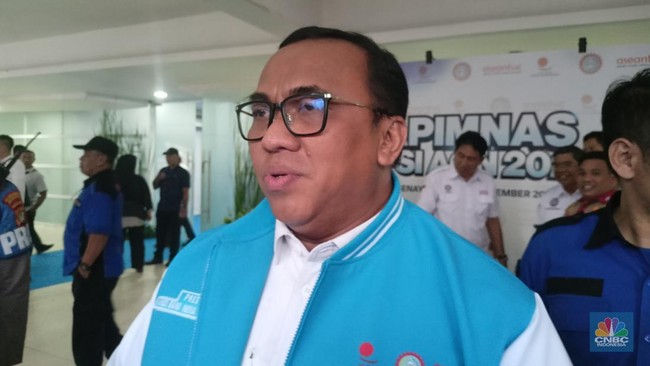
Jakarta, CNBC Indonesia - The President of the Confederation of All-Indonesian Workers’ Unions (KSPSI), Andi Gani Nena Wea, emphasised that all trade unions share the same stance in rejecting Ministry of Manpower Regulation (Permenaker) No. 7 of 2026 on outsourced workers or outsourcing.
According to him, all labour organisations agree to urge the government to revise the regulation and revert it to the provisions of Law No. 13 of 2003.
Andi Gani stated that from the outset, KSPSI had directly conveyed to the government in various meetings that the outsourcing regulation should return to the old scheme, which was clearer and more limited.
“We in KSPSI, of course, agree—in the sense that from the beginning, we have asked the government during meetings with several state officials that the request from KSPSI, which is currently the largest labour confederation in Indonesia, is for the outsourcing regulation to return to Law 13/2003, which includes clear time limits and five types of work,” said Andi Gani to CNBC Indonesia on Thursday (14/5/2026).
He explained that the issue arose because Permenaker 7/2026 expands the categories of outsourcing work to include operational services. However, previous regulations strictly limited the types of outsourcing work.
“There were only five types of work. But now it has expanded to operational services. This is what we believe the government must explain: why can there be an addition of such an article,” he said.
He admitted that his side was quite surprised by the emergence of this additional article because previously the trade unions had requested that the outsourcing regulation be returned to the format of Law 13/2003 without new norms.
“Because our agreement was to return to Law 13/2003 without additional articles. This is what surprises us a bit: why can this addition happen? And who is behind this?” he said.
Andi Gani then explained that under Law 13/2003, the types of outsourcing work are specifically regulated, such as cleaning services, security, catering, and other support work.
“But now it’s different, extending to operational services,” he said.
According to him, the term “operational services” in Permenaker 7/2026 actually opens up room for multiple interpretations that could be exploited by companies to include more types of work in the outsourcing scheme.
“Operational services become debatable. Debatable in the sense that the employer might interpret that administrative staff, operational staff who maintain the production process, are included in that. And there is no clarity on time limits,” he said.
Therefore, KSPSI is asking the Ministry of Manpower to provide an explanation regarding the changes in the regulation. However, in principle, he said, the trade unions are requesting that the outsourcing regulation simply be returned to the old provisions where outsourcing is clearly regulated to only five types of work: security, catering, driver services, mining support services, and cleaning services.
“This is what the Ministry of Manpower must explain. So, in essence, for Permenaker No. 7 of 2026, we oppose the revision. Simply put, just return to Law 13/2003,” he said.
“No need to be confused about what. But returning to Law 13/2003 is sufficient,” Andi Gani continued.
When asked if KSPSI’s stance aligns with other trade unions that also reject Permenaker 7/2026, Andi Gani assured that all labour organisations share the same view.
“All of them, all agree. All are in unison. That we do not agree with this because it will be very burdensome,” he stressed.
Previously, hundreds of workers from the Indonesian Trade Union Confederation (KSPI), Labour Party, Indonesian Metal Workers’ Federation (FSPMI), and National Workers’ Union (SPN) held a protest rally in front of the Ministry of Manpower office in Jakarta on Thursday (7/5/2026).
They rejected Permenaker No. 7 of 2026, which regulates outsourced workers or outsourcing.
During the action, KSPI President and Labour Party President, Said Iqbal, stated that Permenaker 7/2026 actually legalises outsourcing and does not provide legal certainty or protection for workers.
He also highlighted Article 3 paragraph 2 letter E, which states that outsourced workers can be used for operational support services, deeming it too open to interpretation.
KSPI along with the Labour Party threatened to hold follow-up actions in waves across various regions if the demand for revision of the regulation is not responded to by the government.