
Workers Besiege Ministry of Manpower, Protest Against Outsourcing Regulation—Call It Empty Promises
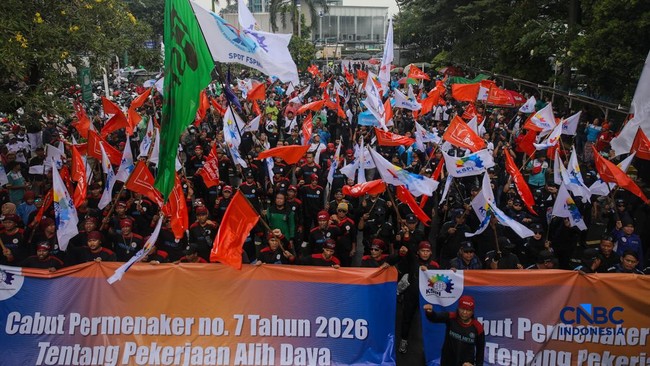
Jakarta, CNBC Indonesia - Hundreds of workers affiliated with the Indonesian Workers’ Confederation (KSPI), Partai Buruh, the Indonesian Metal Workers’ Federation (FSPMI), and the National Workers’ Union (SPN) held a protest rally in front of the Ministry of Manpower (Kemnaker) office in Jakarta on Thursday (7/5/2026).
They rejected Ministerial Regulation on Employment (Permenaker) No. 7 of 2026, which regulates outsourced workers or outsourcing.
The action, originally scheduled to begin at 10:00 WIB, only truly started around 11:00 WIB when KSPI President and Partai Buruh President, Said Iqbal, arrived at the location. Despite being caught in the rain, the workers persisted, voicing their demands alternately through loudspeakers.
The demonstration proceeded in an orderly and peaceful manner. The protesters carried union flags and banners rejecting the outsourcing regulation. No anarchic actions were observed during the protest.
In his speech, Said Iqbal emphasised that today’s action marks the beginning of a wave of worker demonstrations across various regions in Indonesia. According to him, the workers have only one main demand: the revision of Permenaker No. 7 of 2026.
“Today, KSPI together with Partai Buruh is holding an opening action. This action will roll out across Indonesia after today. Led by comrades from FSPMI President Suparno, SPN General Chairman Iwan, KEP General Chairman Sunandar, and others across Indonesia,” Said Iqbal told reporters when met at the location.
“Today we are only bringing a single issue, namely the revision or improvement of Permenaker No. 7 of 2026 on outsourced workers or what we know as outsourcing,” he continued.
Said Iqbal stated that they actually want the regulation revoked. However, he assessed that total revocation would leave no rules governing outsourcing practices.
“Actually, we want Permenaker 7/2026 revoked, but if it is revoked, there will be no regulation to govern outsourcing, which we want eliminated,” he said.
“So as an interim step towards the Employment Law, we can still accept a Permenaker that regulates the prohibition of outsourcing or outsourced workers. Not legalising it,” he added.
According to him, Permenaker 7/2026 instead legalises the outsourcing practice that workers have long rejected. In fact, he said, President Prabowo Subianto in his May Day speech on 1 May 2026 at Monas had expressed agreement with the abolition of outsourcing.
“Permenaker No. 7 of 2026 legalises outsourcing or outsourced workers. Whereas what workers demand, represented by KSPI together with Partai Buruh, is a ban. In Permenaker 7/2026, there is no prohibition on the use of outsourcing,” Said Iqbal stressed.
Said Iqbal then outlined several reasons for rejecting the policy. One of them is the absence of a ban on using outsourcing for direct production processes in the manufacturing sector, or core activities in the service industry.
“The current field fact is the massive use of outsourcing in direct production processes. For example, welders in car factories, screwers in electronics factories—that’s outsourcing, or bank tellers—that’s outsourcing,” he said.
“Core activities in the banking industry are what we demand be banned,” he continued.
Additionally, he highlighted the loss of provisions on legal consequences for companies violating outsourcing rules. According to him, in previous regulations, outsourced workers employed in violation of provisions could automatically change status to permanent employees.
“In the previous Law No. 13/2023, and also the previous Permenaker 19/2012, there was what is called legal consequences,” he said.
“So if the employer company uses outsourcing or outsourced workers that violate the rules, then by law, the employment relationship becomes an indefinite time work agreement, or what we know as permanent employees,” he added.
Said Iqbal also assessed that Permenaker 7/2026 is not in line with the Constitutional Court ruling because it is deemed not to provide legal certainty and protection to workers.
“In Permenaker 7/2026, there is no legal certainty. The employment relationship is unclear. And second, according to the Court, is protection. What is to be protected? Nothing is protected. What about wages? Is it minimum wage? Annual salary increases or not? What about the layoff process? And so on,” he continued.
He also spotlighted Article 3 paragraph 2 letter E, which states that outsourced workers can be used for operational support services. According to him, that definition is too open to interpretation.
“What is the definition of operational support services? It’s unclear. A Permenaker should, if there are a thousand types of jobs allowed, list all thousand, because it’s technical,” Said Iqbal said.
Therefore, KSPI and Partai Buruh threaten to hold follow-up actions in waves across various regions.
Said Iqbal mentioned that worker representatives will be received by Deputy Minister of Manpower (Wamenaker) Afriansyah Noor to directly convey their demands.
“Accordingly, ten people will be received by the Deputy Minister of Manpower, led by Brother Suparno, Brother Helmizan, Brother Iwan, Brother Makbullah Fauzi. There are ten people,” Said Iqbal added.
Furthermore, he also refuted the notion that abolishing outsourcing would trigger a wave of layoffs.
“And once again, it is not true that abolishing outsourcing will lead to layoffs. Not true. Because the employer company can use contract employees for five years. According to the Constitutional Court judge,” he said.
“So it is not true that abolishing outsourcing will cause massive layoffs. That’s empty talk and a monster created to scare business owners and the government,” he stressed.
Meanwhile, FSPMI President Suparno assessed that Permenaker 7/2026 gives too much authority to