
Won Leads Asia’s Currencies as the Peso, Rupiah, Yuan and Ringgit Slide
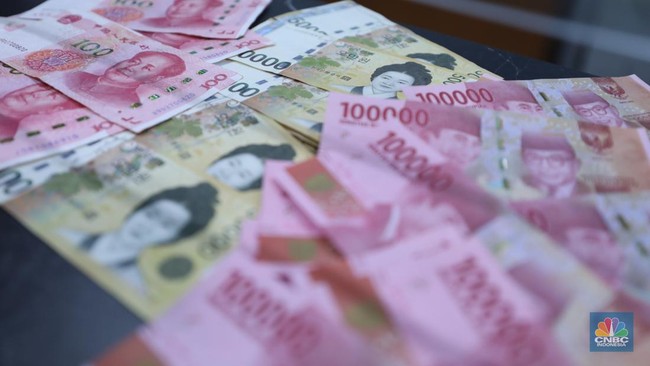
Jakarta, CNBC Indonesia — Most Asian currencies weakened against the US dollar in trading on Tuesday (3 November 2026), as the greenback edged higher in the morning.
Refinitiv data at 9.20am WIB showed that seven of the 10 Asian currencies monitored had fallen against the US dollar, while only three remained in positive territory.
The South Korean won was the strongest performer, rising 0.38% to KRW1,341 per US dollar. The Thai baht followed with a 0.09% gain, while the Japanese yen edged up 0.02%.
At the other end of the scale, the Philippine peso came under the heaviest pressure, weakening 0.47% to PHP63.444 per US dollar.
The Chinese yuan also fell sharply, down 0.33%, followed by the Malaysian ringgit, which lost 0.22%, and the Taiwan dollar, which slipped 0.19%.
The Singapore dollar eased 0.13%, while the Vietnamese dong fell 0.09%.
The rupiah also remained in negative territory, slipping 0.03% to Rp18,145 per US dollar.
As Asian currencies weakened, the US dollar index (DXY) was up 0.08% at 101.822. This reversed its 0.22% decline the previous day, when it closed at 101.76 after briefly touching 101.42, its lowest level since 30 September.
The dollar’s decline on Monday coincided with a slump in oil prices and falling US government bond yields.
Crude oil prices fell by around 7% after ongoing talks between Iranian and Qatari officials raised hopes that the Middle East conflict could ease and disruption to energy supplies could diminish.
The sharp fall in oil prices helped ease inflation concerns and reduced some of the appeal of the US dollar, which had previously been supported by high energy prices.
“Overall, what we are seeing is a fairly resilient market. December WTI briefly tested US$105 on Friday and is now below US$100,” Marc Chandler, chief market strategist at Bannockburn Capital Markets, told Reuters.
Chandler said market conditions changed quickly after the weekend.
“As we headed into the weekend, everything looked bad. Shares were down and oil was at a new high. When markets reopened, there was a kind of collective sense of relief,” he said.
The US dollar began to regain some ground on Tuesday morning as markets prepared for a busy week of key events.
Investors’ main focus is the US midterm elections on Tuesday local time. The result will determine the make-up of Congress and could influence the direction of the US government’s fiscal policy.
Markets are also awaiting a series of labour-market data releases this week, culminating in Friday’s October employment report.
The data will provide an important indication of the strength of the US economy and the Federal Reserve’s interest-rate outlook.
Signals from the manufacturing sector have so far remained relatively strong. The Institute for Supply Management said US manufacturing activity rose to 55.5 in October, from 54.5 in September.
A reading above 50 indicates that manufacturing activity is expanding. At the same time, input prices remain high, meaning concerns about inflationary pressure have not fully subsided.
Source: jawawa.id (https://jawawa.id/newsitem/won-leads-asias-currencies-as-the-peso-rupiah-yuan-and-ringgit-slide-1793677869)
Originally published by CNBC Indonesia (https://www.cnbcindonesia.com/research/20261103092623-128-781785/won-jadi-bintang-asia-peso-rupiah-yuan--ringgit-ambruk-berjamaah), translated from Indonesian