
Won and Rupiah Lead Asia in Pushing Back Against Dollar, Ringgit Lags
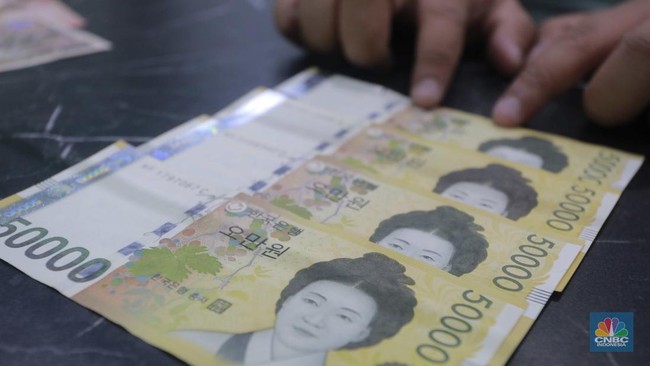
Most Asian currencies strengthened against the US dollar in the final trading session of the week on Friday (21/8/2026). The weakening of the US dollar in global markets provided room for most regional currencies to move positively.
According to Refinitiv data as of 09:40 WIB, seven out of ten Asian currencies were observed strengthening against the US dollar, while three others weakened.
The South Korean won remained the currency with the sharpest gain in Asia this morning. The won jumped 0.92% to KRW 1,381.1 per US dollar.
The rupiah also moved positively, strengthening 0.25% to Rp17,700 per US dollar. The Singapore dollar also recorded gains, appreciating 0.19% to SGD 1.27 per US dollar.
The Thai baht strengthened 0.12% to THB 32.80 per US dollar. The Japanese yen and Taiwanese dollar both rose 0.08%, to JPY 158.91 per US dollar and TWD 31.832 per US dollar respectively.
The Vietnamese dong also moved positively, strengthening 0.07% to VND 26,080 per US dollar.
On the other hand, the Malaysian ringgit was the currency under the deepest pressure in Asia this morning. The ringgit weakened 0.07% to MYR 4.043 per US dollar.
The Chinese yuan and Philippine peso both corrected slightly by 0.01%, to CNY 6.723 per US dollar and PHP 61.671 per US dollar respectively.
The strengthening of most Asian currencies this morning occurred alongside the weakening of the US dollar in global markets. This was reflected in the movement of the US dollar index (DXY), which was observed weakening 0.11% to 98.783 this morning and potentially recording a weekly decline. Pressure on the greenback emerged after investors assessed that the US Treasury Department’s bond buyback measures were only a temporary solution to calm turbulence in the bond market.
US Treasury Secretary Scott Bessent stated that the government could further increase buybacks of US debt securities. The statement came after the US Treasury Department previously announced plans to double buybacks of long-dated bonds to curb the surge in yields.
However, the move has not been enough to calm the market. Investors are still scrutinising US fiscal conditions, especially amid concerns over the growing deficit and government debt.
Carol Kong, currency strategist at Commonwealth Bank of Australia, assessed that the policy shows the US government is using unconventional instruments to manage borrowing costs.
“The Treasury’s buyback of long-term bonds is essentially another example of the US government using unconventional tools to manage borrowing costs, and this is happening amid high government debt, a widening fiscal deficit, and policy uncertainty,” Kong said, as quoted by Reuters.
According to Kong, these conditions could add further pressure on investor sentiment towards US dollar assets.
“I can understand why people are concerned that this operation could become another headwind for investor sentiment towards US dollar assets. Potentially we could see moves like this encourage more dollar hedging and diversification,” Kong said.
Meanwhile, long-dated US Treasury yields remained elevated after the initial boost from the bond buyback plan began to fade. The 30-year US Treasury yield stood at around 5.2508%, while the 10-year yield was around 4.7041%.
Goldman Sachs assessed that the problems facing the US bond market are currently more fiscal than technical in nature.
“Our scepticism is not because policymakers lack tools to influence the long end. History shows they do, at least temporarily. Our scepticism is that today’s problems increasingly appear fiscal, not technical,” wrote Vitali Meschoulam, strategist at Goldman Sachs, as quoted by Reuters.