
Women’s Struggle in the Colonial Era Takes to the Theatre Stage
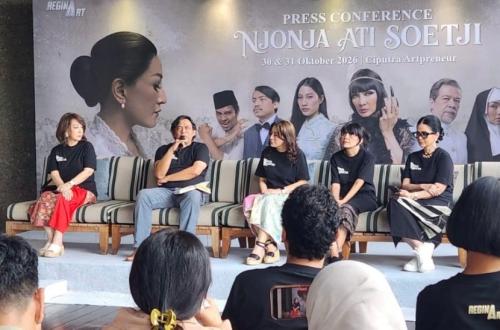
JAKARTA – The struggle of women to protect others from human trafficking during the colonial era is the subject of the theatre production Njonja Ati Soetji. Scheduled for 30–31 October 2026 at Ciputra Artpreneur in South Jakarta, the production tells the story of Auw Tjoei Lan, a woman of Chinese descent known for her concern for women and children in need of protection.
Regina Art adapted Auw Tjoei Lan’s story through research into historical archives, documents and family testimony. The production not only traces the life of a prominent woman, but also explores humanitarian concerns, courage and moral choices amid the social conditions of her time.
Regina Art founder Joane Win plays the title character, Njonja Ati Soetji, and is also the executive producer. At a preview performance at The Forest in Lebak Bulus, South Jakarta, on Tuesday (20 October 2026), Win appeared in batik and performed a scene reflecting the character’s views on human values.
“We don’t need your money, but [we do need to know] how to obtain it in an honourable way,” Win said in one of the production’s lines, according to a press release received on Saturday (24 October 2026).
Auw Tjoei Lan founded the Hati Suci Foundation, known for its work helping women and children during the colonial era. Her life provided the basis for a story linking historical events with social issues that remain relevant today.
Wenny, deputy chair of the Hati Suci Foundation, said the production was one way of introducing the foundation’s founder and her struggle to the public. The humanitarian values Auw Tjoei Lan championed, she said, could offer lessons to today’s generations.
“We appreciate Regina Art for telling the story of our founder. For us, this is not just history, but also an example to follow. Through art, we hope the values championed by Njonja Ati Soetji can be preserved,” Wenny said.
The production’s script took two years of research. Writer Endah D. Jenura and her team examined historical documents to understand Auw Tjoei Lan’s life and the social circumstances behind her work.
One source they found was a 23 June 1925 article in the newspaper De Locomotief containing information about human trafficking. The archive was used as one reference for portraying social conditions during the colonial era.
The limited availability of written records and visual material posed a challenge in developing the story. To supplement the historical sources, the team gathered testimony from Stela, Auw Tjoei Lan’s granddaughter, who provided insights into her personal life.
The family’s account included details of Auw Tjoei Lan’s habits, such as the way she walked, her use of Dutch in everyday conversation, and her nickname for her husband, “Brur”. The information helped the team develop a character closer to the figure described by her family.
Not every event in the production, however, could be traced through historical documents. The writers developed some characters and conflicts to serve the dramatic needs of the play, without presenting every scene as a factual reconstruction.
Distinguishing historical sources from artistic interpretation was one aspect of the production process. The story of Auw Tjoei Lan is therefore presented through a combination of historical facts, family testimony and theatrical invention.
Njonja Ati Soetji is directed by Wawan Sofwan, with a script by Endah D. Jenura. They have shaped the protagonist’s life into a production addressing the protection of women, humanitarian concerns and the consequences of moral choices.
Actress Maudy Koesnaedi also appears as the character Sayap Hitam. The role offers a different perspective on women’s lives and the choices people make in particular social circumstances.
“I’m helping these women earn an income…,” Maudy said in one of Sayap Hitam’s lines during a press conference.
The line forms part of a conflict that highlights differing views about actions and their effects on others. Through Sayap Hitam, the production invites audiences to consider humanitarian issues from different perspectives.
The cast also includes Tika Bravani as Noona Kneefel, Willem Bievers as Van Walsem, Lutfi Ardiansyah as Jirrin, Chloe Gerry as Suyun, Jim Lim as Seng Hoe, Haikal Mubarok as Tuan Lie, Andri Surawan as Buron, and Andi Solohin as Jagal.
The production is supported by Indonesia Kaya, Ciputra Artpreneur, BFI Finance, Alcester, Regina Realty, Sariayu Martha Tilaar and Le Minerale. It is scheduled to run for two days, on 30–31 October 2026.
Through its adaptation of Auw Tjoei Lan’s story, theatre offers a way to reintroduce a historical figure whose work helped protect women and children. The production also creates space for audiences to explore humanitarian issues of the colonial era through art.