
With Regional Transfers Cut, NTT Regencies Ask Central Government for Compensation
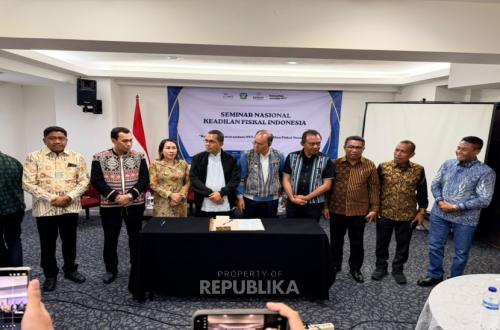
JAKARTA — Cuts to transfers to regions (TKD) are seen as limiting the ability of regency governments in East Nusa Tenggara (NTT) to fund basic infrastructure development. The situation has prompted several NTT regional leaders to ask the central government for affirmative policies and special compensation for areas with low fiscal capacity.
Flores Timur Regent and NTT Regional Coordinator of the Association of Indonesian Regency Governments (APKASI), Antonius Doni Dihen, said the current General Allocation Fund (DAU) distribution system did not reflect fiscal fairness, particularly for island regions and areas with limited financial capacity.
He said areas with low fiscal capacity needed special treatment to ensure they could continue meeting development needs and providing basic public services.
“We are asking for affirmative measures: affirmative financial policies and fiscal fairness for all areas with low fiscal capacity, especially NTT, including a compensation fund. For a long time, the General Allocation Fund calculation has not been fair enough to us,” Doni said at the National Seminar on Fiscal Justice in Indonesia in Cikini, Menteng, Central Jakarta, on Saturday evening (7 November 2026).
The seminar was also attended by several regional leaders from NTT, including Malaka Regent Stefanus Bria Seran and East Manggarai Regent Agas Andreas. Ombudsman RI member Robert Na Endi Jaweng was also present.
Doni said cuts to TKD had directly affected Flores Timur Regency’s finances. He said the central government’s transfer allocation to the regency had fallen by as much as Rp147 billion in the current year.
The reduction has further narrowed the local government’s fiscal space to meet Minimum Service Standards (SPM), particularly for basic infrastructure such as roads, clean water and bridges.
He said Flores Timur still had about 300 kilometres of roads in severely damaged condition. With repairs estimated to cost Rp2 billion to Rp3 billion per kilometre, the budget needed to address the damage was substantial.
Doni said the approximately Rp250 billion in budget support requested by the Malaka Regent illustrated the scale of infrastructure needs in NTT.
“Earlier, the Malaka Regent said that we need at least Rp250 billion. That may be a large figure, but we badly need funding in that range to meet major needs, especially roads, water and bridges, which are a major concern for local governments and our communities,” he said.
Doni said budget constraints made it difficult for local governments to address large-scale development needs, even though basic infrastructure was key to improving people’s welfare.
“For other matters, we can still manage with a minimal budget. But for major needs, especially roads, water and bridges, we are practically struggling,” he said.
He also said limited regional fiscal capacity could hamper the achievement of national development targets, including reducing poverty and unemployment.
In addition to seeking compensation, Doni urged the central government to improve the formula for allocating transfers to regions. He said allocations should take account of differences in fiscal capacity, locally generated revenue (PAD) and revenue-sharing funds (DBH) across regions.
He said regions with limited fiscal capacity should not be treated the same as those with greater sources of revenue.
“The central government controls too much of the budget. A larger share should be transferred to the regions, and the calculations should be fairer. We have felt this unfairness for a long time. Regions with strong fiscal capacity are still favoured with regional transfers, while we are treated as if we were the same as fiscally strong regions,” he said.
Doni said the DAU allocation formula should be reviewed to better reflect the principles of fairness and fiscal balance, which are among the aims of regulating financial relations between the central and regional governments under Law No. 1/2022 on Financial Relations between the Central Government and Regional Governments (HKPD).
As a follow-up, NTT’s regional leaders plan to take the seminar’s recommendations to the Ministry of Finance, the Ministry of Home Affairs and the Budget Committee of the House of Representatives (DPR RI).
“We plan to take the results of today’s seminar to the Budget Committee (of the DPR) for discussion, then follow up with better budget policies,” Doni said.
Meanwhile, Home Affairs Ministry Director General of Regional Finance Agus Fatoni acknowledged that most regencies in NTT had weak fiscal capacity and remained reliant on central government transfers rather than their own-source revenue.
Fatoni said, however, that the Ministry of Finance used a range of technical variables and regional data to determine allocations for the DAU and Special Allocation Fund (DAK). Local governments therefore needed to strengthen and update their data to reflect conditions on the ground.
This data included road conditions, the Construction Cost Index (IKK), the number of poverty pockets and student numbers.
“When the Ministry of Finance sets transfer allocations, it will naturally examine why a region receives a particular amount and what the basis is. We need to strengthen that basis with data,” Fatoni said.
In addition to improving data, he urged local governments to make better use of opportunities to receive Fiscal Incentive Funds (DIF). These incentives are awarded based on performance in areas including inflation control, stunting reduction, the eradication of extreme poverty, economic growth and the efficiency of civil registration administration.
Fatoni also cautioned local governments against relying solely on TKD in their regional budgets (APBD). Regency and city governments, he said, could access central government ministry and agency spending, which is set to reach Rp1,337.9 trillion in 2026, to support development in their areas.
“That funding can also reach regencies and cities that have the information, complete data and good coordination. Rp1,337.9 trillion is a substantial amount. If you in NTT can secure some of it, that would help considerably, even though it would not be included in the regional budget,” he said.
Fatoni also encouraged local governments to explore alternative financing, or creative financing, to reduce their dependence on regional budgets.
Such schemes could involve optimising regionally owned enterprises (BUMD), making regional public service agencies (BLUD) such as public hospitals and community health centres more self-reliant, and using public-private partnerships (KPBU) for clean water and electricity projects.
Local governments could also work with companies through corporate social responsibility (CSR) programmes or partner with philanthropic organisations.
He stressed the importance of building the capacity of regional government agency (OPD) staff so they could more proactively seek funding opportunities and implement development programmes.
“The regional head should not be the only one working hard while the bureaucracy is stalled. That is why capacity-building is important,” Fatoni said.
Source: jawawa.id (https://jawawa.id/newsitem/with-regional-transfers-cut-ntt-regencies-ask-central-government-for-compensation-1794120668)
Originally published by Republika (https://daerah.republika.co.id/berita/to65jd522/tkd-dipangkas-pemkab-sentt-minta-dana-kompensasi-dari-pusat), translated from Indonesian