
With Only Two Minutes of Training, This Robotic Hand Successfully Mimics Piano Melodies Through Hearing
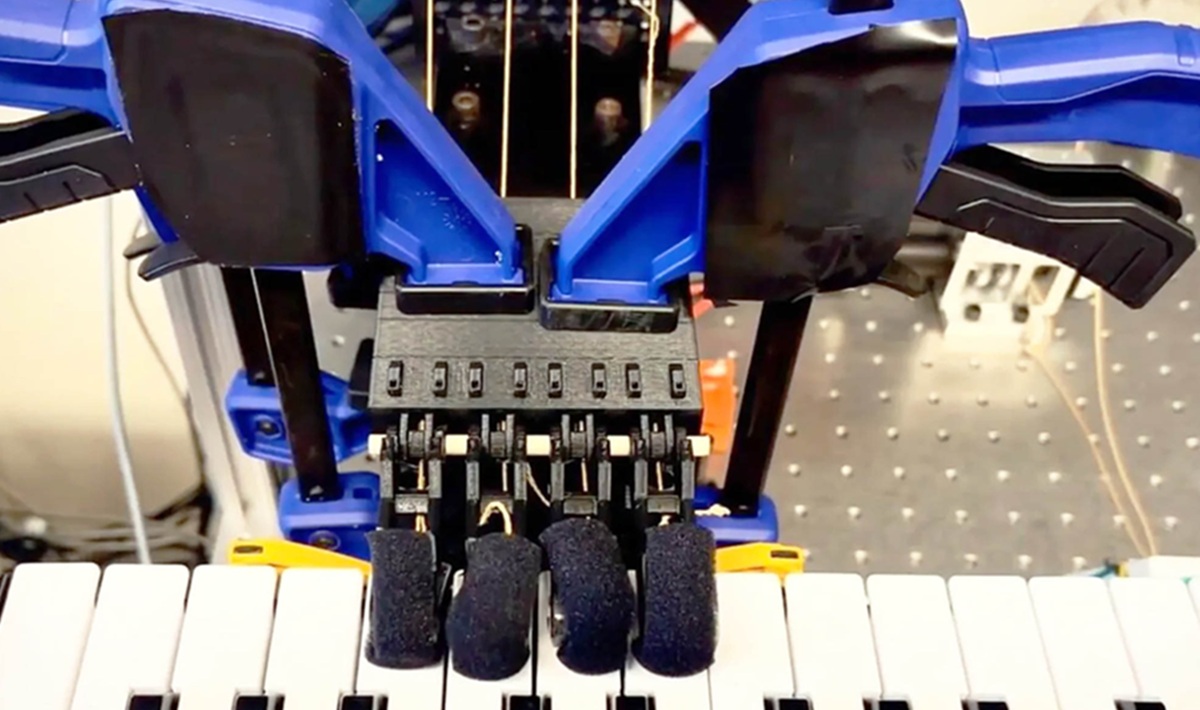
Teaching a robot to play a musical instrument usually requires complex programming, where every note and finger position must be pre-set. However, a new breakthrough has broken these barriers after a robotic hand successfully reproduced melodies it had never heard before in a single attempt.
Named ‘Musician Hand’, the robot was developed in the laboratory of Hesam Azadjou, a doctoral candidate at the Viterbi School of Engineering, University of Southern California (USC). Instead of being fed massive amounts of instrument data, this four-fingered robot was allowed to randomly explore piano keys for two minutes to record its own sounds and finger movements, a process similar to how infants learn their body functions.
Following this random process, the robot was able to hear a new 30-note melody and immediately play it back accurately without correction. Using small electric motors that move strings similar to human tendons, the internal software successfully translated sound into accurate finger pressure movements.
To test its capabilities, the research team conducted a blind test judged by two music experts. The robot was tested alongside four trained pianists and five beginners to play songs by ear. The results showed that the Musician Hand’s performance was equivalent to that of trained players and far surpassed the abilities of beginners. In fact, judges often could not distinguish between the robot’s performance and that of a human.
Francisco Valero-Cuevas, a professor of biomedical engineering at USC leading the project, explained that this method is known as perceptual robotics. This system rejects the old assumption that robots must possess perfect information before acting.
“The Achilles heel of traditional robotics is the assumption that perfect information is required to act effectively,” said Valero-Cuevas.
The success of this project, published in the Journal of The Royal Society Interface, opens wide opportunities for use, particularly in medical therapies such as recovery from stroke or Parkinson’s disease. Valero-Cuevas envisions a future where robotic exoskeletons can learn a patient’s natural walking pattern shortly after diagnosis. As the disease progresses, the suit would transition into an assistive mode to redirect the body towards natural movements without the need for expensive reprogramming.
Furthermore, Azadjou believes this technology could be applied to physical therapy at home. Robots could mimic techniques directly from therapists and adjust exercises in real-time based on the patient’s bodily responses.
“With two minutes of training and a simple laptop, this system learns to perform something that is intrinsically human: artistic expression,” concluded Valero-Cuevas.