
With Increasing Disaster Risks, the Ministry of Home Affairs Encourages Regional Disaster Management Agencies to be More Independent and Responsive
REPUBLIKA.CO.ID, JAKARTA – The Ministry of Home Affairs is strengthening the governance of regional disaster management by mandating the establishment of independent and responsive Regional Disaster Management Agencies (BPBDs). This step is being taken amid the increasing frequency and complexity of disasters in recent years.
This strengthening is affirmed through the issuance of Ministry of Home Affairs Regulation No. 18 of 2025 concerning the Establishment, Organization, and Working Procedures of Regional Disaster Management Agencies at the end of December 2025. To accelerate its implementation, the Ministry of Home Affairs held a national-level socialization and Focus Group Discussion on May 7, 2026, attended by representatives from provinces, regencies, and cities.
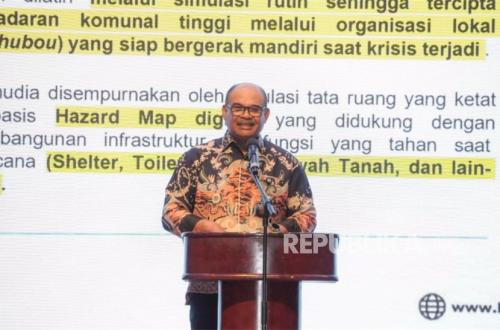
Director General of Regional Administration at the Ministry of Home Affairs, Safrizal ZA, said that the patterns and characteristics of disasters in Indonesia have changed significantly, requiring a new approach. He opened his presentation with a reflective question.
“If a major disaster occurs tonight, will we truly be ready to protect the community, or will we still be caught off guard when the impact has spread?” said Safrizal in a press release, Friday (May 15, 2026).
According to Safrizal, disaster patterns are now more difficult to predict and move faster than the readiness of existing systems. A series of flash floods, extreme weather, and hydrometeorological disasters in various regions indicate that response times are becoming increasingly limited, while the impact is growing.
In some cases, the time between rainfall in the upstream area and flooding in the downstream area is very short, so early warning systems and response mechanisms often lag behind. Infrastructure built based on risk assumptions from decades ago is also facing greater disaster intensity today.
Globally, Indonesia ranks third in the world in the 2025 Disaster Risk Index with a very high level of vulnerability. As much as 96.27 percent of the population lives in areas exposed to disaster risk, economic losses reach IDR 22.85 trillion per year, and 75 percent of national infrastructure is located in disaster-prone areas.
“These are not just statistical figures, but a serious alarm for all of us to act immediately. Our failure to mitigate risks today is a guarantee of greater losses in the future,” Safrizal emphasized.
The Ministry of Home Affairs is encouraging a paradigm shift from emergency response to risk management and prevention. Safrizal believes that climate change and environmental degradation are making disasters increasingly unpredictable.
“Disasters are now becoming increasingly unpredictable, both in terms of time, location, and impact. We can no longer use old methods,” he added.
He emphasized that protecting the community must begin before a disaster occurs. “We must be brave enough to anticipate disasters, not just keep chasing after their impact,” Safrizal said.
Ministry of Home Affairs Regulation No. 18 of 2025 affirms that disaster management is a mandatory basic service for local governments, on par with education and health. Each region is required to establish a strong and independent BPBD so that it can make quick decisions and coordinate responses effectively.
“The safety of the community should not be managed by a structurally weak agency. The BPBD must stand alone so that it can act quickly and appropriately when a crisis occurs,” said Safrizal.
Safrizal emphasized that local governments are at the forefront when disasters occur because initial responses within the first 24 hours are crucial for the safety of residents.
Strengthening the system is also being carried out through four main pillars, namely prevention, cross-sectoral collaboration, decentralization, and multi-party partnerships involving the government, community, academics, the private sector, and the mass media.
In the forum, Safrizal introduced the concept of “Harmony with Disaster” which encourages communities to adapt and live side by side with disaster risks more safely and sustainably, given that relocation is not always an easy solution due to social, cultural, and economic factors.
“We cannot choose when disasters will come, but we can determine how prepared we are when they occur,” said Safrizal.
The event was attended by the Deputy for Systems and Strategy at the BNPB, the Acting Secretary of the Regional Government of North Sumatra Province, representatives from the BPBD, and related regional agencies from throughout Indonesia. The Australian Government, through the SIAP SIAGA Program, also supports this activity as an Indonesia-Australia partnership in disaster risk management.
Minister Counsellor for Human Development and Humanitarian Affairs, Tim Stapleton, expressed his appreciation for this initiative. “The Australian Government greatly appreciates the efforts of the Ministry of Home Affairs and the BNPB for their ongoing leadership and commitment in strengthening disaster management systems in Indonesia, especially through strengthening the governance and institutionalization of Regional Disaster Management Agencies so that it can provide real benefits for the Indonesian people,” said Tim Stapleton.
Source: jawawa.id (https://jawawa.id/newsitem/with-increasing-disaster-risks-the-ministry-of-home-affairs-encourages-regional-disaster-management-agencies-1780574182)
Originally published by Republika (https://news.republika.co.id/berita/tf2onj416/risiko-bencana-meningkat-kemendagri-dorong-bpbd-lebih-mandiri-dan-cepat-tanggap), translated from Indonesian