
With China-Russia 'Backing', US Struggles to Undermine Iran
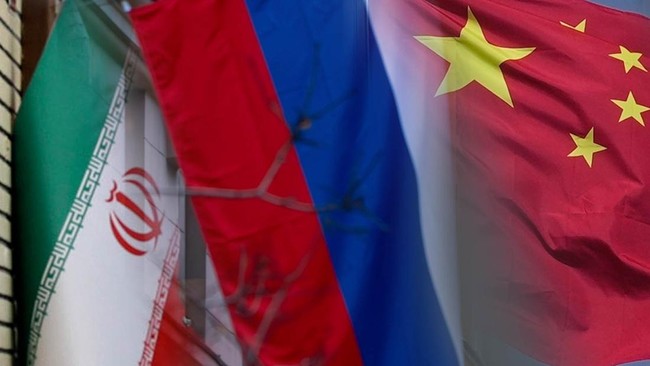
The prolonged conflict between the United States and Iran has the potential to position China and Russia as key actors determining Tehran’s resilience against Washington’s pressure. Amidst negotiations that have reached a deadlock due to Israeli military operations in Lebanon, both nations are seen as playing vital roles in supporting Iran economically, diplomatically, and defensively.
“Iran perceives that Trump is essentially attempting to stall for time. In response, Tehran will logically strengthen ties with Beijing and Moscow to face economic challenges and prepare for potential military confrontations,” stated Mehdi Kharranteyan, Head of the Institute for Revival of Politics in Tehran, to Newsweek.
Over the years, Iran has built increasingly close ties with China and Russia. Although not bound by a formal military alliance, both nations remain strategic partners helping Tehran endure US efforts to isolate the Islamic Republic through various sanctions.
Pressure on the White House continues to mount. The protracted conflict has triggered rising energy costs due to shipping disruptions in the Strait of Hormuz, while US ammunition stocks are reportedly being depleted. Conversely, Iran relies on a strategy of war of attrition, which has long been a core part of its military doctrine.
Kharrarratiyan assesses that Washington hopes economic pressure and maritime blockades will force Iran to accept the terms proposed by President Donald Trump. However, he notes that Tehran remains adamant that the cessation of conflict must cover all fronts, including Lebanon, which serves as the base for Hezbollah, Iran’s primary ally.
“Iran views Lebanon as an existential issue involving its geopolitical prestige in the Middle East. Therefore, it is very difficult to imagine a ceasefire between Iran and the US without a resolution to the Lebanon issue,” said Kharratiyan.
Amidst this deadlock, China and Russia are seen as having interests in ensuring Iran does not suffer significant weakening. Jon Alterman, Chair of Global Security and Geostrategy at the Center for Strategic and International Studies (CSIS), stated that both nations benefit when US attention is diverted by other conflicts.
“Russia and China have an interest in ensuring the United States is distracted by threats other than themselves. All three also oppose US dominance and the use of sanctions as an instrument of global pressure,” said Alterman.
Nevertheless, support from Beijing and Moscow to Tehran is expected to have limits. The strategic partnership agreement signed between Iran and Russia does not include mutual defence clauses similar to those held between Moscow and North Korea. Similarly, the 25-year Iran-China partnership focuses more on investment and economic cooperation.
In practice, China has become a vital lifeline for the Iranian economy. The nation purchases a large portion of Iran’s sanctioned oil exports. Christopher Walker, Vice President of the Center for European Policy Analysis (CEPA), even noted that Chinese companies have helped build one of the largest sanctions-evasion networks ever recorded.
Beyond energy trade, various reports suggest Iran benefits from intelligence exchanges with China and Russia, including access to satellite imagery and information regarding the movement of US troops and military assets in the region.
While ties between the three nations are tightening, observers believe Tehran recognises that Beijing and Moscow will not engage in direct warfare to defend Iran. For both China and Russia, maintaining relations with oil-rich Gulf nations such as Saudi Arabia and the United Arab Emirates also holds immense strategic value.
“China and Russia are more important to Iran than vice versa. Iran contributes less than 1% to China’s trade, while China is Iran’s largest oil customer. Both see Iran as an opportunity to weaken America’s global influence,” said Alterman.
Consequently, the future of cooperation between the three nations is unlikely to evolve into a formal military alliance. According to Arash Reisinezhad, an academic at Tufts University, the primary focus will shift towards developing Eurasian connectivity through trade routes, logistics, and economic corridors connecting East Asia, Central Asia, Russia, and the Middle East.
For China and Russia, Iranian stability remains a critical strategic asset. While they are unlikely to enter the battlefield directly, both nations have a strong interest in ensuring Tehran remains a partner capable of balancing US influence in the region and strengthening the Eurasian geopolitical network.