
With 3,700 GW Renewable Potential, Indonesia Still Faces Investment Bottlenecks
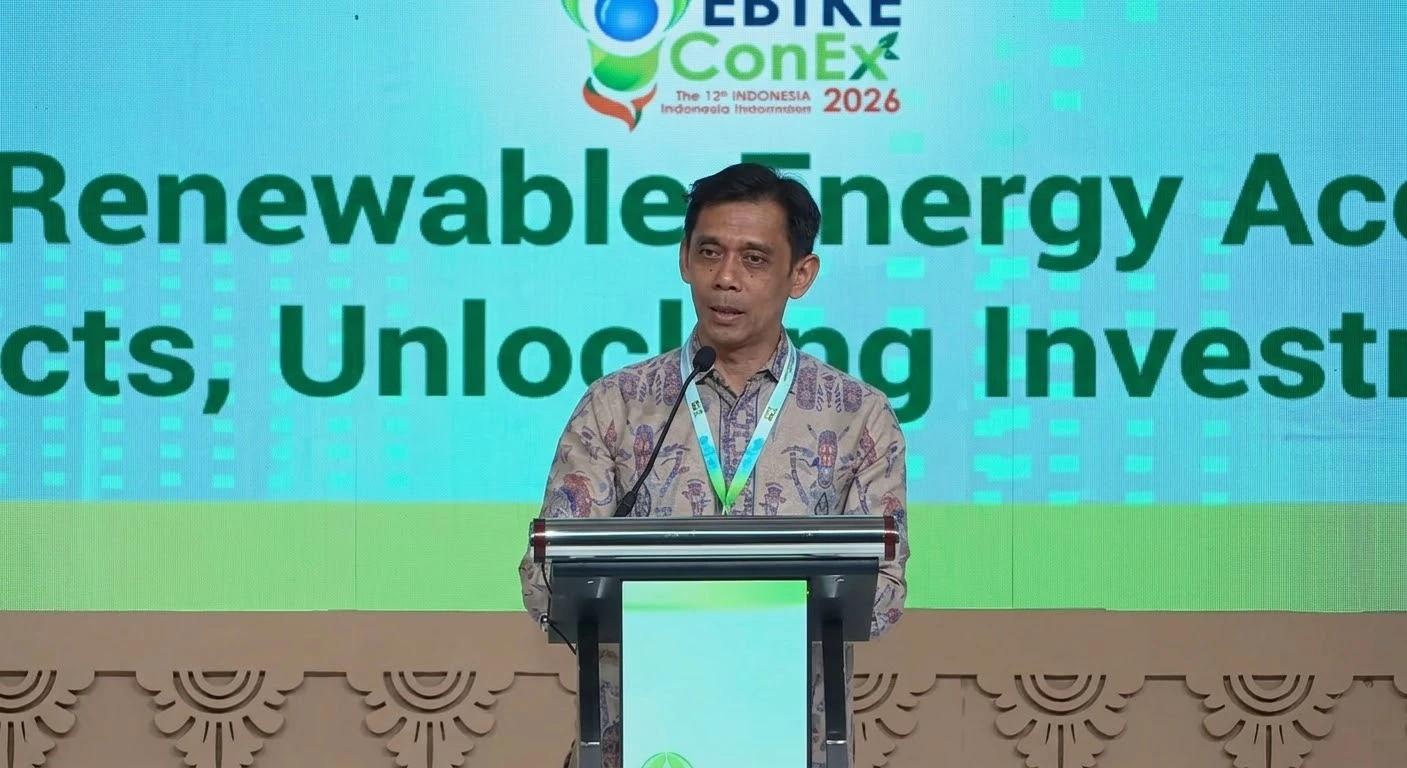
The Ministry of Investment and Downstreaming/BKPM has noted that global clean energy investment this year has reached a staggering USD 2.2 trillion. This presents a significant opportunity for Indonesia to absorb such capital, given its renewable energy potential of 3,700 Gigawatts (GW).
Ichsan Zulkarnaen, Deputy for Investment Planning at the Ministry of Investment and Downstreaming/BKPM, emphasised that the current global investment landscape is dominated by the pursuit of eco-friendly projects. “The world is currently in a sprint towards clean energy. It is estimated that total global investment in 2026 alone could reach approximately USD 3.4 trillion, with more than 50 per cent, or about USD 2.2 trillion (65 per cent), flowing into clean energy,” Ichsan stated during the Indonesia EBTKE ConEx 2026 forum, quoted on Friday, 4 September 2026.
Ichsan explained that this 65 per cent share of global fund flows represents a golden momentum for Indonesia to attract large-scale foreign capital. Indonesia is considered to possess a rare global comparative advantage in the form of abundant renewable energy resources.
“Indonesia has renewable energy potential of more than 3,700 GW. We have massive potential in hydro, wind, geothermal, and more. This is a huge opportunity for us,” he explained.
Despite the abundance of clean energy resources, the government’s greatest challenge is converting the potential capital on paper into actual project execution on the ground. BKPM is focusing its national strategy on three main pillars: removing investment bottlenecks, executing strategic projects, and building energy resilience.
“The challenge now is how we can realise that 3,700 GW potential into a tangible benefit for the Indonesian economy. The key lies in how we can unlock investment and resolve deadlocks on the ground,” Ichsan asserted.
To capture the USD 2.2 trillion investment opportunity, the government is working to improve the business climate by refining the licensing system and ensuring spatial planning certainty. This step is being taken to address the doubts of global investors, who are often hindered by lengthy licensing processes at the regional level.
“The main challenges that must be resolved are licensing certainty, transparency in sales contracts, and resolving land overlaps through the strengthening of integrated OSS-based RDTR,” he added.
Ichsan emphasised that the Ministry of Investment and Downstreaming/BKPM continues to coordinate closely with the Ministry of Energy and Mineral Resources (ESDM) and other technical ministries to align the energy transition roadmap. Inter-agency synergy is an absolute requirement to ensure Indonesia’s renewable energy investment competitiveness does not fall behind neighbouring countries in Southeast Asia.
“The government is fully aware of the giant potential we possess. With regulatory transparency and improvements in licensing infrastructure, we are optimistic that we can attract a significant portion of the world’s clean energy investment,” he said.
Renewable Energy Investment Remains Flat, Indonesia’s Installed Capacity Only at 16.32 GW
Previously reported, the Ministry of Energy and Mineral Resources (ESDM) admitted that renewable energy investment growth is still following a flat trend, even though the total installed capacity of clean energy-based power plants has reached 16.32 Gigawatts (GW).
Eniya Listiani Dewi, Director General of EBTKE at the Ministry of ESDM, revealed the dynamics of the national energy mix achievement, which in the first semester was still dominated by coal and petroleum-based fossil fuels.
“The current renewable energy mix, looking at our national energy mix achievement, has only reached 17.3 per cent this semester. In the first quarter, it reached 18.3 per cent. In Indonesia, coal and petroleum still dominate, while our target at Bappenas must reach 17 per cent to 21 per cent as part of the national strategic design,” Eniya stated at the Indonesia EBTKE ConEx 2026 forum on Wednesday, 2 September 2026.
Eniya explained that, cumulatively, installed renewable energy capacity has actually increased year-on-year. However, the rate of addition to the installed capacity is still considered slow compared to the ambitious long-term energy transition targets.
“The achievement of installed capacity rose from 12 GW in 2021, to 13 GW, 13.7 GW, 14.8 GW, and so on, up to 16.32 GW now. This shows that investment is indeed rising, but it is still considered flat,” she asserted.
The slow growth in installed capacity serves as a serious alarm for the government to pursue the national energy mix targets set by the National Energy Council (DEN) and the National General Energy Plan (RUEN). The government targets the portion of renewable energy in the national energy mix to reach 30 per cent by 2034.
“We certainly need to pay attention to this so that we can achieve the targets in the DEN strategic plan, RUKN, and RUEN. We target a 30 per cent national energy mix for renewables by 2034,” Eniya said.
Eniya then broke down the 17.3 per cent renewable energy mix, which is supported by two main components: the electricity sector and the non-electricity sector. In the electricity sector, Bioenergy Power Plants (PLTBio) contribute 4.19 per cent, Hydro Power Plants (PLTA) 2.69 per cent, and Geothermal Power Plants (PLTP) 1.84 per cent.
“Solar power (PLTS) is still a very small portion, at only 0.51 per cent, and Wind power (PLTB) is still very small at 0.06 per cent,” she detailed.
Meanwhile, on the non-electricity side, the largest contribution comes from the use of biofuels, specifically Fatty Acid Methyl Ester (FAME) or biodiesel, which ranks highest at 5.01 per cent, followed by biomass at 2.82 per cent. These figures prove that the bioenergy group is currently the main backbone of the national renewable energy source.
Source: jawawa.id (https://jawawa.id/newsitem/with-3-700-gw-renewable-potential-indonesia-still-faces-investment-bottlenecks-1788519117)
Originally published by kabarbursa.com (https://www.kabarbursa.com/carbon-trading/punya-potensi-ebt-3700-gw-ri-masih-hadapi-sumbatan-investasi), translated from Indonesian