
Wind Power Becomes Additional Solution for Electricity Supply in South Sulawesi
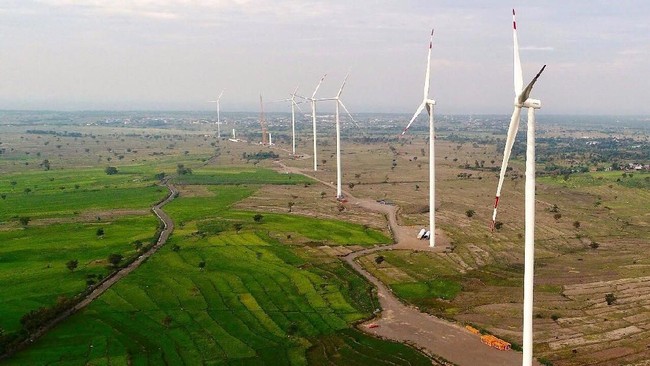
The Ministry of Energy and Mineral Resources (ESDM) believes that Wind Power Plants (PLTB) can serve as a solution to maintain the reliability of the electricity supply in South Sulawesi.
This comes as the El Niño phenomenon triggers a decrease in river water levels in Sulawesi and Kalimantan, which has impacted the production output of Hydroelectric Power Plants (PLTP).
The Director General of New, Renewable Energy, and Energy Conservation (EBTKE) at the Ministry of ESDM, Eniya Listiani Dewi, stated that a combination of water and wind energy is ideal, as the reduction in hydropower capacity occurs simultaneously with increased wind potential.
In South Sulawesi, two main wind farms, namely the Sidrap Wind Farm and the Jeneponto Wind Farm, are recorded as being able to operate at full and optimal capacity to support the region’s energy needs.
“Essentially, that is the metric used by PLN. I have also just returned from a visit there. Hydropower production has indeed decreased due to prolonged drought. Rivers in Kalimantan are also receding. What I see is that wind power is indeed the answer,” said Eniya, when met at the DPR RI Building in Jakarta recently.
According to her, wind energy during the El Niño season blows for a full 24 hours, making it capable of covering the decline in power from hydroelectric plants.
Eniya revealed that the characteristics of wind in Indonesia follow a specific cycle lasting 4 to 4.5 months, from June, July, August, and September until mid-October, during which wind can generate energy 24 hours non-stop. Extreme hot weather even triggers higher wind speeds and intensity.
“So, our preliminary conclusion is that during hot periods, when rivers recede and water levels drop, hydropower must be combined with wind,” she explained.
She added that although the mapping of wind power potential in the Electricity Supply Business Plan (RUPTL) reaches 11 Gigawatts (GW) across various regions—including South Sulawesi, East Java, South Kalimantan, NTT, and Maluku—investment in the wind energy sector has not increased in the last four years.
To attract investor interest, the Ministry of ESDM is currently processing a revision of Presidential Regulation (Perpres) Number 112 of 2022 regarding the benchmark pricing regulation for renewable energy.
“We are currently revising Perpres 112 regarding pricing. I will discuss the pricing further because, during El Niño, the wind potential can actually run for a full 24 hours. We have wind speeds of up to 31 metres per second,” she concluded.